'Las Vegas in Laos': the riverside city awash with crime / Photo: STR - AFP

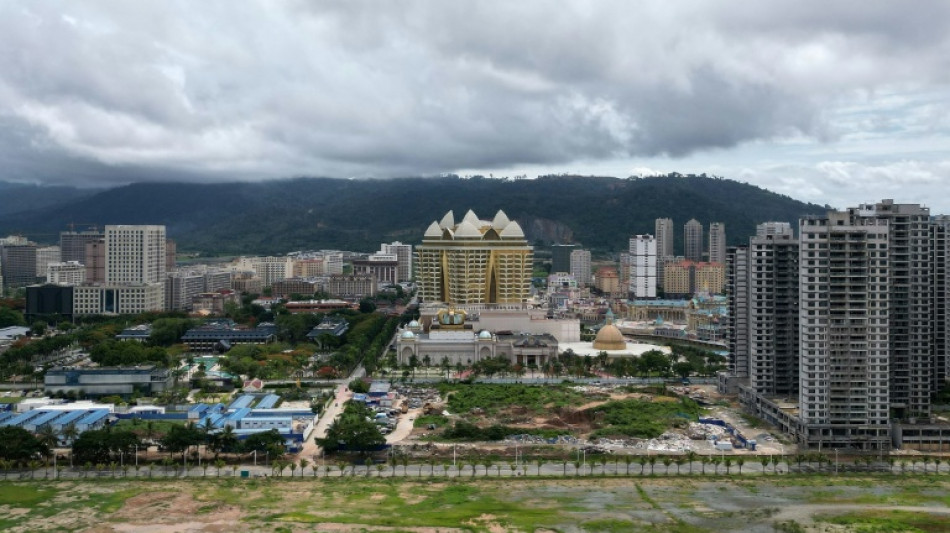
Rising from the muddy fields on the Mekong riverbank in Laos, a lotus tops a casino in a sprawling city which analysts decry as a centre for cybercrime.
Shabby, mismatched facades –- including an Iberian-style plaza replete with a church tower, turrets and statues -- stand alongside high-rise shells.
The Golden Triangle Special Economic Zone (GTSEZ) is the most prominent of more than 90 such areas established across the Mekong region in recent years, often offering people reduced taxes or government regulation.
Traffic signs in the GTSEZ are in Chinese script, while everything from cigarettes to jade and fake Christian Dior bags are sold in China's yuan.
Analysts say the towers are leased out as centres operating finance and romance scams online, a multibillion-dollar industry that shows no signs of abating despite Beijing-backed crackdowns in the region.
The GTSEZ was set up in 2007, when the Laos government granted the Kings Romans Group a 99-year lease on the area.
Ostensibly an urban development project to attract tourists with casinos and resorts, away from official oversight international authorities and analysts say it quickly became a centre for money laundering and trafficking.
The city has now evolved, they say, into a cybercrime hub that can draw workers from around the world with better-paying jobs than back home.
Laundry hung out to dry on the balconies of one high-rise building supposed to be a tourist hotel, while the wide and palm-lined boulevards were eerily quiet.
It is a "juxtaposition of the grim and the bling", according to Richard Horsey of the International Crisis Group.
It gives the "impression of opulence, a sort of Las Vegas in Laos", he said, but it is underpinned by the "grim reality" of a lucrative criminal ecosystem.
- 'Horrendous illicit activities' -
In the daytime a few gamblers placed their bets at the blackjack tables in the city's centrepiece Kings Romans Casino, where a Rolls Royce was parked outside.
"There are people from many different countries here," said one driver offering golf buggy tours of the city, who requested anonymity for security reasons. "Indians, Filipinos, Russians and (people from) Africa."
"The Chinese mostly own the businesses," he added.
Cyberfraud compounds have proliferated in special economic zones across Southeast Asia, according to the UN Office on Drugs and Crime.
Kings Romans' importance as a "storage, trafficking, deal-making, and laundering hub (is) likely to expand", it said in a report last year, despite crackdowns on illegal activities.
The founder of the Kings Romans Group and the GTSEZ is Zhao Wei, a Chinese businessman with close links to the Laos government, which has given him medals for his development projects.
He and three associates, along with three of his companies, were sanctioned by the US Treasury in 2018 over what it called "an array of horrendous illicit activities" including human, drug and wildlife trafficking and child prostitution.
Britain sanctioned him in 2023, saying he was responsible for trafficking people to the economic zone.
"They were forced to work as scammers targeting English-speaking individuals and subject to physical abuse and further cruel, inhuman and degrading treatment or punishment," Britain's Treasury said.
The same year and again last August, authorities in China and Laos cracked down on cyberfraud operations in the GTSEZ, raiding offices and arresting hundreds of suspects.
- 'Violence doesn't always pay' -
With public anger in China mounting, over both scamming itself and alleged kidnappings, Beijing instigated raids this year on centres in Myanmar and Cambodia.
The operations primarily targeted Chinese workers, thousands of whom were released and repatriated, along with hundreds of other foreigners.
Some say they are trafficking victims or were tricked and forced to scam people online, but some authorities say they are there voluntarily.
Scammers have adapted by shifting their locations and targets, specialists say, and Horsey explained that trafficking and abuses have reduced as the business model has developed.
"If you're trying to scale and produce a huge business... violence doesn't always pay," he said.
"It's better to have motivated workers who aren't scared, who aren't looking over their shoulder, who are actually free to... do their job."
Beijing realises it cannot completely stop criminality in the region, so prefers to manage it, he added.
Chinese authorities can "pick up the phone" to Zhao and tell him: "Don't do this, limit this, don't target Chinese people", he said.
That "is actually more valuable for China than trying to eradicate it everywhere and just lose all influence over it".
The United States Institute for Peace estimated in 2024 that Mekong-based criminal syndicates were probably stealing more than $43.8 billion annually.
Representatives of both the GTSEZ and Kings Romans did not respond to AFP's repeated requests for comment, while Zhao could not be reached.
The Laos government could not be reached for comment, but the official Lao News Agency said after last year's busts that the country was "committed to decisively addressing and eliminating cyber-scam" activity.
(F.Schuster--BBZ)