Berliner Boersenzeitung - Japan inflation slows in August, rice price surges ease

EUR -
AED 4.284055
AFN 76.990671
ALL 93.078883
AMD 425.733944
ANG 2.087821
AOA 1069.700581
ARS 1746.739083
AUD 1.637787
AWG 2.099739
AZN 1.987822
BAM 1.965914
BBD 2.349739
BDT 142.563477
BGN 1.978848
BHD 0.439954
BIF 3487.095973
BMD 1.166522
BND 1.489162
BOB 13.480065
BRL 6.032785
BSD 1.166677
BTN 111.655063
BWP 15.757069
BYN 3.548557
BYR 22863.824435
BZD 2.346321
CAD 1.611375
CDF 2648.004322
CHF 0.934197
CLF 0.027316
CLP 1075.148386
CNY 7.866204
CNH 7.851583
COP 3597.401136
CRC 522.074842
CUC 1.166522
CUP 30.912824
CVE 110.833805
CZK 24.159858
DJF 207.744375
DKK 7.4757
DOP 68.542646
DZD 154.725143
EGP 59.075808
ERN 17.497825
ETB 190.561941
FJD 2.5667
FKP 0.861354
GBP 0.857061
GEL 3.038825
GGP 0.861354
GHS 12.978495
GIP 0.861354
GMD 86.322654
GNF 10250.606691
GTQ 8.902612
GYD 244.080543
HKD 9.146183
HNL 31.281269
HRK 7.535266
HTG 152.595089
HUF 363.611795
IDR 20767.585021
ILS 3.472794
IMP 0.861354
INR 111.470769
IQD 1528.363299
IRR 1603471.503919
ISK 142.186362
JEP 0.861354
JMD 184.348457
JOD 0.827037
JPY 184.775886
KES 151.062701
KGS 102.012671
KHR 4717.269953
KMF 496.938372
KPW 1049.869832
KRW 1619.242909
KWD 0.359685
KYD 0.972202
KZT 538.890999
LAK 26273.612428
LBP 104472.56349
LKR 386.106485
LRD 211.749433
LSL 18.954815
LTL 3.444436
LVL 0.705617
LYD 7.425106
MAD 10.817416
MDL 20.119513
MGA 5027.759645
MKD 61.848204
MMK 2448.815867
MNT 4196.154406
MOP 9.422256
MRU 46.676145
MUR 54.802967
MVR 18.034072
MWK 2022.964627
MXN 19.782096
MYR 4.734796
MZN 74.546501
NAD 18.954815
NGN 1575.527046
NIO 42.929951
NOK 10.887351
NPR 178.65215
NZD 1.967234
OMR 0.448537
PAB 1.166677
PEN 3.928628
PGK 5.16752
PHP 72.003535
PKR 323.778714
PLN 4.316049
PYG 7018.107567
QAR 4.253383
RON 5.246084
RSD 117.32988
RUB 98.481949
RWF 1719.044337
SAR 4.381688
SBD 9.362283
SCR 16.151138
SDG 701.664827
SEK 11.020148
SGD 1.483611
SHP 0.864236
SLE 28.754932
SLL 24461.374939
SOS 666.721653
SRD 44.026889
STD 24144.643057
STN 24.626172
SVC 10.20839
SYP 15167.114447
SZL 18.960305
THB 38.355546
TJS 10.76224
TMT 4.082826
TND 3.409743
TOP 2.808704
TRY 55.920133
TTD 7.913545
TWD 37.179146
TZS 3088.629706
UAH 52.1624
UGX 4351.293783
USD 1.166522
UYU 46.760579
UZS 13766.829167
VES 900.061104
VND 30540.120184
VUV 137.900924
WST 3.168153
XAF 659.349296
XAG 0.01776
XAU 0.00026
XCD 3.152583
XCG 2.102591
XDR 0.824791
XOF 659.340774
XPF 119.331742
YER 276.588204
ZAR 18.777386
ZMK 10500.131025
ZMW 21.844922
ZWL 375.619497
  • BCC

    2.3700

    82.55

    +2.87%

  • JRI

    0.0000

    12.44

    0%

  • NGG

    -1.7900

    80.36

    -2.23%

  • RYCEF

    -0.6500

    20.6

    -3.16%

  • BCE

    0.2600

    23.62

    +1.1%

  • CMSC

    0.1100

    21.35

    +0.52%

  • RIO

    3.7000

    100.39

    +3.69%

  • GSK

    1.0250

    52.175

    +1.96%

  • CMSD

    0.0800

    21.17

    +0.38%

  • VOD

    0.0750

    16.205

    +0.46%

  • BTI

    -0.4910

    55.889

    -0.88%

  • RELX

    0.7450

    35.255

    +2.11%

  • RBGPF

    0.3500

    69

    +0.51%

  • AZN

    4.1400

    164.24

    +2.52%

  • BP

    0.6970

    44.107

    +1.58%

Japan inflation slows in August, rice price surges ease
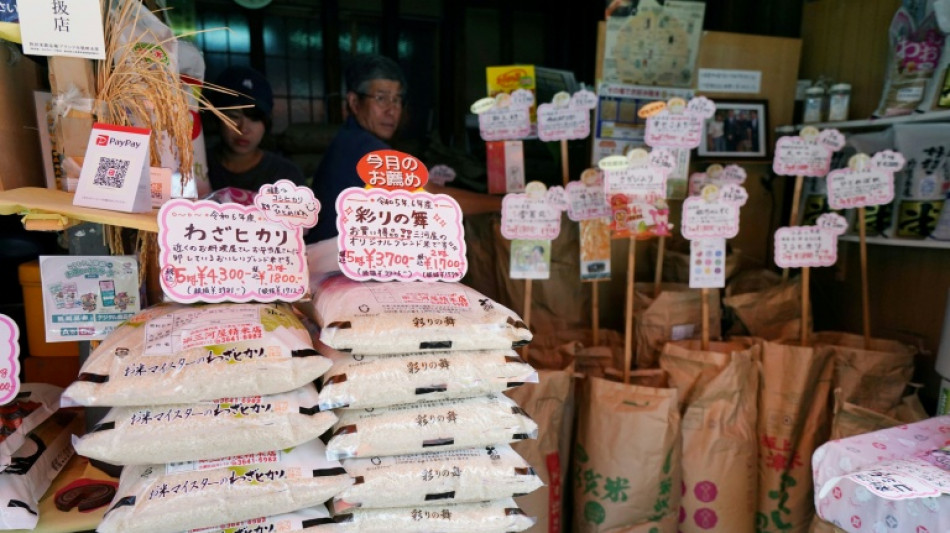
Japan inflation slows in August, rice price surges ease / Photo: Kazuhiro NOGI - AFP/File

Japan inflation slows in August, rice price surges ease

Inflation in Japan slowed to 2.7 percent in August due partly to government energy subsidies, official data showed Friday, with the cost of rice easing following a huge price spike.

Text size:

Inflation continues to be driven by rice prices, which increased by 68.8 percent year-on-year in August after surges of around 100 percent in June and 90.7 percent in July.

Voters angry about rising rice costs have deserted the long-dominant ruling Liberal Democratic Party, and this month an under-pressure Prime Minister Shigeru Ishiba announced he would step down after his coalition lost its majority in both chambers.

Rice prices have skyrocketed because of supply problems linked to a very hot summer in 2023 and panic-buying after a "megaquake" warning last year, amongst other factors.

The core inflation reading from the internal affairs ministry, which excludes volatile fresh food prices, was in line with market expectations, and was down on the 3.1 percent in July.

Abhijit Surya of Capital Economics said the main factor behind the fall in inflation was "a deepening of energy price deflation... due to the resumption of electricity and gas subsidies".

But Taro Kimura, an analyst with Bloomberg Economics, said that a pullback in inflation "won't change the big picture".

"Consumer prices will remain warm enough to keep the Bank of Japan on track to pare stimulus, likely as soon as October," he added.

Ishiba appointed a new farm minister and his government has released emergency stocks in an effort to bring prices down.

Last month Japan announced a change in its decades-old policy of encouraging farmers to grow crops other than rice.

US President Donald Trump also wants Japan to import more American rice.

- Export woes -

Last month, data showed that Japan's economy grew at an annualised pace of 1.0 percent in the second quarter.

The reading suggested the economy was suffering less than feared from US tariffs.

But other data released this week showed exports to the United States plunged nearly 14 percent in August, with cars down 28.4 percent.

The auto industry, which accounts for about a third of Japan's exports to the United States, has been suffering under a 27.5 percent levy.

However, on Tuesday, lower US tariffs on Japanese autos kicked in as Washington implemented a recent trade pact between the two countries.

Vehicles will now face a 15 percent toll, the same as many other goods.

While the implementation of the trade deal marked a win for Japan, the levies will continue to cause huge pain for the nation's industries and Japanese business lobbies are hoping Tokyo will push on with fresh negotiations.

Japan's automobile industry, which includes major firms such as Toyota and Honda, accounts for around eight percent of the country's jobs.

(H.Schneide--BBZ)