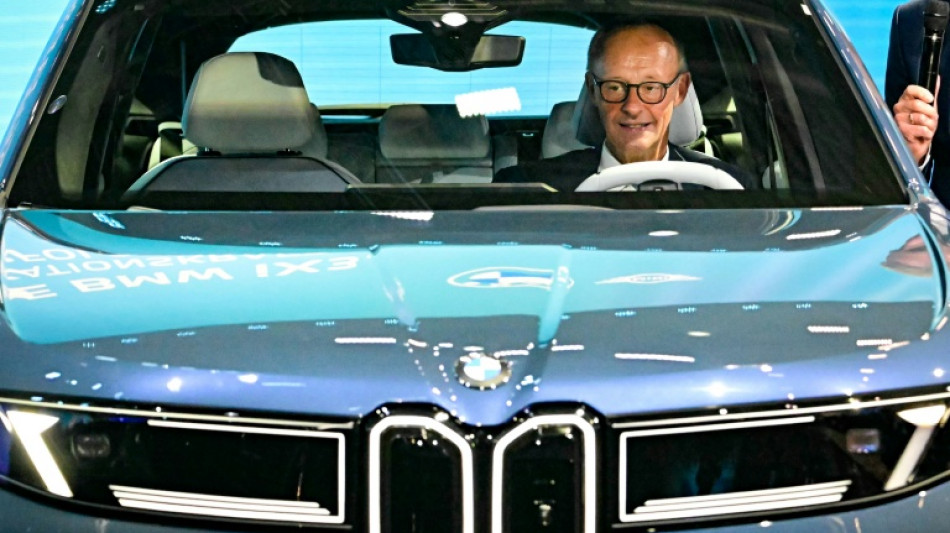
At German auto crisis meet, Merz vows to fight EU gas guzzler ban / Photo: Tobias SCHWARZ - AFP

Chancellor Friedrich Merz vowed Thursday to do everything in his power to fight EU plans to ban combustion-engine car sales from 2035 after crisis talks with the struggling German car industry.
The flagship auto sector in Europe's biggest economy is mired in crisis as it faces weak demand, a choppy transition to electric vehicles (EVs), and fierce Chinese competition.
Manufacturers fear the looming EU ban will deal them another blow, complaining they have not had enough time to build up competitive EV offerings while demand for battery-powered cars is moving far more slowly than expected in Europe.
After holding talks with auto industry leaders, Merz vowed to fight against an abrupt total ban from 2035 of sales of new fossil fuel-burning cars.
"I will do everything in my power to ensure that this does not happen," he told a press conference.
He stressed that "the path to electromobility had been opened", and Germany was committed to pursuing it and meeting climate goals, but that "flexibility" was needed.
At an EU summit later this month, Merz said he would advocate "technological advancement towards climate neutrality, but not with a date on the calendar that we cannot meet, that is unrealistic."
Under pressure from Europe's carmakers, the EU had already agreed last month to fast-track a review of the ban.
Volkswagen CEO Oliver Blume, who was at the talks, echoed Merz's views.
Europe's biggest carmaker was committed to the shift to EVs, he said, but added: "We will need more time for this."
"All political forecasts about the ramp-up were too optimistic."
- Coalition tensions -
Merz's vocal calls to scrap the 2035 ban have fuelled tensions between his centre-right CDU party and his junior coalition partners, with some senior figures in the centre-left SPD having insisted Berlin should continue backing the policy.
But signs are growing the two sides are reaching a common stance.
Speaking alongside Merz, Finance Minister Lars Klingbeil of the SPD also called for "flexibility" in the shift to more climate-friendly vehicles.
During talks late Wednesday, senior members of the ruling coalition had discussed technologies such as plug-in hybrids and allowing cars to run on alternative fuels, he said.
His comments suggested Berlin may propose watering down the ban by allowing the continued use of such alternatives after 2035.
Hildegard Mueller, president of Germany's VDA auto industry association, said it was a "positive sign" the coalition supported such technologies.
"We need timely decisions and a united German voice in Brussels," she said.
As well as slow take-up from consumers for EVs, the auto industry complains that charging infrastructure is sparse and charging prices too expensive.
Attempts to water down the ban have alarmed environmental campaigners.
Christoph Bautz of activist group Campact said efforts to ease the ban were "disastrous and will harm the climate, industry, and jobs".
"Instead of setting clear guidelines for the industry towards electrification, the chancellor wants to return to the zigzag course of the past, which manoeuvered German car manufacturers into the current crisis."
If Berlin seeks to soften the ban, it will still need to win backing from other EU members.
There are signs Germany has some support, with reports this week saying Rome and Berlin sent a joint letter to the European Commission urging a change of course on the ban.
The German government is also taking other steps to help the beleaguered auto sector.
Earlier Thursday, Merz said the government would provide three billion euros ($3.5 billion) in incentives for EV purchases, which would be aimed at low- and middle-income households.
The auto sector's crisis reflects broader problems for the Germany economy, which has faced two years of recession due to a manufacturing slump and weak demand for its exports.
In the latest sign of weakness, data released Thursday showed that German exports unexpectedly dropped in August, pulled down by another fall in shipments to the United States as the tariff blitz takes its toll.
(S.G.Stein--BBZ)