Mexican car industry fears higher tariffs on China will drive its demise / Photo: Ulises Ruiz - AFP

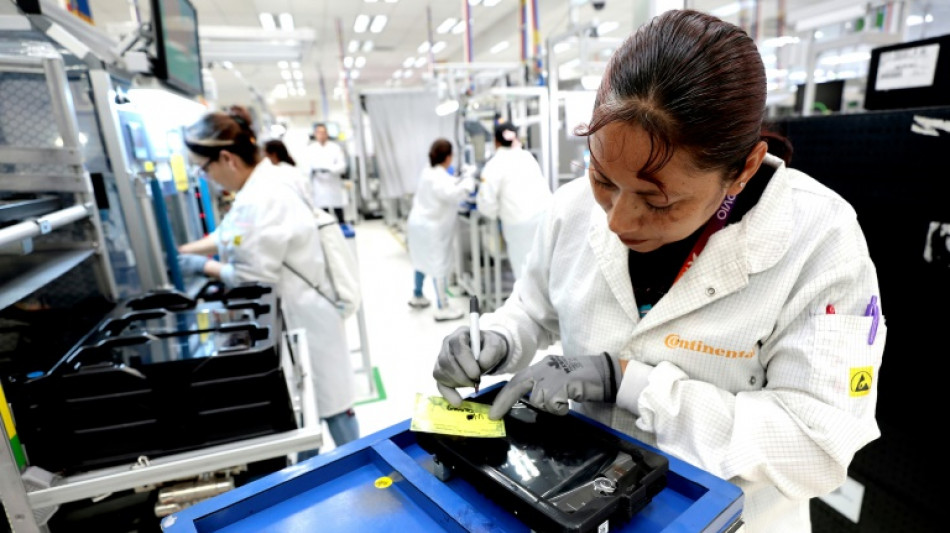
Mexico's car assembly industry, one of the biggest in the world, fears US President Donald Trump's tariff war will impede access to an increasingly indispensable component: digital dashboard touchscreens for which parts are sourced mainly in China.
As Washington has engaged Beijing in a commercial tug-of-war, Mexico has come under pressure to act in step with its wealthier northern neighbor, and its Congress is considering hiking tariffs on Chinese imports.
President Claudia Sheinbaum insists the measure is meant to boost domestic manufacturing.
One problem: Mexico does not produce most of the electronic parts used in car assembly -- particularly for the dashboard screens that provide drivers with real-time navigation and music at their fingertips.
China does.
And even if alternative sources could be found, it would take time while prices go up in the short term, undermining a mainstay of the country's export economy, industry players told AFP.
One company that has expressed concern is Germany headquartered Aumovio, which assembles dashboard displays in Guadalajara in Mexico's west for car companies including Ford, and General Motors and Stellantis.
"We have had talks with the Secretary of Economy as a group, not just Aumovio but the entire automotive industry, and we...explained to them the dependence we have" on Chinese parts, Aumovio purchasing director Carlos Gomez told AFP.
He said building an alternative supply chain would require a significant investment in machinery and skills training and would take years.
- 'An opportunity' -
Amapola Grijalva of the Mexico-China Chamber of Commerce told AFP the government risked harming the car industry, which has thrived under the USMCA free-trade deal between Mexico, the United States and Canada.
"There are components such as electric batteries and electronic components that we believe are very difficult to obtain from other places," she said.
"Nowadays, especially...electronics, photovoltaic generation, and batteries for all kinds of applications, including motorcycles and motor vehicles, come from China because they are truly very efficient."
The Trump administration has said Chinese producers are abusing the USMCA to send goods northward over the Mexican border tariff-free.
Many interpreted Sheinbaum's proposal of a tariff hike on China and other countries with which Mexico has no free-trade agreements as a capitulation to her powerful northern counterpart.
According to Luis de la Calle, a Mexican economist who was involved in negotiating the NAFTA trade deal that preceded the USMCA, Sheinbaum's tariff increases were at least partly driven by a desire to protect the domestic industry.
Mexico's trade deficit with China rose to a record of nearly $120 billion last year.
"Not all the increases made were for reasons related to the United States," de la Calle told AFP.
One company that could benefit, for example, is Kold Roll, a manufacturer of steel bars used in cars and other products.
"We see it as an opportunity," said general manager Eric Gonzalez.
Mexico replaced China in 2023 as the largest trading partner of the United States, which bought more than 80 percent of its exports.
Mexico sends nearly 3 million automobiles to the United States every year, including cars and trucks assembled on its soil by US companies.
(F.Schuster--BBZ)