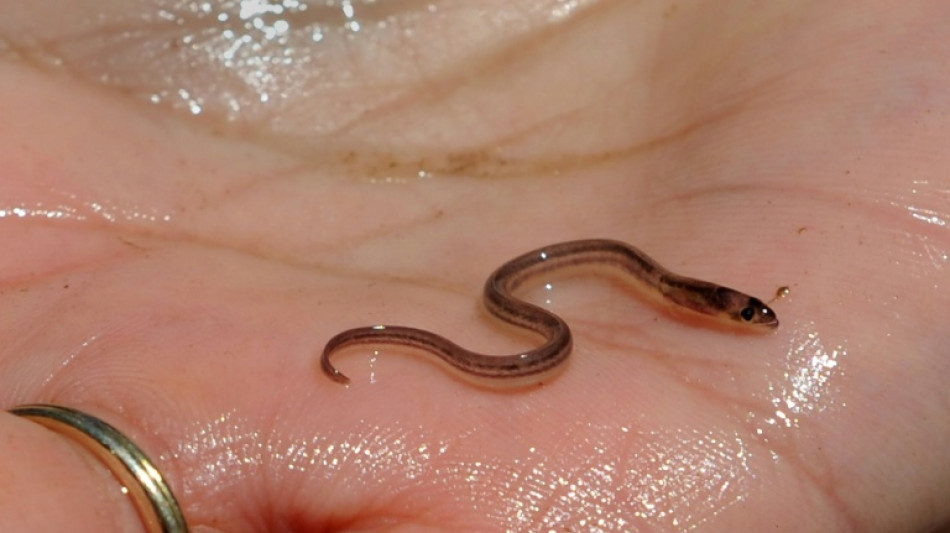
Haitian gangs getting rich off murky market for baby eels / Photo: STAN HONDA - AFP/File

Gangs in Haiti are profiting from a lucrative trade in baby eels caught in the crime-ridden country's rivers and estuaries and sold abroad for thousands of dollars.
Demand for the worm-like creatures with dots for eyes comes largely from Asia and is filling the coffers of the criminal organizations terrorizing Haiti, experts warn.
Known in Haitian creole as "Zangi," the glass eels drift each year from the Sargasso Sea in the North Atlantic to the ocean's coasts -- including along the coasts of the island of Hispaniola, shared by Haiti and the Dominican Republic.
They infiltrate the rivers where they grow until they return to sea to reproduce.
The global trade of European eels has been strictly controlled since 2009 by the CITES convention on endangered species, but the trade of American eels is not.
They are however classed as endangered on the International Union for Conservation of Nature's Red List of Threatened Species -- primarily due to overfishing of the species which commercial fish farms cannot breed in captivity.
They are used to supply farms where they are fattened up for sale in Asia where eels are a highly sought delicacy.
Haiti along with the Dominican Republic has become a key exporter of American eels in recent years, CITES says.
To protect American and European eels, indistinguishable to the naked eye, from continuing to be shipped to Asia under false labels, the EU and Panama want CITES to restrict the trade of all eels.
If their move is adopted at a meeting in Uzbekistan starting on November 24 "it will certainly penalize several stakeholders -- exporters in particular -- as well as poor and vulnerable small-scale fishermen" in Haiti, Natural Resources Minister Vernet Joseph told AFP.
To protect the species Haiti -- which is not a party to CITES -- has implemented a "modest approach," significantly reducing the overall harvest, while acknowledging a lack of reliable data on exploitation of the species.
- 'Like the Mafia' -
Haiti's glass eel industry is entirely geared to export, is not "organized" and does not record "clear and reliable data -- whether at the level of fishermen or the government," an environmental activist told AFP on condition of anonymity.
"It's a sector like the Mafia."
Ghada Waly, the outgoing head of the UN's drugs and crime office, warned "there is growing evidence that several Haitian nationals are part of a wider criminal network connected to lucrative eel trafficking, operating in Haiti and beyond."
Evidence showed "powerful political and economic figures in Haiti use the eel industry to launder drug profits," she added.
UN experts charged with enforcing sanctions have stepped up their monitoring of fishermen, intermediaries, customs officers and airlines.
In a report published in October, they criticized how the opaque and unregulated sector had created "an ideal environment for criminals to launder money."
The government is responsible for fishing licenses -- but a lack of controls allows for money laundering, fishermen and couriers to be extorted by gangs, with contraband often added to their outbound shipments, the experts said.
Reliable data is scanty, but experts point to a 2009 government estimate of an export "capacity" of 800 tonnes -- enough to make the trade highly lucrative.
One gram of exported Haitian eels -- seven to 10 actual specimens -- can be sold for between $3.60 and $4.50, with the fishermen paid between 50 cents and $1.50 a kilogram.
Though paid a fraction of the eels' true value, the sums earned by the fishing community are still significant and attractive at a time of deep crisis in Haiti.
Between fall and spring, the fishermen "spend 12 hours in challenging conditions, barefoot in the waters of the river mouths, from 6 pm until sunrise -- all without appropriate kit," said the environmental campaigner.
To catch the minute, translucent fish, fishermen often use mosquito nets in wooden frames.
A fisherman in Bas-Limbe anonymously told the UN sanctions report's authors it was "every man for himself" and that he had seen hundreds of people hospitalized for various ailments including infections.
The campaigner said "it would be better to put an end to eel fishing and help supply fishing communities with equipment to catch other species of seafood."
(Y.Berger--BBZ)