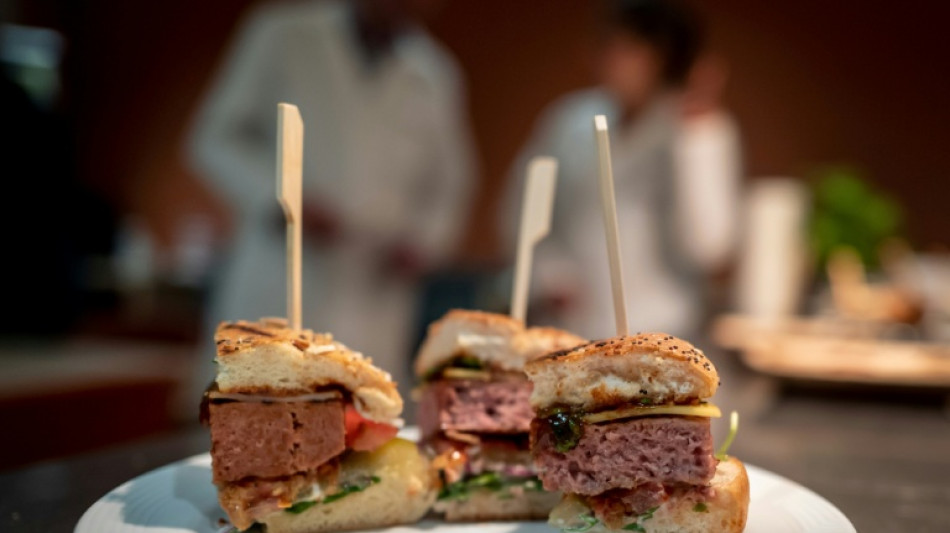
Veggie 'burgers' at stake in EU negotiations / Photo: Fabrice COFFRINI - AFP

EU countries and lawmakers will wrangle Thursday over whether to give plant-based "sausages" and veggie "burgers" the chop, amid a push to restrict such labels to meat products.
Many of Europe's livestock farmers see plant-based foods that mimic meat products as potentially misleading for consumers, and a threat to their already troubled sector.
Lawmakers at the European Parliament in October backed a proposal to reserve a list of labels including burger and sausage for foods containing meat.
The EU's 27 member states will now look to hash out the initiative with negotiators from the parliament as part of a broad-ranging package of new measures to protect farmers.
Some countries seem reticent -- and officials say it may need more rounds of negotiations to reach an agreement.
Food retailers in Germany, Europe's largest market for plant-based alternative products, have spoken out against the move, along with environmentalists and consumer advocates.
Among the high-profile opponents is also former Beatle and famed vegetarian Paul McCartney, who co-signed a letter to the EU's executive arguing against the measure.
"We urge you not to adopt these restrictions, as we are deeply concerned about the significant global impact they could have," the letter said.
"The evidence is clear: existing legislation already protects consumers; consumers themselves overwhelmingly understand and support current naming conventions."
But livestock farmers argue the opposite, with French industry group Interbev saying it "confuses consumers and undermines recognition" in meat products.
EU consumption of plant-based alternatives to meat products has grown five-fold since 2011, according to data from BEUC, a consumer group.
Concerns over animal welfare and greenhouse gas emissions from livestock farms as well as health arguments have fuelled the boom.
This is not the first time there has been a push to beef up rules on the labelling of such products in the EU.
The debate has stirred emotions in France, which passed a similar label ban in 2024 to appease angry farmers -- only for it to be overturned the following January in line with a ruling by the EU's top court.
And a similar proposal was rejected by European lawmakers in 2020.
The balance of power has since shifted, as the 2024 European elections saw big gains by right-wing parties that cultivate close ties to the farm sector.
But even among those groups there is no clear consensus, with centre-right leader Manfred Weber insisting the proposal was "not a priority at all".
(Y.Yildiz--BBZ)