Can Venezuela survive US targeting its oil tankers? / Photo: Handout - Cuenta de X de la fiscal general de EEUU, Pam Bondi/AFP

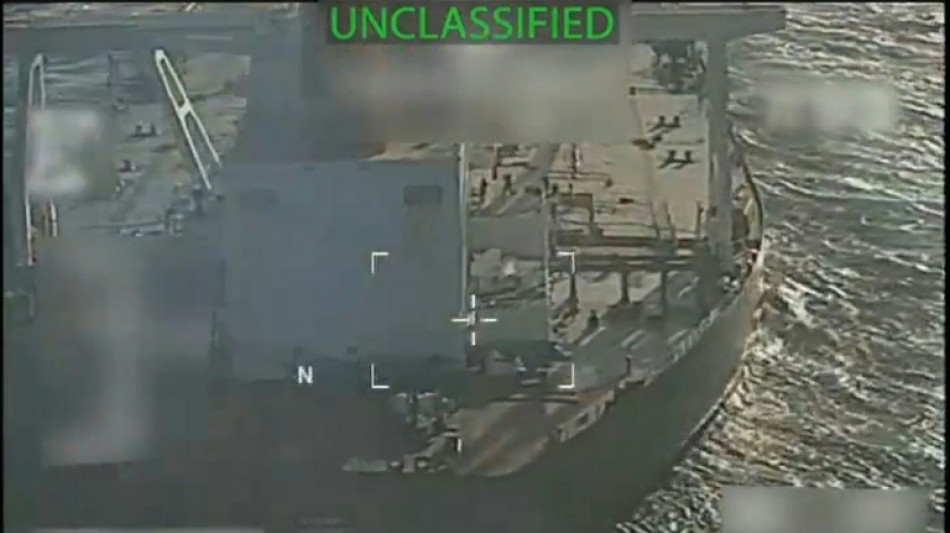
Venezuela has been sidestepping a US oil export embargo for years, selling crude at a discounted price mainly to China. But even this limited income stream is now under threat after the United States seized a Cuba-bound tanker.
In one fell swoop, Venezuela lost 1.9 million barrels of oil, according to sanctioned President Nicolas Maduro, who denounced an act of "naval piracy." According to ship tracking platform MarineTraffic, it was closer to 1.1 million barrels.
The estimated value of the oil seized, and which the United States has said it intends to keep, ranges between $50 million and $100 million.
Venezuelan so-called "ghost" tankers had until now been left untouched despite a mighty US naval presence in the Caribbean Sea since September.
In a follow-up move on Thursday, the US Treasury announced sanctions on six companies it said were shipping the South American country's oil, and identified six vessels as "blocked property."
Such actions "would make the fleet operating on the black market afraid to come to Venezuela. That would increase the risk premium and therefore the discounts... (to buyers), which would be very steep," Francisco Monaldi of the Baker Institute, a Houston-based think tank, told AFP.
Maduro has claimed the massive US military deployment within striking distance of his country is part of a plan to overthrow him and "steal" Venezuela's abundant oil under the ruse of an anti-drug operation.
The targeting of ships transporting Venezuela's only valuable commodity could indeed imperil Maduro's political fortunes.
"If there are no oil exports, it will affect the foreign exchange market, the country’s imports... There could be an economic crisis," Elias Ferrer of Orinoco Research, a Venezuelan advisory firm, told AFP.
"Not just a recession, but also shortages of food and medicine, because we wouldn’t be able to import."
- Black market -
Venezuela is estimated to have oil reserves of some 303 billion barrels, according to the Organization of the Petroleum Exporting Countries (OPEC) -- more than any other nation.
But years of mismanagement and corruption slashed production from a peak of more than three million barrels per day (bpd) in the early 2000s to an historic low of 350,000 bpd by 2020.
Back on track to reach a million bpd this year, analysts say it will be hard to boost production beyond that, given the shortage of foreign currency needed to improve infrastructure.
Caracas has been scraping by under a regime of economic sanctions and a US oil embargo in place since 2019, tightened in 2025.
It adapted, using a fleet of "ghost" tankers that sail under false flags, declare fake routes or switch off their transponders to avoid detection.
Since Trump threatened an export tariff of 25 percent on any country buying Venezuelan oil, the country has had to slash its black market prices by as much as 20 percent.
Moreover, Chevron, which operates under a special license and accounts for roughly 10 percent of Venezuelan production, is no longer allowed to transfer money to the state and therefore pays taxes and other dues in crude.
- Help coming? -
It is estimated that China buys 80 percent of Venezuelan production.
To avoid sanctions, clients pay in cryptocurrency, including asset-pegged stablecoins, mainly USDT.
This has contributed to a shortage of greenbacks in Venezuela's partly dollarized economy -- and a deep gap between the official exchange rate and the black-market one.
A surge in product prices has raised fears of a return to hyperinflation in a country still smarting from a million percent rise in prices recorded in 2018 -- the peak of a four-year hyperinflationary period that pushed millions to emigrate.
"Now we’ll see to what extent countries like China, Iran, and Russia are willing to take risks to prop up Venezuela," said Ferrer.
The tanker seized by US forces this week, The Skipper, was sanctioned by the US Treasury in 2022 for alleged links to Iran’s Islamic Revolutionary Guard Corps and Hezbollah, according to MarineTraffic.
Iran is one of Venezuela’s main allies along with Russia, whose President Vladimir Putin this week reaffirmed his support for Maduro but is tied down in a grinding war in Ukraine.
Ferrer pointed out that Maduro has already survived years of US sanctions and political pressure, even at a time when "oil production was at 300,000 barrels and inflation at one million percent."
(K.Müller--BBZ)