India's navy sails back to the future with historic voyage / Photo: Peter MARTELL - AFP

India's navy boasts aircraft carriers, submarines, warships and frontline vessels of steel as it spreads its maritime power worldwide.
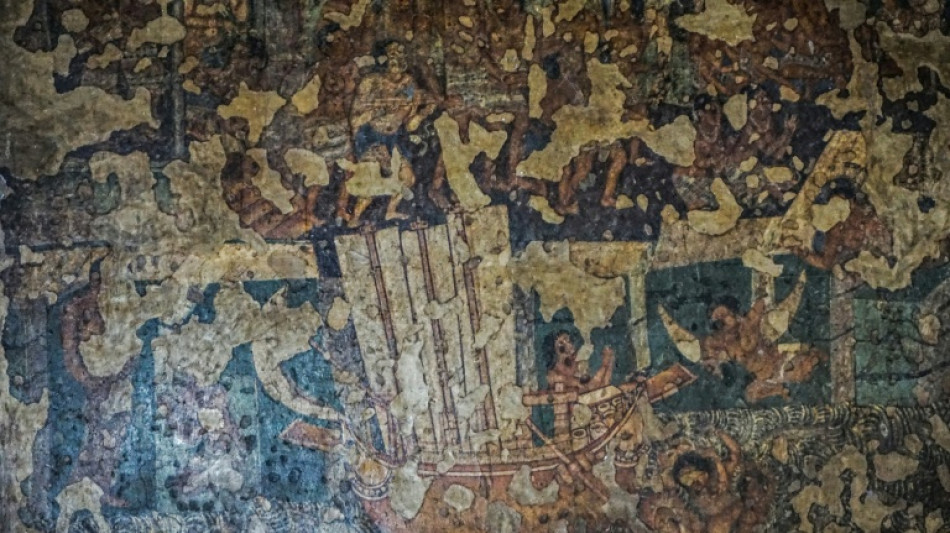
But none of its vessels is as unusual as its newest addition that sets sail on its maiden Indian Ocean crossing on Monday -- a wooden stitched ship inspired by a fifth-century design, built not to dominate the seas but to remember how India once traversed them.
Steered by giant oars rather than a rudder, with two fixed square sails to catch seasonal monsoon winds, it heads westward on its first voyage across the seas, a 1,400-kilometre (870-mile) voyage to Oman's capital Muscat.
Named Kaundinya, after a legendary Indian mariner, its 20-metre (65-foot) long hull is sewn together with coconut coir rope rather than nailed.
"This voyage reconnects the past with the present," Vice Admiral Krishna Swaminathan said, sending the ship off from Porbandar, in India's western state of Gujarat, on an estimated two-week crossing.
"We are not only retracing ancient pathways of trade, navigation, and cultural exchange, but also reaffirming India's position as a natural maritime bridge across the Indian Ocean."
The journey evokes a time when Indian sailors were regular traders with the Roman Empire, the Middle East, Africa, and lands to the east -- today's Thailand, Indonesia, China and as far as Japan.
"This voyage is not just symbolic," Swaminathan said. "It is of deep strategic and cultural significance to our nation, as we aim to resurrect and revive ancient Indian maritime concepts and capabilities in all their forms."
- 'A bridge' -
The ship's 18-strong crew has already sailed north along India's palm-fringed coast, from Karnataka to Gujarat.
"Our peoples have long looked to the Indian Ocean not as a boundary, but as a bridge carrying commerce and ideas, culture and friendship, across its waters," said Oman's ambassador to India, Issa Saleh Alshibani.
"The monsoon winds that once guided traditional ships between our ports also carried a shared understanding that prosperity grows when we remain connected, open and cooperative."
The journey is daunting. The ship's builders have refused modern shortcuts, instead relying on traditional shipbuilding methods.
"Life on board is basic -- no cabins, just the deck," said crew member Sanjeev Sanyal, the 55-year-old historian who conceived the project, who is also Prime Minister Narendra Modi's economic adviser.
"We sleep on hammocks hanging from the mast," he told AFP before the voyage.
Sanyal, an Oxford-educated scholar and former international banker, drew up the blueprints with traditional shipwrights, basing designs on descriptions from ancient texts, paintings and coins.
"Vasco da Gama is 500 years back," he said, referring to the Portuguese sailor who reached India in 1498. "This is 6,000-, 7,000-year-old history."
- 'So much gold' -
India is part of the Quad security alliance with the United States, Australia and Japan, seen as a counterweight to Beijing's presence in the Indian Ocean.
For India, the voyage is also a soft-power showcase to challenge perceptions that it was China's "Silk Road" caravans that dominated ancient East-West trade.
That land trade, as described by 13th-century Venetian merchant Marco Polo, peaked centuries after India's sea route.
"India was running such large surpluses with the Romans that you have Pliny the Elder... complaining that they were losing so much gold to India," Sanyal said.
The ship's only modern power source is a small battery for a radio transponder and navigation lights, because wooden vessels do not show up well on radar.
"When you hit a big wave, you can see the hull cave in a little bit", he said, explaining that the stitched design allowed it to flex.
"But it is one thing to know this in theory," he said. "It is quite another thing to build one of these and have skin in the game by sailing it oneself."
(F.Schuster--BBZ)