India and Germany seek to boost defence industry ties / Photo: Shammi MEHRA - AFP

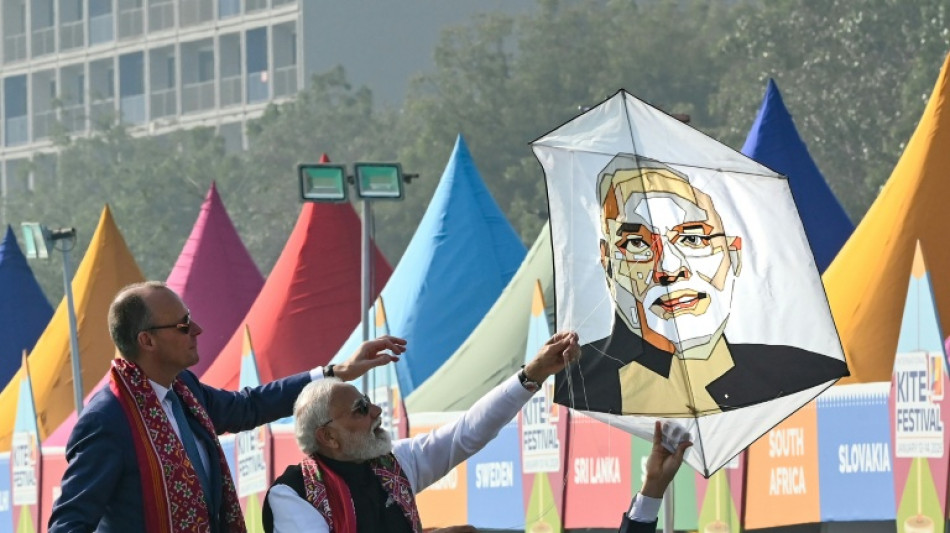
India and Germany are looking to boost defence industry cooperation, Prime Minister Narendra Modi said Monday after hosting Chancellor Friedrich Merz in his home state of Gujarat.
Merz said Berlin also wants a closer security partnership with New Delhi, including deeper "cooperation between our defence industries" to cut India's traditional dependence on Russia for military hardware.
Merz began his two-day India visit -- his first to Asia since taking office in May -- two weeks ahead of an EU-India summit and as India and the European bloc are working on a free trade agreement.
Both countries announced several agreements and joint declarations after the leaders' meeting with an aim to boost their $50 billion trade.
The announcements included strengthening defence industry cooperation and on semiconductors and critical minerals.
The two countries "are working together on secure, trusted, and resilient supply chains and our MoUs on these issues will strengthen our partnership", Modi said.
The meeting between the Indian and German leaders comes at a time when both are facing economic and security challenges from the world's two biggest economies, China and the United States.
Merz said Berlin was "committed to an international order in which we can live freely and securely, because the world is currently undergoing a process of realignment".
"It is increasingly characterised by great power politics and thinking in terms of spheres of influence, which is why we must join forces to weather these rough winds," he added.
"That is why we also want to move closer together in terms of security policy, such as conducting joint exercises between our air forces and navies for security in the Indo-Pacific."
Recent actions and statements by US President Donald Trump including arbitrary trade tariffs have played a key role in upending global alliances and regional geopolitics, with New Delhi still negotiating a trade deal with Washington.
- 'Strategic importance' -
"It is of particular strategic importance that we deepen cooperation between our defence industries. This strengthens both sides and also helps to make India less dependent on Russia, for example," said Merz.
New Delhi, which has relied on Moscow for decades for its key military hardware, has tried to cut its dependence on Russia in recent years by diversifying imports and pushing its own domestic manufacturing base.
India today counts France, Israel and the United States as its key military suppliers besides Russia.
Berlin and New Delhi have also been negotiating a potential deal for Germany's Thyssenkrupp Marine Systems to build six submarines for the Indian Navy in partnership with Indian state-run Mazagon Dock Shipbuilders.
While still being negotiated, that deal would allow India to replace its ageing fleet of Russian-built submarines and likely include technology transfer provisions to help its domestic defence industry.
In defence, the two sides are also exploring other areas of convergence as New Delhi pumps billions of dollars to upgrade its naval fleet and air force in the next few years.
There are around 300,000 Indians and people of Indian origin in Germany, including about 60,000 students -- many of them in critical science, engineering and other key technology research fields.
Many Indian workers have filled a recent shortfall of qualified professionals in Germany's IT, banking and finance sectors.
Modi said that "India is honoured that he (Merz) has chosen our nation as the place of his first visit in Asia".
He said the leaders had agreed on "deeper cooperation in defence, space and other critical and emerging technologies".
Merz will wrap up his visit with a trip to the southern technology hub of Bengaluru on Tuesday.
(F.Schuster--BBZ)