Berliner Boersenzeitung - Easier said than done for US to apply tariffs on single EU states

EUR -
AED 4.382198
AFN 78.754674
ALL 96.774708
AMD 453.149301
ANG 2.136006
AOA 1094.207135
ARS 1723.102862
AUD 1.703562
AWG 2.147844
AZN 2.027442
BAM 1.958133
BBD 2.409352
BDT 146.164116
BGN 2.003902
BHD 0.44984
BIF 3543.996936
BMD 1.193246
BND 1.513406
BOB 8.265053
BRL 6.196645
BSD 1.1962
BTN 110.054406
BWP 15.599563
BYN 3.379194
BYR 23387.630134
BZD 2.405847
CAD 1.612422
CDF 2693.762547
CHF 0.916294
CLF 0.025959
CLP 1024.998187
CNY 8.291151
CNH 8.289429
COP 4358.929228
CRC 591.891888
CUC 1.193246
CUP 31.621031
CVE 110.398824
CZK 24.32057
DJF 213.014461
DKK 7.467264
DOP 75.160557
DZD 154.348858
EGP 55.874598
ERN 17.898697
ETB 185.131832
FJD 2.622039
FKP 0.865821
GBP 0.867049
GEL 3.215789
GGP 0.865821
GHS 13.067895
GIP 0.865821
GMD 87.70765
GNF 10498.001207
GTQ 9.178126
GYD 250.254403
HKD 9.315604
HNL 31.597639
HRK 7.540838
HTG 156.807821
HUF 381.264314
IDR 20023.868432
ILS 3.681565
IMP 0.865821
INR 109.70767
IQD 1563.749454
IRR 50265.506279
ISK 145.027398
JEP 0.865821
JMD 187.696961
JOD 0.846036
JPY 183.553496
KES 154.250804
KGS 104.349672
KHR 4801.014384
KMF 491.617467
KPW 1074.001913
KRW 1714.128315
KWD 0.365981
KYD 0.996775
KZT 600.868221
LAK 25678.663363
LBP 107122.636637
LKR 370.091721
LRD 221.344446
LSL 18.781995
LTL 3.523347
LVL 0.721783
LYD 7.487624
MAD 10.8345
MDL 20.12057
MGA 5321.878904
MKD 61.653933
MMK 2506.310149
MNT 4256.181546
MOP 9.616435
MRU 47.574622
MUR 54.20887
MVR 18.435607
MWK 2072.668697
MXN 20.600147
MYR 4.698762
MZN 76.069502
NAD 18.865481
NGN 1659.806193
NIO 43.189568
NOK 11.43188
NPR 176.109616
NZD 1.971279
OMR 0.458799
PAB 1.196155
PEN 3.989617
PGK 5.083822
PHP 70.236878
PKR 333.900229
PLN 4.209046
PYG 8027.167678
QAR 4.344732
RON 5.098262
RSD 117.403788
RUB 89.791784
RWF 1733.190447
SAR 4.47538
SBD 9.615301
SCR 17.094249
SDG 717.748765
SEK 10.549557
SGD 1.511223
SHP 0.895244
SLE 29.085359
SLL 25021.780252
SOS 681.970209
SRD 45.34754
STD 24697.792058
STN 24.610708
SVC 10.466336
SYP 13196.79832
SZL 18.849358
THB 37.471506
TJS 11.172143
TMT 4.188295
TND 3.373606
TOP 2.873051
TRY 51.903114
TTD 8.118705
TWD 37.455406
TZS 3036.811959
UAH 51.195332
UGX 4255.17589
USD 1.193246
UYU 45.264869
UZS 14555.155623
VES 437.738577
VND 30910.452286
VUV 142.675312
WST 3.241825
XAF 656.725554
XAG 0.010797
XAU 0.00023
XCD 3.224808
XCG 2.155741
XDR 0.816831
XOF 653.262056
XPF 119.331742
YER 284.471219
ZAR 18.895594
ZMK 10740.668787
ZMW 23.654963
ZWL 384.224865
  • SCS

    0.0200

    16.14

    +0.12%

  • RBGPF

    1.3800

    83.78

    +1.65%

  • JRI

    -0.0500

    12.94

    -0.39%

  • BCC

    -0.5500

    80.3

    -0.68%

  • CMSC

    0.0100

    23.71

    +0.04%

  • CMSD

    0.0392

    24.09

    +0.16%

  • RELX

    -1.2100

    36.17

    -3.35%

  • GSK

    0.5600

    50.66

    +1.11%

  • BCE

    0.2200

    25.49

    +0.86%

  • NGG

    0.3900

    85.07

    +0.46%

  • RIO

    1.7600

    95.13

    +1.85%

  • RYCEF

    -0.0700

    16.88

    -0.41%

  • AZN

    -0.6300

    92.59

    -0.68%

  • VOD

    0.1400

    14.71

    +0.95%

  • BTI

    0.0600

    60.22

    +0.1%

  • BP

    0.3400

    38.04

    +0.89%

Easier said than done for US to apply tariffs on single EU states
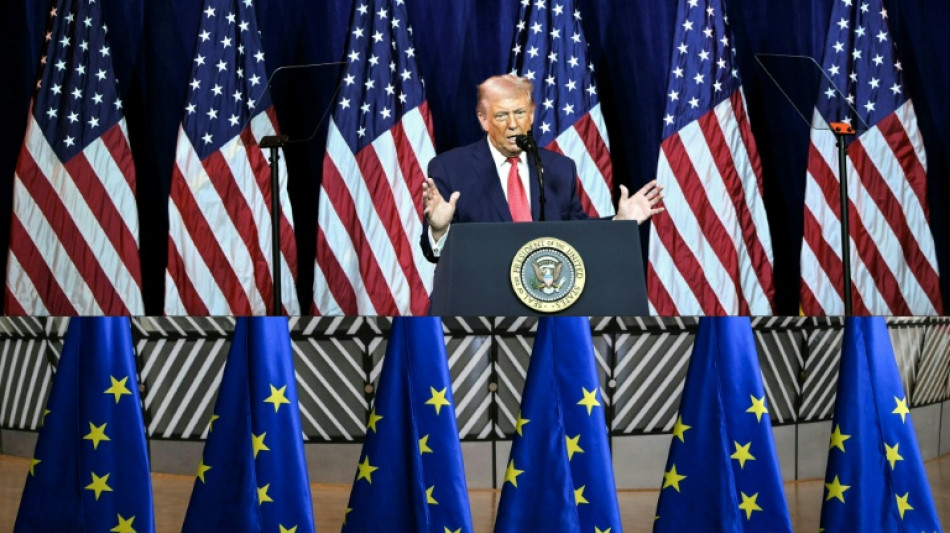
Easier said than done for US to apply tariffs on single EU states / Photo: Mandel NGAN, NICOLAS TUCAT - AFP/File

Easier said than done for US to apply tariffs on single EU states

US President Donald Trump's tariff threats on eight European states, most of which are part of the EU common market, raises the question: can he really target them individually? Technically yes, but in practice -- it's not so simple.

Text size:

When asked the same question, a smiling European Commission spokesman Olof Gill urged reporters to "take a deep breath" before spelling out his explanation.

Trump stunned Europe at the weekend when he threatened levies of up to 25 percent on EU members Denmark, Finland, France, Germany, the Netherlands and Sweden, plus non-members Britain and Norway.

But because the European Union functions as a single market with a customs union, Brussels explained, while it might be technically possible for Trump to slap sanctions on each, that could mean bureaucratic hell for US importers.

- How does the single market work? -

Denmark, Finland, France, Germany, the Netherlands and Sweden are part of the EU single market with 21 other countries, and a customs union, which allows the free flow of goods from one member state to another.

This also means products made in the EU, which could be exported later to the United States, move around the union without their origin being tracked.

Because of this free movement, many companies use products made from across the bloc. For example, a car might be assembled in Germany using parts made in Slovakia.

This means any restrictions on trade aimed at one of the EU's 27 countries could in theory be circumvented by moving goods to another member state before exporting them.

"Exports of French wine, Dutch cheese and Danish pharmaceuticals from Budapest to the US might suddenly spike," quipped an EU diplomat -- in a nod to the warm ties linking Hungary's Prime Minister Viktor Orban and the White House.

"Let's see if Trump is going to punish his friend Orban with a tariff," the diplomat said.

The situation is different for Norway and the United Kingdom.

Norway is part of the European Economic Area that also includes the EU's 27 states, but there is one major difference -- it is not part of the bloc's customs union and must fulfil extra border checks.

When Britain left the EU, it opted to remain outside the single market.

- So then, are individual tariffs feasible? -

The above means that the United States would have a hard time trying to figure out where European goods actually come from.

"From a customs and operational perspective, it is practically very difficult to attribute goods exclusively to a single member state, given that production and transformation processes are often distributed across the EU," Gill said.

While nothing prevents a third country from demanding more information about national provenance, under EU rules, goods manufactured in the bloc have only to be labelled as "EU origin".

"So to summarise, it is technically possible. It is immensely bureaucratically and procedurally complex to do so," Gill said.

(A.Lehmann--BBZ)