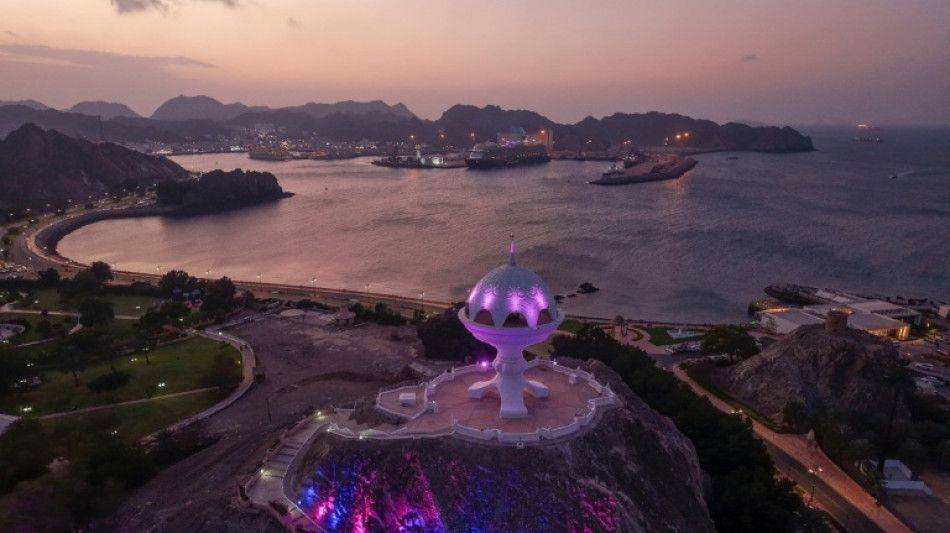
What does Iran want from talks with the US? / Photo: Haitham AL-SHUKAIRI - AFP

Iran and the United States are holding talks on Friday in Oman, with Tehran pushing to focus squarely on its nuclear programme, while Washington's demands go beyond that.
The two foes had held several rounds of Oman-mediated nuclear talks in 2025, but the Iran-Israel war, which saw the United States conduct strikes on Iranian nuclear sites, derailed diplomacy days before a meeting was due.
US President Donald Trump has threatened renewed military action against Iran following its deadly crackdown on mass anti-government protests, but has also said he thinks Tehran is open to a deal.
The United States has said talks must cover Tehran's missile programme and its support for militant groups in the region.
AFP takes stock of the thorny issues on the table:
- Uranium enrichment -
The main dispute between Iran and the US concerns uranium enrichment.
Western countries and Israel, thought to be the Middle East's only country with nuclear weapons, say Iran is seeking to acquire a bomb, which the Islamic republic denies.
During the Iran-Israel war last June, the United States bombed three nuclear sites in Iran (Fordow, Natanz and Isfahan), with Trump later claiming the strikes "obliterated" the nuclear programme, although the extent of the damage remains unknown.
Experts say uranium enriched above 20 percent can have potential military applications but that enrichment must reach 90 percent to make a bomb.
Before the war, Iran was enriching uranium to 60 percent, according to the UN's International Atomic Energy Agency, far exceeding a 3.67 percent cap allowed under a now-defunct nuclear agreement that Iran reached with world powers in 2015.
The United States withdrew from that deal in 2018 and Iran subsequently abandoned its commitments under the agreement in retaliation.
Trump has repeatedly called for a complete end to enrichment, a condition much stricter than the 2015 deal.
Iran, which says it has a right to civilian nuclear power, deems this demand a "red line" and contrary to the Nuclear Non-Proliferation Treaty to which it and 190 other nations are signatories.
- Stockpile -
The location of Iran's reserves of more than 400 kilogrammes of highly enriched uranium is unclear after the US bombings last year. The stocks were last seen by IAEA inspectors on June 10.
"The materials are under the rubble (of bombed nuclear sites) and we have made no attempt to extract them... because it is dangerous," Ali Shamkhani, an adviser to Iran's supreme leader, told Lebanese media this week.
"We are discussing this issue with the IAEA in order to find a solution while ensuring safety," he added.
Iran suspended all cooperation with the UN nuclear watchdog at the end of September, justifying its decision as retaliation after UN sanctions were reinstated over its nuclear programme.
Several countries, including Russia, have offered to house Tehran's stockpile of enriched uranium as a safeguard, but Iran has refused.
"There is no reason to move the materials abroad when we can eliminate the sources of concern" about their end use, Shamkhani insisted.
"We have no plan to militarise our nuclear programme" and "we can therefore dilute the material from 60 to, say, 20 percent", he added.
"But in exchange, something must be paid," Shamkhani said, alluding to Iran's demand that sanctions be lifted.
- Nuclear and nothing else -
Tehran is adamant that the talks be strictly limited to the nuclear issue and the lifting of sanctions, and considers this demand non-negotiable.
But Washington and its ally Israel are pushing for other grievances against the Islamic republic to be included.
In 2018, the United States' withdrawal from the previous nuclear deal was partly motivated by the absence of curbs in the agreement on Iran's ballistic missile programme, perceived as a threat to Israel.
According to media reports, Israel is now pushing to put this issue on the negotiating table, along with Iran's policy of financing militant groups across the Middle East, including Hezbollah in Lebanon, Hamas in Gaza and the Houthis in Yemen.
(Y.Yildiz--BBZ)