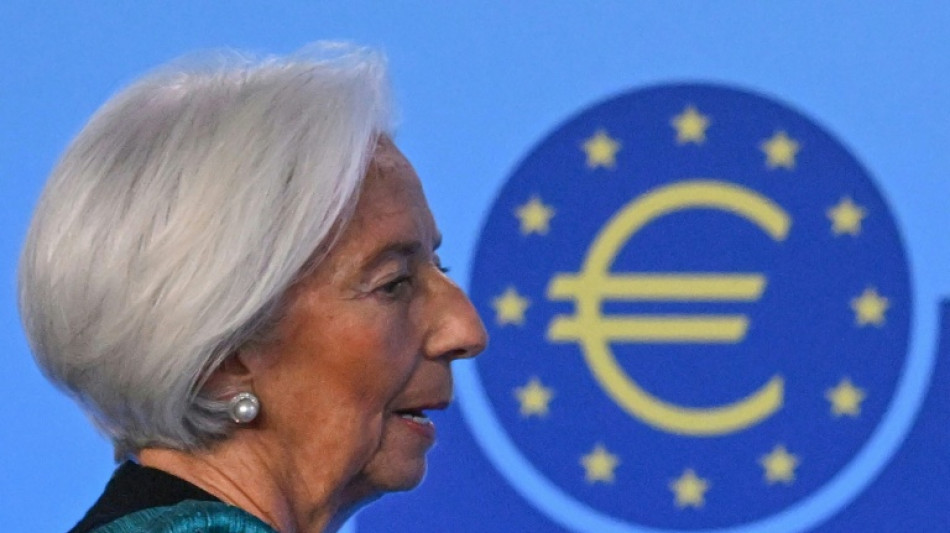
ECB warns of stronger euro impact, holds rates / Photo: Kirill KUDRYAVTSEV - AFP

The European Central Bank warned Thursday a stronger euro could push inflation down too far after recent gains in the single currency, but sought to downplay any immediate threat to the eurozone economy.
As expected, the central bank for the 21-nation single-currency area kept its benchmark interest rate on hold at two percent, where it has been since June last year.
ECB President Christine Lagarde stressed the eurozone economy, which has been picking up speed recently, remained "resilient" and officials were confident inflation would settle around the central bank's two-percent target.
But much attention at her press conference focused on the recent gains of the euro, which jumped above the $1.20 threshold last week as the dollar weakened on renewed worries about US economic policy under President Donald Trump.
Combined with news that inflation had dropped below the ECB's target in January, speculation had mounted that the central bank might start mulling if and when to cut rates.
Lagarde made a nod to these concerns, warning that "a stronger euro could bring inflation down beyond current expectations", and noted the issue had been discussed by ECB officials at Thursday's meeting.
- Currency concerns -
A stronger currency makes imports cheaper, which tends to push inflation down -- potentially leading consumers to delay purchases, with negative ripple effects across the economy.
A strong euro can also weigh on the eurozone's crucial exporters, particularly Germany, as it makes the cost of companies' goods pricier overseas.
But despite the gains last week, Lagarde pointed out that the euro had been steadily strengthening against the dollar since shortly after Trump took power last year.
And the current exchange rate was "very much in line with the overall average" since the euro was introduced, she stressed.
She also reiterated that the ECB feels it is in a "good place" -- phrasing which has been taken to mean the central bank is happy with the current level of rates.
The euro was barely changed against the dollar after Thursday's meeting at $1.18.
However Frederik Ducrozet, an economist at Pictet Wealth Management, said some of the central bank's language appeared to signal "the ECB's growing discomfort with regard to the stronger euro".
Lagarde's comments indicate "that further currency appreciation would bring us closer to a pain threshold", he added.
- 'Uncertain outlook' -
As usual, the ECB chief gave no signal about the central bank's next move on rates.
But, given the movements in currencies and inflation, some analysts are now raising their bets on rate cuts in the second half of the year.
The Bank of England also left its benchmark interest rate unchanged Thursday, at 3.75 percent, while cutting its forecasts for UK growth this year and next.
Lagarde also said the global environment remained "challenging".
"The outlook is still uncertain, owing particularly to ongoing global trade policy uncertainty and geopolitical tensions," she said.
Trump's volatile trade policies in particular have unnerved Europe.
There was another flare-up last month when Trump threatened to hit eight European countries with new tariffs over their opposition to his desire to annex Greenland, but he later climbed down.
Central bankers around the world have been especially worried by Trump's targeting of US Federal Reserve chair Jerome Powell, whom he has criticised for not cutting rates faster.
On Thursday however Lagarde welcomed Trump's nomination of Kevin Warsh, a former Fed official, to be the next chief of the US central bank, a move that has broadly reassured markets.
"We go back a long way and I very much welcome (the) announcement of his appointment," said Lagarde.
(B.Hartmann--BBZ)