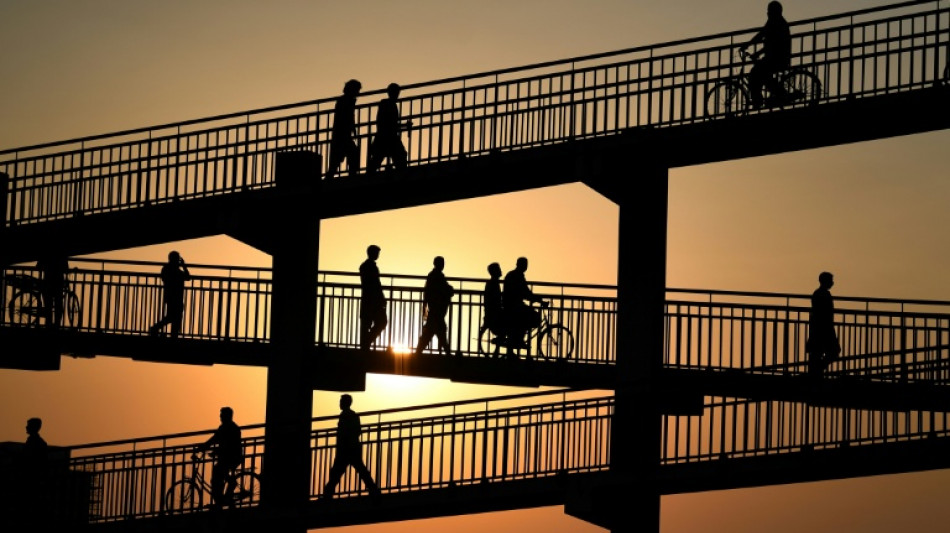
Migrant workers bear brunt of Iran attacks in Gulf / Photo: Karim SAHIB - AFP

Bangladeshi migrant Ahmad Ali, 55, was doing his regular round delivering drinking water to residents in the United Arab Emirates when Iran launched its first retaliatory attacks against Gulf countries.
Debris from a missile strike tore through his delivery van, killing him instantly and ending his three decades spent in the Emirates.
"My dad told my cousin he would be back soon," Ali's son Abdul Hoque said from Barlekha in eastern Bangladesh. "But those were his last words. He died instantly when his van was hit."
Since February 28, Tehran has launched wave after wave of missile and drone attacks against the Gulf states in retaliation for US and Israeli strikes on Iran.
In a region home to more than 35 million migrant workers, mostly from South Asia, many of those killed have been foreign labourers filling the lowest-paid roles in Gulf economies.
Among fourteen civilians killed in the Gulf since the conflict began, according to an AFP tally, eight were foreign nationals from Pakistan, Nepal, Bangladesh and India.
And while some wealthy residents have been able to leave the Gulf, migrant workers remain among the most vulnerable during the conflict.
For many workers, leaving is not an option having borrowed to pay recruitment agents for visas and jobs abroad and with families at home dependent on the remittances they send.
- 'Don't know why' -
"My father was a hard-working man doing a respectable job," Hoque said. "We don't know why he had to die."
After nearly three decades in the UAE, Ali had recently begun building a house in Bangladesh, a dream shared by many migrant workers in the Gulf.
"That dream has ended with his death," Hoque said. "My mother and my three siblings are still in shock."
Pakistani migrant Murib Zaman Nizar, 44, was another victim in the UAE, killed on February 28 in Abu Dhabi when debris from an intercepted drone fell on his car.
A father of five children aged between four and 12, Nizar worked as a driver for a family in the Emirati capital.
"My brother was washing the car inside the compound when the accident happened," Murib's brother Muhammad Khan told AFP by phone from their hometown of Bannu in Pakistan's northwestern Khyber Pakhtunkhwa province.
"He was a family man who wanted to give the best life to his five children. And now he is gone," said Khan, who also works in the UAE as a construction worker.
- 'Emotionally shut' -
With no immediate sign of de-escalation, several Gulf countries have shifted to remote work and online schooling as repeated alerts and the sounds of air defence interceptions fuel anxiety among residents but migrant workers continue their daily lives outside.
"We are trying to stay calm and continue working as usual," said Binoy, an Indian engineer in Dubai who asked that his full name not be used.
A resident of Mohammed Bin Zayed City on the outskirts of Abu Dhabi, Binoy said the frequent explosions from interceptions are unsettling.
"We know they are interceptions, but it is still worrying," he said.
A Filipino nurse in Dubai who asked to be identified as Jane said she continues to report to work while trying to "emotionally shut out" the constant noise.
"Two days ago, I was walking home early in the morning after my night shift when I heard loud booms," she said. "I kept walking. What else can we do?"
Jane, who has lived in the UAE for seven years, said her two children aged seven and ten call her frequently.
"They are scared after watching the news on TV. I keep reassuring them that everything is safe here."
(A.Berg--BBZ)