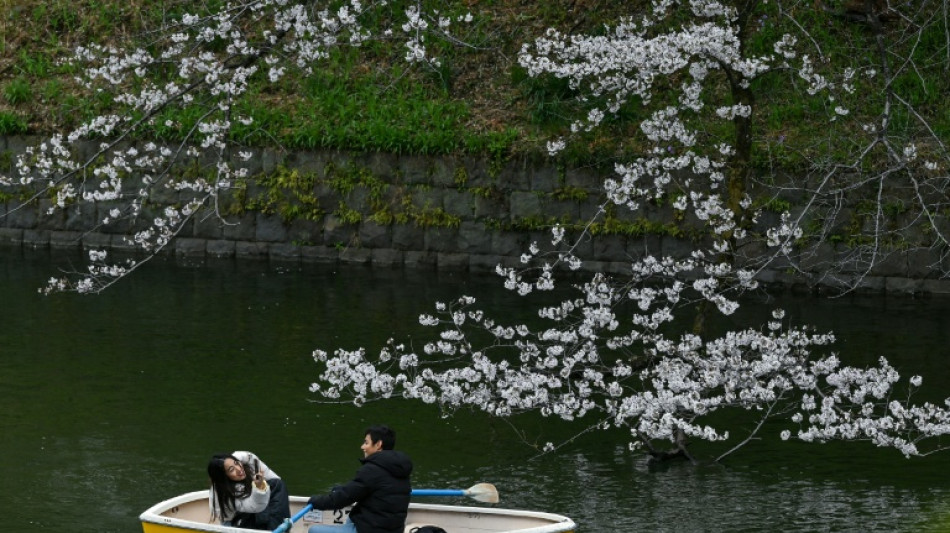
'Perfect Japan' posts spark Gen Z social media backlash / Photo: Richard A. Brooks - AFP

Take an everyday video on any suburban transport network, add anime-style music and a rosy filter, and it's suddenly a scene from the Japanese holiday of your dreams.
That's the "Japan effect": a Gen Z social media trend satirising the often-romanticised image of the Asian country, which welcomed a record number of visitors last year.
Residents of Kyoto and other tourist hotspots have expressed exasperation with selfie-taking crowds, and now an online backlash against Japan fever is growing.
The short video posts on platforms like TikTok show how even just the words "Tokyo, Japan" with a cherry blossom emoji can make an otherwise banal street scene more appealing for some users.
"The point is to make fun of Japan's 'cute' image online, with all its cliches and stereotypes," 25-year-old French YouTuber Rocky Louzembi, who analyses internet culture, told AFP.
Along with the chronically weak yen, the booming popularity of anime and game franchises such as Pokemon is drawing tourists to the nation.
But some people take their love of Japan too far, said Louzembi, who goes by the handle rockylevrai.
To describe the phenomenon, he used the slang word "glazing" -- to excessively praise something.
A "Japan glazer" is "someone who puts everything that comes from Japan on a pedestal, while disparaging things that come from their own country", Louzembi said.
- 'Not that clean' -
Japan logged a record 42.7 million tourist arrivals in 2025, despite a steep fall in Chinese visitors in December due to a diplomatic row.
Many visitors post online about their trip -- making pilgrimages to real-life locations from cartoons or joking about spending $1,000 on flights just so they can eat a $1 convenience store rice ball.
"The 'Japan' portrayed in an anime world is often quite different from how Japanese society is", said Marika Sato, a 29-year-old who works in marketing in Tokyo.
For instance, many women have experienced groping, said Sato, a contributor to "Blossom The Project", an Instagram account focused on Japanese social issues.
Graphic designer and fellow Blossom contributor Maya Kubota, 28, said that she appreciates people liking Japan and wanting to visit.
But over-the-top comments such as "Japanese people are next level" give her an "icky vibe", Kubota told AFP.
Some of the online Gen Z pushback focuses on the exaggerated idea that Japan's streets are so spotless people don't even have to wear shoes.
"Japan is clean but not THAT clean," joked a US couple who post social media content about the country under the name The Hitobito -- showing off their dirty white socks after a real-life experiment.
- Viral effect -
Japan's tourist boom has forced some authorities to take action.
A cherry blossom festival boasting a highly Instagrammable view of Mount Fuji was cancelled this year after residents complained of overtourism.
"People associate Japan with carefully composed visuals," said Seio Nakajima, a professor in the Graduate School of Asia-Pacific Studies at Waseda University.
That could be because of the detailed, beautiful backgrounds in anime, or because of a deeper "cultural tradition of emphasising form".
"If people focus on form rather than meaning, it becomes easier to go viral. Because you don't need to think," Nakajima told AFP.
Japan's formalities -- from the complexity of polite language to extreme attention to detail in packaging or wrapping -- may surprise visitors, he said.
But "Japan is not always clean and aesthetic. That's only part of the reality."
Despite the backlash, tourists in Tokyo's busy Tsukiji market told AFP that the country had lived up to their expectations.
"In Russia, it's very popular to hype Japan," said Tatiana Mokeeva, 25.
When asked if posts about Japan could be unrealistic, she said: "To tell the truth, no... I love all about Japan."
(S.G.Stein--BBZ)