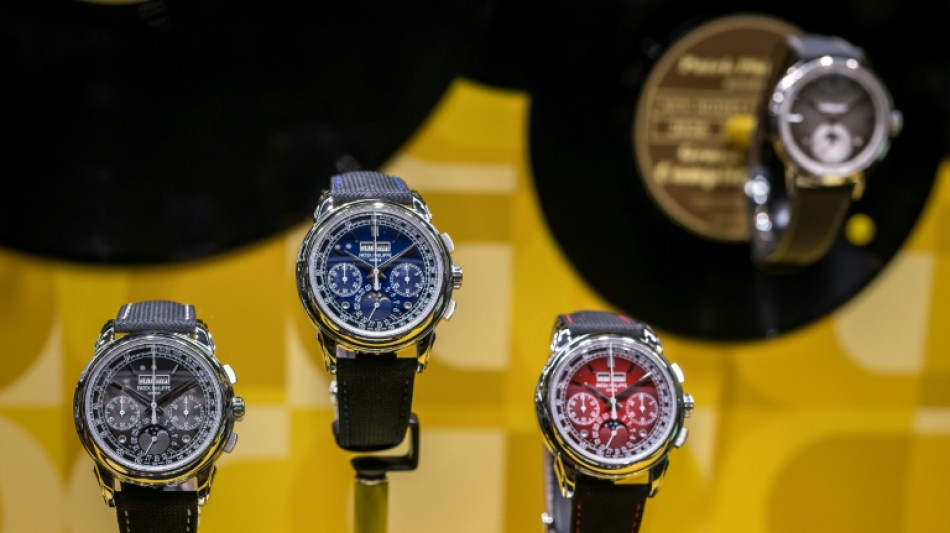
Swiss watchmakers say time will tell on effects of Mideast conflict / Photo: Fabrice COFFRINI - AFP

The Middle East war has plunged Swiss watchmakers into uncertainty, testing the resilience of an iconic national industry already shaken by several crises.
Behind the opulent booths at the Watches and Wonders fair in Geneva, the industry's biggest annual showcase, the conflict is on everyone's lips.
The war is not the first crisis that watchmaking has faced in recent years, said Elie Bernheim, the chief executive of Raymond Weil, a family business started by his grandfather that generates approximately 10 percent of its revenue in the Middle East.
"There was the subprime mortgage crisis in 2008," then the arrival of the smartwatch, when "the worst was predicted for the watchmaking industry"; the Covid-19 pandemic and "the US tariffs last year", Bernheim said.
And yet, in the long run, "the watchmaking industry has demonstrated considerable resilience", he added.
Over the last 20 years, Swiss watch exports have more than doubled, despite all the challenges.
The unusual aspect of current events in the Middle East -- a war which has seen Tehran target Gulf countries in retaliation for US and Israeli strikes on Iran -- is that "nothing can be anticipated", said Bernheim.
"Everything can change from one day to the next, we have no control, and I think that is the most destabilising thing," he said.
- Uncertain consumer climate -
Like many watchmakers, Bertrand Meylan, co-owner of the H. Moser brand, believes the war could have an impact on the global consumer climate.
"The longer the conflict lasts, the greater the risk that anxiety will spread to the rest of the economy," he told AFP, noting that "people don't buy during times of anxiety".
On the ground, "brands that depend on tourism are suffering enormously", the Dubai-based entrepreneur said.
But with local customers, business continues to thrive, "a bit like during the Covid period", when consumers, unable to travel, had more time and disposable income to buy a watch.
His brand generates six percent of its revenue in the Middle East.
- 10% of exports -
The Geneva watch fair, which runs until April 20, sees 65 major watch brands, including Rolex, Patek Philippe and Cartier, display their latest creations.
This year's Watches and Wonders comes after two tough years for the sector, with a drop in demand in China followed by US tariffs.
Swiss watch exports first fell by 2.8 percent in 2024 and then by 1.7 percent in 2025, to 25.6 billion Swiss francs ($32.5 billion).
Last year, the Middle East as a whole accounted for around 10 percent of the sector's exports, which is "already a lot", Yves Bugmann, president of the Federation of the Swiss Watch Industry, told AFP.
For comparison, the United States -- the leading market for Swiss watchmakers -- represents 17 percent of exports, he explained.
Japan comes second, ahead of mainland China, Hong Kong, Britain and then Singapore.
The United Arab Emirates is the largest market in the Middle East, ranking eighth among the top 10 destination countries, sandwiched between Switzerland's neighbours France and Germany.
Saudi Arabia is the 15th-biggest market, with Qatar 21st, Kuwait 25th and Bahrain 27th.
At the start of the year, Bugmann was "relatively confident" for the industry's prospects in 2026.
However, "the war in the Middle East is a game-changer", and it is "too early to make predictions" as to its impact, he said.
Everything, he said, will depend on "how the conflict unfolds".
(S.G.Stein--BBZ)