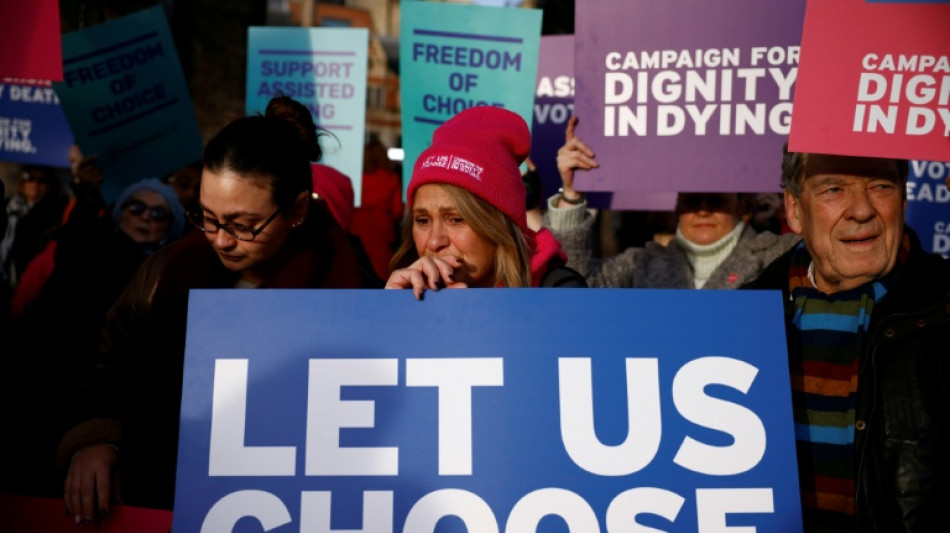
Bill legalising assisted dying in England and Wales set to fail / Photo: BENJAMIN CREMEL - AFP

A contentious bill to legalise assisted dying in England and Wales was set to fail Friday after running out of parliamentary time, having been stuck in the UK's unelected upper house.
The bill has "no prospect" of becoming law in parliament's current session set to end next week, a lawmaker co-sponsoring the legislation confirmed Friday.
MPs in the House of Commons backed legalising euthanasia for adults who have been given less than six months to live and can clearly express a wish to die, in a historic vote last June.
But more than 1,200 bill amendments subsequently introduced in the unelected House of Lords mean it will not pass before parliament's prorogation, which will conclude its current session and is expected on Tuesday.
"There is no prospect that the bill can get through this House (of Lords) today or before prorogation," Charlie Falconer, who sponsored it in the Lords, said at the start of a final debate Friday.
"I am despondent that this bill, so important to so many, has not failed on its merits, but failed as a result of procedural wrangling," he added.
Other proponents of the legislation are similarly upset.
"We're calling it here a vandalism of democracy," campaigner Rebecca Wilcox told AFP. Her mother Esther Rantzen -- a high-profile television personality -- has a terminal diagnosis.
"We're incredibly angry with what's happened but we're determined to get it through," she added. "This is not the end, we will not be stopped."
- 'Deliberate delaying' -
Under the Terminally Ill Adults (End of Life) Bill, Britain would emulate several other countries in Europe and elsewhere that allow some form of assisted dying, including Belgium and the Netherlands.
Both chambers of the UK parliament must approve legislation for it to become law, and bills that are still in progress when a session ends usually fail.
More than 200 lawmakers signed a letter late Thursday blaming the bill's scuppering on "deliberate delaying tactics pursued by a minority of peers opposed to its passage".
"We've sadly seen a small number of peers who have talked the bill out, essentially, meaning it will fall," Kim Leadbeater, the MP who introduced it in the House of Commons in 2024, told Sky News Friday.
"I'm really sad, really upset, really disappointed, but also a little bit angry," she added, noting terminally ill people will continue to be denied "choice, compassion and dignity".
Supporters staged a small protest near parliament early Friday ahead of the scheduled Lords debate, which is due to end by 3:00 pm (1400 GMT).
- 'Not going away' -
Leadbeater vowed supportive MPs will "go again" when they reconvene next month for a new parliamentary session, though the legislative process will have reset and a different MP will likely need to introduce a new bill.
"The issue is not going away -- there's a very clear direction of travel around the world," she said, adding polling in Britain showed support for the change.
But critics, including the Christian Medical Fellowship (CMF) which represents medical professionals opposed to assisted dying, said they were "relieved" the bill would fail.
"It is not possible to construct an assisted suicide service that is safe, equitable, and resistant to placing unacceptable pressure on the most vulnerable", a spokesperson said in statement to AFP.
Under the proposed legislation, any patient's wish to die would have to be signed off by two doctors and a panel of experts.
They would have to be able to administer the life-ending substance themselves.
Its supporters say that will give people with an incurable illness dignity and choice at the end of their lives.
Lawmakers in the self-governing British dependencies of Jersey and the Isle of Man have already approved euthanasia legislation but the moves are still awaiting royal assent.
Lawmakers in Edinburgh in March rejected a bill in the devolved Scottish parliament to legalise assisted dying.
(S.G.Stein--BBZ)