Frugal and more online: smarter spenders rewrite luxury's China dream / Photo: GREG BAKER - AFP

When Beijinger Jacqueline Li first heard one of her favourite luxury department stores in the city was closing, she was shocked -- until she considered how Chinese spending habits have changed in recent years.
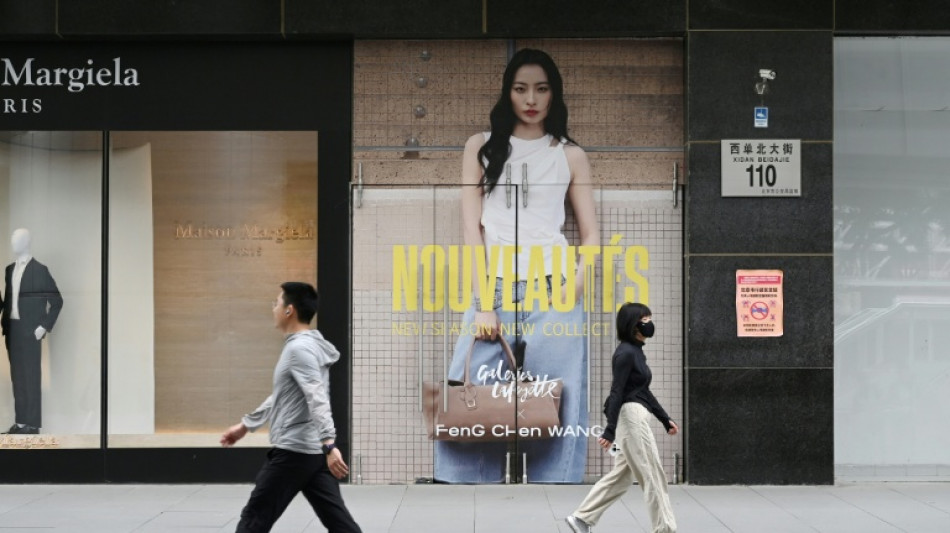
The closure of France's Galeries Lafayette in the Chinese capital on Wednesday takes place against the backdrop of a sluggish post-pandemic economy and shifting consumption practices.
It is the latest sign foreign luxury brands might not retain the pull -- and the cashflow -- that they counted on in the world's second largest economy in the 2010s.
"I think people's spending habits after the pandemic may be more cost-effective and practical," Li told AFP, on a pilgrimage to the Galeries on its penultimate day of operations.
"It's no longer as over-the-top as before, like needing to have an impressive logo. So you'll see that (demand for) luxury goods has fallen," the international school admissions officer said.
While luxury consumption in Europe and the United States has been driven by pandemic-era savings, Chinese consumers have spent more frugally as the post-Covid recovery has stuttered.
The property market, into which millions had poured their savings, is struggling to recover from a long-running crisis, while middle class incomes have stagnated and youth unemployment remains high.
Last month, consumer spending grew at the slowest pace in more than three years, official data showed.
In 2025, the luxury market in China declined three to five percent, after plummeting 17 to 19 percent the year before, according to consultancy Bain & Company.
- Pandemic hangover -
Before the pandemic, China's burgeoning middle class produced plenty of first-time high-end buyers, said Lisa Nan, editor at Jing Daily, a publication that focuses on China's luxury market.
Now, "because of the economic downturn, people are much more rational and they have to navigate through this difficult period", she said.
Even in financial hub Shanghai's swanky shopping districts, buyers still viscerally feel the uncertainty of the Covid pandemic.
"I find myself wanting to save money even more now," said 24-year-old July Xu, who was browsing the stores in upmarket Xintiandi with her friends.
"Having lived through such an extraordinary period (during the pandemic), I've come to realise that having some personal savings is quite important."
"Beforehand, people felt like money came pretty easily, with their income increasing every year, but during the pandemic a lot of people suddenly lost their jobs," said 61-year-old Hu Shuqing, speaking to AFP outside a luxury fragrance store.
Some analysts think there could be light on the horizon though, with the country's high-wage sector steadily growing.
"There could be a pent-up demand," said Jelena Sokolova from investment research firm Morningstar.
"(People) have a lot of savings, and once they feel kind of good, or better about their financial situation, they could go on and spend this money that has been accumulated."
- Changing market -
Unfortunately for traditional brands, consumer confidence is not the only challenge they face in China.
The dominance of e-commerce means shoppers from college students to retirees are used to buying marked-down clothing in just a few taps from the comfort of their sofas.
They have a plethora of choices, from apps like Taobao and JD.com to hours-long sales livestreams on the Instagram-like Xiaohongshu and Douyin, China's version of TikTok.
At Galeries Lafayette on Tuesday, as employees packed away denuded mannequins, admissions officer Li said she thought the store had been too reliant on "the traditional... business model that has existed for decades in France".
"This new generation of Chinese likes to shop online," she said. "For a lot of people born in the 1990s and 2000s... this mall is a stranger."
Even when shoppers do frequent brick-and-mortar shops, their online equivalents still inform purchase decisions.
"When I shop offline, after I spot an item of clothing, I'll see how much it costs to purchase online," said 46-year-old freelancer Yang Dunqin, who had come for one last trip to the department store.
Chinese consumers have "matured a lot", becoming more discerning, said Jing Daily's Nan.
Younger shoppers in particular focus less on legacy logos, instead seeking out pop-ups or emerging domestic brands.
"The need of buying luxury is no longer just a taste of their social status," she said. "It's really about self-expression."
Yang, the freelancer, was stoic about the loss of the Galeries.
"It just shows that this era continues to move forward," he said. "It's part of changing times."
(L.Kaufmann--BBZ)