In Finland, radioactive spent nuclear fuel soon to be buried underground / Photo: Alessandro RAMPAZZO - AFP

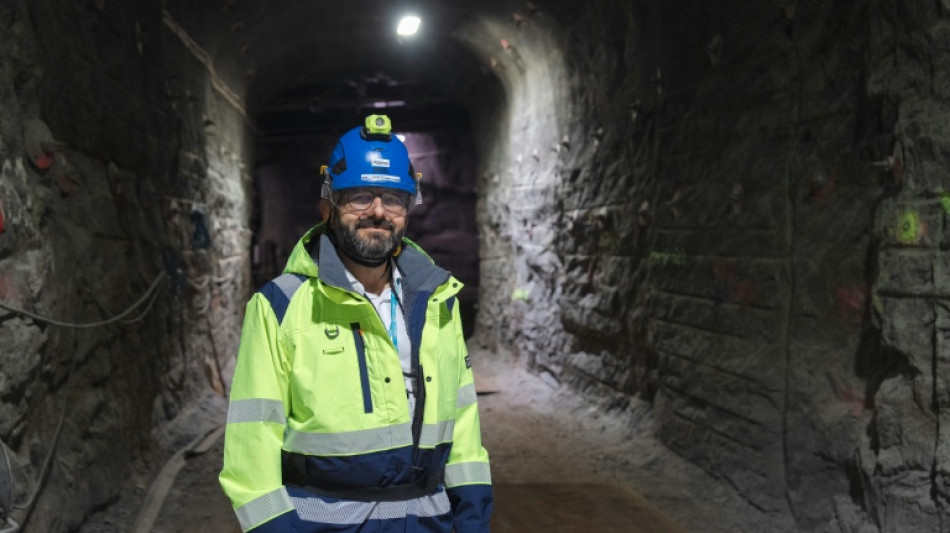
The elevator display reads "433", the number of metres below ground. The doors slide open, revealing the entrance to what is expected to be the world's first permanent repository for radioactive spent nuclear fuel.
Blasted into 1.9 billion-year-old stable bedrock in Eurajoki, southwest Finland, the geological repository for spent nuclear waste -- dubbed Onkalo which means "cave" in Finnish -- is nearly ready to start operations.
Countries have been wrestling with what to do with dangerous nuclear by-products since the first plants were built in the 1950s. Currently, most of it is in temporary storage.
Final repositories are being built in other countries, including neighbouring Sweden and France, but Finland is expected to be first to open an underground storage solution.
The Finnish Radiation and Nuclear Safety Authority (STUK) is due to give approval in its final assessment in June, after which an operating licence can be granted.
"We hope we can start the operation either at the end of this year or most probably at the beginning of next year," said Philippe Bordarier, chief executive of nuclear operator Teollisuuden Voima Oyj (TVO).
His voice echoed in the damp tunnel where the spent nuclear fuel will be buried in holes drilled into the bedrock, where it will remain harmfully radioactive for thousands of years.
The waste currently cooled in water pools at an interim storage site, at the nearby Olkiluoto power plant next to the Baltic Sea, will be first to be deposited, Bordarier said.
With space for 6,500 tons of uranium, Onkalo is aimed at providing permanent storage for spent fuel from Finland's five nuclear reactors -- three of them located in Olkiluoto.
Nuclear waste management company Posiva began building the site in 2004, with the cost now estimated at one billion euros ($1.16 billion).
- 'Forever'-
Spent fuel is planned to be deposited in Onkalo's massive network of tunnels for 100 years but operations may be extended if new nuclear reactors are built.
Subsequently, the vault will be sealed to provide safe storage for at least 100,000 years.
"Basically, it needs to be safe forever," noted Lauri Parviainen, a Posiva chemist who showed reporters around the facilities.
The fuel will be highly radioactive for "tens of thousands of years", he said.
After 100,000 years, they will be "about the same level as the uranium ore of which the fuel is made."
Above ground, the spent nuclear fuel will be encapsulated in highly corrosion-resistent copper canisters.
The canisters will be lowered into holes drilled in the tunnels, before the holes are filled with bentonite clay to seal them, Parviainen explained.
"So if the bentonite stays in place, we are safe," he said.
Once each 300-metre-long disposal tunnel is filled, it will be sealed with a steel-reinforced concrete plug.
- Long-term risks -
Jarkko Kyllonen, an expert on nuclear safety at Finland's nuclear regulator STUK, has assessed risk scenarios for the Onkalo project stretching up to a million years into the future.
Considering the "hazard potential of the waste, the first 10,000 years are very important for keeping the capsules intact," he told AFP.
The main long-term risks are corrosion of the copper canisters or earthquakes during future ice ages, which could potentially damage the capsules and cause radioactive fuel to leak, Kyllonen said.
But the results of various risk assessments conducted over the years have been "positive".
While France's plans for a similar underground nuclear tomb have met with strong opposition, Onkalo has received broader backing in Finland.
There was some opposition locally when the plans were first introduced in the 1970s, but "people have gotten used to it and they trust the assessments made by STUK", Matti Kojo, social sciences professor at Lut University, told AFP.
"At the moment, support for nuclear power is at a historically high level in Finland," he noted.
The Finnish Association for Nature Conservation remains critical of the project, however, insisting that nuclear waste poses a long-term, serious risk.
"No one can guarantee the safety of Onkalo for thousands of years," director Tapani Veistola told AFP in an e-mail.
- Finland's nuclear push -
Under Finnish law, nuclear waste produced in Finland has to be deposited in the country, Climate and Environment Minister Sari Multala told AFP.
"Before the legal change in 1994, the spent nuclear fuel was exported to, for example, Russia," she said.
Increasing nuclear power in Finland has been a priority for the right-wing government, and the country is considering building so-called small modular reactors (SMRs).
How the spent nuclear fuel from future SMRs would be managed "has not been decided yet," Multala said. An assessment should be completed by March next year, she added.
(K.Müller--BBZ)