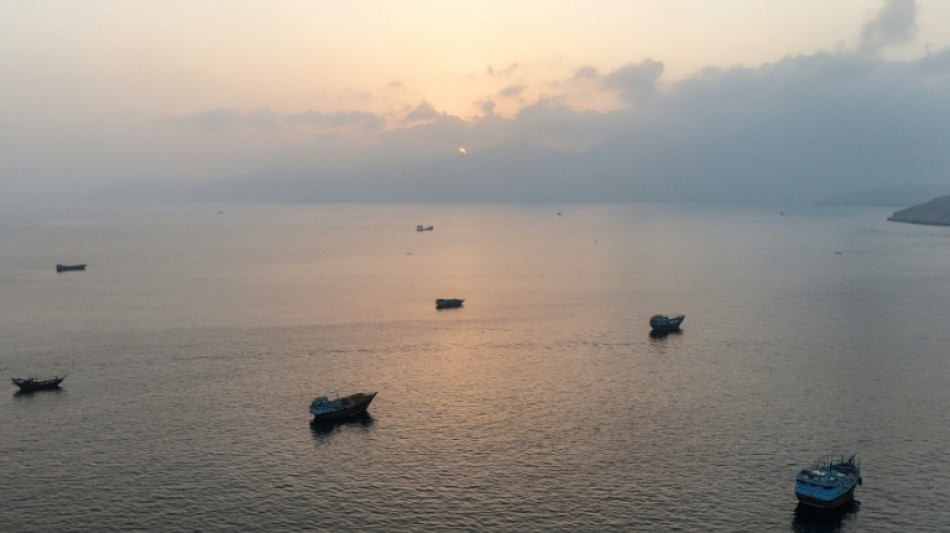
Indian sailors fear returning to Gulf after Middle East war / Photo: - - AFP

Indian sailors shaken by war have finally cleared the Strait of Hormuz after being stranded there for months, but some fear they have little choice but to return to make a living.
The country is one of the largest contributors of sailors to merchant shipping, sending out hundreds of thousands of seafarers to work worldwide.
Thousands of Indian sailors have left the Gulf since the war began, including more than 3,600 aided by the South Asian nation's shipping ministry.
But during the conflict between the United States and Iran, commercial shipping in the Gulf became a target, and some Indian mariners saw their vessels attacked and their shipmates killed or wounded.
Many who have since made it out remain apprehensive despitean interim deal to end the war, as sporadic violence has continued and traffic through the Strait of Hormuz remains a flashpoint.
Thirty-one-year-old Sitaram Tandel, from a small fishing village in India's Gujarat state, saw the danger at first hand while aboard a Marshall Islands-flagged bulk carrier.
In March, another vessel owned by his company, the crude tanker Safesea Vishnu, was attacked, killing an Indian crew member.
Weeks later, Tandel's own vessel was hit by a strike.
"Our luck ran out," he said. "It was early morning, I was getting ready for my shift when we were struck."
The crew escaped physically unharmed, and he said his family was "relieved" he was back home safely.
"No one died, but the entire crew slipped into depression after that. It was a life-changing experience, unimaginably scary," he said.
"I don't know what lies next. The attack has left me shaken and too scared to go back to the Gulf, but I also have a family to feed."
- Escape in the dark -
More than 320,000 Indian sailors were working in global merchant shipping in 2025, according to the shipping ministry.
After initial US-Israeli strikes on Iran in February, Tehran effectively blockaded the Strait of Hormuz, and ships passing through the wider region risked becoming military targets.
In June, an American strike on a Palau-flagged vessel off Oman killed three Indian sailors, and attacks on two other Indian-majority crewed ships left dozens more in need of rescue.
Indian Prime Minister Narendra Modi later raised the strikes with Donald Trump, urging the US president to ensure the safety of civilian mariners.
For sailors, sailing through Hormuz meant taking extraordinary risks.
Ratheesan Kuttiyan, 45, from the southern Indian state of Kerala, joined a Marshall Islands-flagged cargo vessel in March, waiting to depart from the Gulf.
"The previous crew refused to cross," he said. "We tried hard to cross, but the fighting was too intense, and another vessel from the company was attacked."
When hostilities eased, crew members were asked to sign documents confirming they were willing to undertake the voyage.
"Finally, in the dead of the night we sailed through the danger zone," he said, speaking to AFP via telephone at sea.
Kuttiyan said he would return to the Gulf only if conditions improve.
"I will go back if the risk goes down," he said. "I trust my company to take the right call."
Haridas Puthiyakodi, 49, also from Kerala, was on a Marshall Islands-flagged cargo ship heading towards Hormuz, when the ship ahead came under attack. His ship turned back to Abu Dhabi.
"I didn't tell my wife I was in the war zone," he said, speaking back in India.
"Now that she knows finally, she says I should never go to the Gulf.
"If I had my way, I wouldn't either-- but then, I know as a seafarer, you have to sail everywhere."
- 'Never going back' -
Veteran seafarer Tanel Hirenkumar Praveenbhai, 42, has spent more than two decades at sea and sailed through the Strait of Hormuz countless times, carrying oil from the Gulf to China and Singapore. The war has changed his outlook.
He was one of thousands of Indians among the estimated 20,000 seafarers stranded by the blockade, having joined the crew of a Panama-flagged oil tanker in Dubai in February.
"Two days before we were about to head to Singapore, the war broke out," he said.
"A helicopter crashed just 10 to 15 metres from our vessel, and several missiles also passed at a short distance."
The crew received orders not to move, and remained at anchor for nearly three months.
"Of course we were scared, but there was nothing we could do," he said. Movement resumed only after the ceasefire, and the vessel left on May 29 via Dubai, where he signed off.
"I am never going back to Hormuz again," he said. "No money is worth more than my life."
(T.Renner--BBZ)