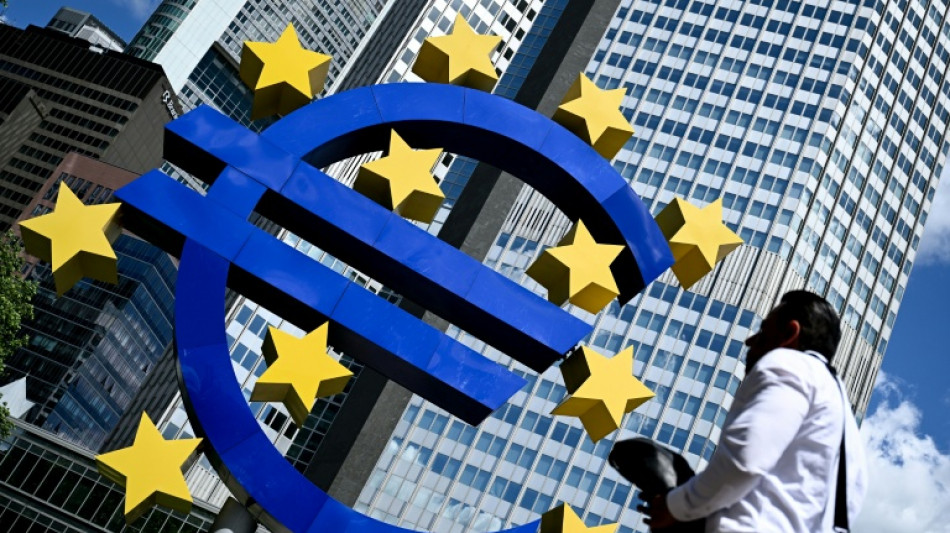
New Mideast fighting puts eurozone rate-setters on alert / Photo: Kirill KUDRYAVTSEV - AFP

Fresh fighting in the Middle East and rising oil prices have put the European Central Bank on alert ahead of its rate-setting meeting on Thursday.
Two weeks of renewed conflict between Iran and the United States have once again slowed traffic through the Strait of Hormuz to a trickle, restricting energy exports on a waterway that in peacetime carries about a fifth of the world's oil and natural gas.
The ECB in June became the first major central bank to raise rates after the near total closure of the strait, putting rates up a quarter of a percentage point to 2.25 percent.
The memorandum of understanding signed last month by Washington and Tehran raised hopes of a durable solution to the conflict but the resumption in fighting has sparked fears that eurozone inflation -- which in June eased to 2.8 percent -- might pick up again.
"Energy prices have reversed the decline that followed the signing of the memorandum of understanding between the US and Iran, making the benign inflation data for June an 'old' piece of information," UniCredit analysts said Monday.
"The looming risk of military escalation, oil inventories substantially below pre-war levels and intensifying pressure on natural gas prices imply with near certainty that the Governing Council will continue to view risks to price stability as skewed to the upside," they added.
- Wait-and-see -
Rising energy prices can give rise to so-called stagflation, a nightmare combination for central banks of stagnant growth and high inflation.
If central banks cut interest rates to boost growth during a period of stagflation they run the risk of further aggravating inflation.
But if they raise interest rates to tame inflation they risk slowing growth further.
Some economists criticised the ECB's move in June as heavy-handed, drawing parallels with rate-hikes in 2011 that some blame for choking off a nascent eurozone recovery after the Great Recession.
Most observers expect the ECB to keep its powder dry on Thursday and pause for now whilst it waits to see the outcome and duration of the latest fighting.
"We don't expect any change to interest rates at this meeting," Berenberg bank senior economist Felix Schmidt told AFP.
Oil prices had not jumped too sharply, he said, while there were no major signs of knock-on effects in the eurozone, such as higher inflation seeping through to a wider range of goods and services.
- Geopolitical effects -
While also considering a hold the most likely outcome, ING economist Carsten Brzeski said there was nevertheless a small possibility the ECB could raise rates, pointing out that renewed hostilities had pushed oil prices back up to where the ECB had assumed they would be in its baseline scenario.
That forecast sees inflation overshooting the ECB's two-percent inflation target this year and next.
"Very little sign of indirect or even second-round effects should have taken away the urge to hike policy rates further," Brzeski said.
"Still, the ECB's base case scenario will be a clear argument in favour of yet another rate hike."
Heavily dependent on imported oil and gas, Europe can expect inflation to lift off if energy prices soar -- leaving eurozone monetary policy largely at the mercy of fast-moving geopolitical events.
"I do not know what we will have to do in our July meeting," German Governing Council member Joachim Nagel said earlier this month.
"Is there a probability that we will have to hike more? Maybe. Is there a probability that we have to stay where we are? Maybe, or maybe we have to do other things."
(S.G.Stein--BBZ)