'Don't have to hide': Thai IDs, legal work give hope to Myanmar refugees / Photo: Lillian SUWANRUMPHA - AFP

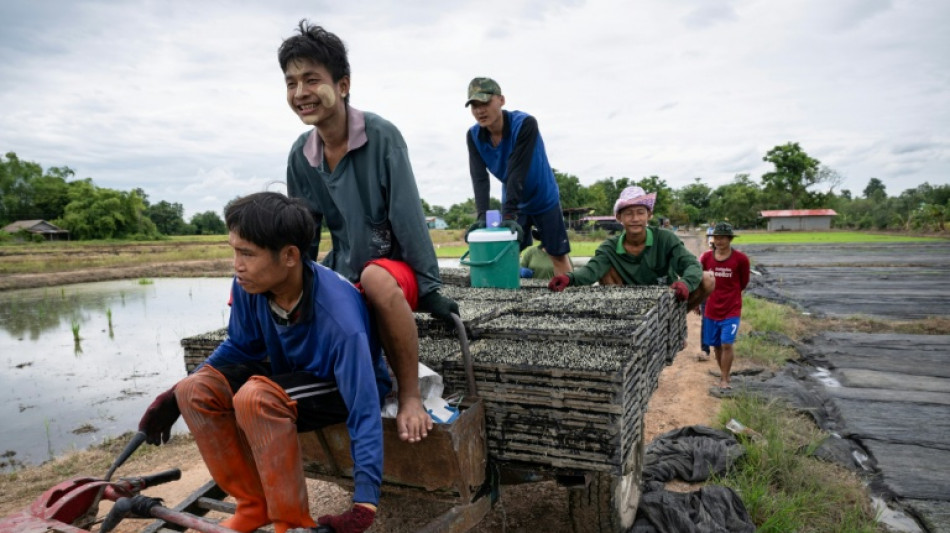
Next to a mound of black earth, Myanmar refugees feed soil and rice seed into a clacking conveyor machine that arranges them into ready-made planting trays for Thai farms.
The farmworkers are among their Thai boss's newest employees, with a fresh sense of job security after Thailand began permitting Myanmar refugees living in camps to work legally and granting them non-citizen identity cards.
"I do not tire from the work. I can do it," Ney La Jaw, 25, told AFP.
He spent much of his life confined to the Mae La refugee camp, the largest of nine temporary shelters along the border with Myanmar, according to the United Nations.
But he now lives and works more than 200 kilometres (124 miles) away on a farm in Thailand's Nakhon Sawan province, earning around 3,000 baht ($90) per week -- a life-changing sum for many refugees.
"I send all of my money home to my mom" in the camp, he said.
After decades of being barred from leaving the camps and working legally, Myanmar refugees and their children began receiving non-citizen Thai ID cards in June, a step away from statelessness and towards gainful, legal employment.
About 4,600 people from Myanmar living in camps have sought permission to work legally from October 2025 to July this year, the Thai interior ministry said.
They are a fraction of the about 80,000 people who have fled conflict-torn Myanmar and live in the camps, according to UN figures.
Myanmar migrants have long toiled in neighbouring Thailand, but the country's civil war, triggered by a 2021 military coup, has sent even more fleeing across the border.
Myanmar's leader, ex-junta chief Min Aung Hlaing, arrived in Bangkok on Thursday, with the two nations signing an agreement on labour cooperation.
- 'My own future' -
In Prachinburi province, AFP journalists saw 15 displaced people collect their new ID cards at a district office in July, smiling and taking photos of the pink documents to send to their families.
"After getting the card, I don't have to be afraid anymore when travelling around," said Gay Lah, a Myanmar refugee who fled to a Thai camp with her family at the age of six.
She said her job as a scaffolder was tiring but going smoothly.
"I want to work hard, save money, buy a place, build a house and then bring my family out of the camp, that's what I imagine," she added.
Sit Nyein Aye also fled Myanmar as a child and lived most of his life "in misery" in another border camp.
Being allowed to work in construction and having an ID card gave him the chance to start fresh.
"Since I have the opportunity, I'm going out to work," the 27-year-old said. "I have my own future."
- 'Self-reliance' -
The UN refugee agency (UNHCR) welcomed Thailand's move to issue ID cards in June, calling it a "landmark step towards inclusion, protection and self-reliance for one of the world's most protracted refugee populations".
Thailand's porous borders and reputation for religious and cultural tolerance have long drawn those seeking sanctuary, but Bangkok does not legally recognise refugees or offer asylum.
However, the government began authorising legal employment for longstanding refugees last year, with more than 5,500 refugees joining the workforce since October, UNHCR said in June.
Phil Robertson, director of Bangkok-based Asia Human Rights and Labour Advocates, said the shift was a "huge step forward" and "long overdue".
"With these so-called 'pink cards', the refugees can access health and other services, work to support their families, and enjoy greater freedom of movement," he said.
- Peace of mind -
At the farm in Nakhon Sawan, owner Manas Lohsuwan said he had previously hired Cambodian migrants.
But since deadly border clashes between Thailand and Cambodia broke out in July last year, hundreds of thousands of Cambodian workers have returned home, leaving Manas short of labourers.
While Manas said Cambodians had more skills and experience than Myanmar refugees, the latter were cheaper to employ and required to stay with the same employer.
"If they do not want to work with us, they have to return to the camp and wait to be recruited again," he said.
For 29-year-old Ko Ko Oo, who was born and grew up in a Thai refugee camp, an ID card provides more than permission to work and earn a higher income.
It has also granted him peace of mind, especially when officials come around checking workers' papers, he said.
"I do not have to hide."
(S.G.Stein--BBZ)