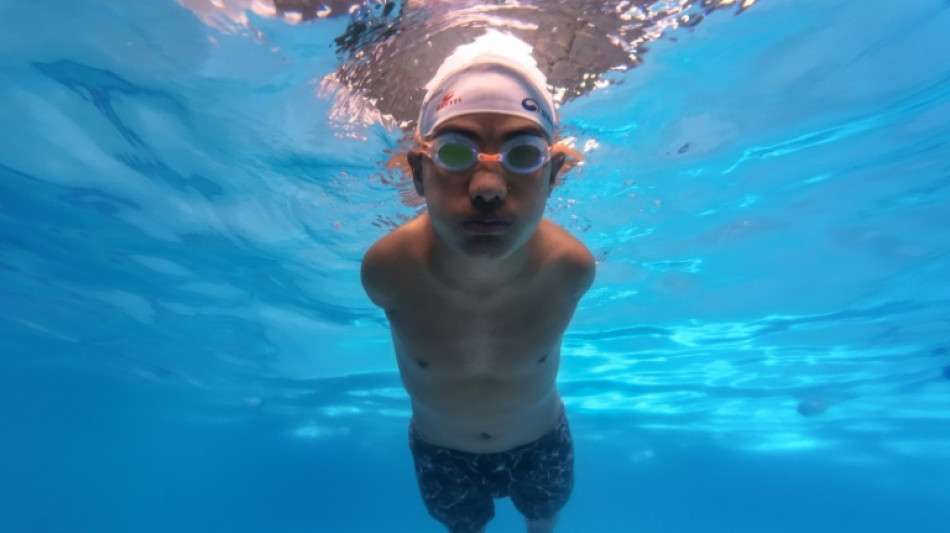
'His feet are his pillars': Nepal para swimmer gives all for Asian glory / Photo: Prakash MATHEMA - AFP

Every morning Harka Man Gharti slices into the blue water of a swimming pool in Nepal's capital Kathmandu, chasing a dream that stretches far beyond its 25 metres.
Unlike the swimmers around him who rely on long strokes of their arms, Gharti powers through his legs and torso because he does not have arms.
The 21-year-old is training with three other disabled swimmers who will represent Nepal in the Asian Para Games in Japan in October, chasing medals despite limited resources in the Himalayan country.
"It is not my hope, it is my target," Gharti told AFP after finishing a gruelling session. "Just for a medal, I am giving everything... every possible thing."
A decade ago an electrocution accident near a hydroelectric project in his native Baglung district in western Nepal changed his life forever, costing him both arms.
The tragedy that could have ended his ambitions instead helped forge his extraordinary determination.
What began as an experiment with competitive swimming in 2020 soon became a passion and a career pathway.
"I love everything about swimming, whether competitive or just for enjoying," he said.
At the hostel where he lives in Kathmandu a row of medals hangs above his bed, proof of a remarkable journey.
During training he concentrates on his technique and body position in the water. On race days a different instinct takes over.
"I don't really think about the techniques or my body alignment," he said. "I just go hard. I just push fast and I just want to push power. That's it. I just think about speed and for speed I just kick harder and harder."
- Leg power -
At last year's Para Swimming World Series in Japan, Gharti's times met the minimum qualifying standards for the Asian Para Games, earning him a chance to compete on one of the biggest sporting stages.
He will participate in the S5 classification, including the 50-metre freestyle.
China's Guo Jincheng holds the men's 50m freestyle record at 29.33 seconds in the category.
Sports facilities in Nepal are modest by international standards.
Para athletes in the country often face limited funding, scarce specialised infrastructure and a lack of competitive opportunities.
His coach, Subha Shrestha, believes Gharti's greatest strength lies not in what he has lost, but in what he has built.
"When we don't have even a single finger we feel the impact," Shrestha said. "But he is working so hard with no hands.
"His feet are his pillars, his legs are very powerful."
The wider significance of Gharti's quest is not lost on Nepal's para swimming community.
The nation has had only one Asian Para Games medallist, taekwondo athlete Palesha Goverdhan, who won bronze last time out before also claiming a medal in Paralympics.
For many years Nepali athletes have arrived at major competitions with modest expectations.
"In Nepal they often say that we go only for the sake of participation," said Saroj Shrestha, president of the National Para Swimming Association of Nepal.
"But Harka and we both dream to do something in swimming that even able-bodied athletes have not been able to achieve."
- Inspiring others -
Back on the pool deck, Gharti's ambitions extend beyond sport.
Having recently completed high school, he plans to study computer science.
He navigates a computer with his toes, displaying the same determination that has become central to his swimming.
"Swimming is a platform for me where it is on me whether I can make my life better or not.
"Because if I hit a world record then of course my life will be better," he said.
"Only then can I speak of inspiring anyone else."
(L.Kaufmann--BBZ)