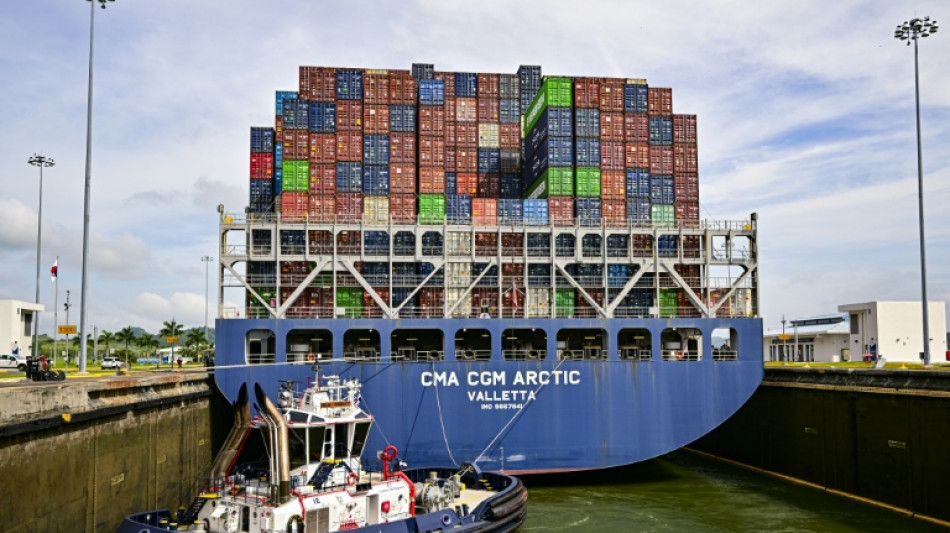
How El Nino is choking the Panama Canal / Photo: MARTIN BERNETTI - AFP

The Panama Canal will restrict the number of vessels transiting the crucial waterway from Friday for the second time ever due to drought caused by the El Nino climate phenomenon.
Five percent of global trade passes through the canal that connects the Pacific Ocean with the Atlantic.
The waterway is set to reduce daily traffic from 36 to 32 ships a day in an effort to conserve water amid a severe drought likely to last until mid-2027.
Canal authorities are also reducing the permitted draft of vessels -- how deep they sit in the water -- from 15.24 to 14.63 meters.
Panama has declared an emergency over El Nino, which raises surface temperatures in the central and eastern equatorial Pacific Ocean and causes global changes in winds and rainfall as well as erratic weather conditions.
The canal's incoming administrator Ilya Espino de Marotta has acknowledged the current "challenging" conditions.
- Nothing without water -
The 80-kilometer (50-mile) canal draws on freshwater that comes mainly from rainfall and is stored in artificial lakes.
Without water, its locks that lift and lower ships at the beginning and end of the journey would not function.
Each transiting ship requiers about 200 million liters of water, which is then discharged into the sea.
Water "is the most important resource for operations," but "between April and August the accumulated rainfall deficit was 35.8 percent below the historical average," the canal's water manager Erick Cordoba told AFP.
And there are "no signs of recovery in the short term," Cordoba added.
- 'No signs of recovery' -
Forecasts indicate that the 2027 dry season, normally between January and April, will start a little earlier than usual and extend into May.
In 2023 and 2024, El Nino forced a reduction in daily transits to 22 and the maximum draft to 13.41 meters.
That led to 20 percent fewer vessels and a 17 percent drop in tonnage, not to mention longer lines of ships queuing up.
Further restrictions could follow those imposed on Friday.
"If we don't manage to fill the lakes in November, we're going to have to tighten our belts," former canal administrator Jorge Quijano told AFP.
- Worldwide repercussions -
Long-lasting restrictions will lead to "higher shipping costs and longer waiting times" and therefore higher prices for consumers, Rebecca Bill Chavez, president of the Inter-American Dialogue, told AFP.
A ship loses around 200 containers for every 30-centimeter draft decrease, according to Quijano.
That amounts to hundreds of units for large vessels that can carry up to 16,000.
"We're going to see a significant impact on the container sector," which is the canal's biggest source of revenue, he said.
But Danish shipping company Maersk believes it is still "too early" to "speculate" about the impact.
The route mainly connects China, South Korea and Japan with the United States -- the origin or destination of seven in ten containers that pass through the canal.
Rising costs could "potentially affect US trade," said analyst Natasha Lindstaedt of Britain's University of Essex.
If he wanted to, US President Donald Trump could argue "that trust and reliability in the channel have been lost," Lindstaedt said.
The US-Israel war on Iran has pushed up traffic in the Panama Canal given the standstill the conflict caused in the Strait of Hormuz, through which around a fifth of the world's oil and gas normally travels.
The difficulties on both routes "put real pressure on global supply chains," noted Bill.
- Future-proofing -
The canal authority plans to build a new 4,600-hectare reservoir on the Indio River to the west as a way to limit the effects of future droughts on operations.
But this project would not be ready before 2031.
The canal's watershed also supplies drinking water to half of Panama's 4.6 million inhabitants via infrastructure that was designed almost a century ago.
(U.Gruber--BBZ)