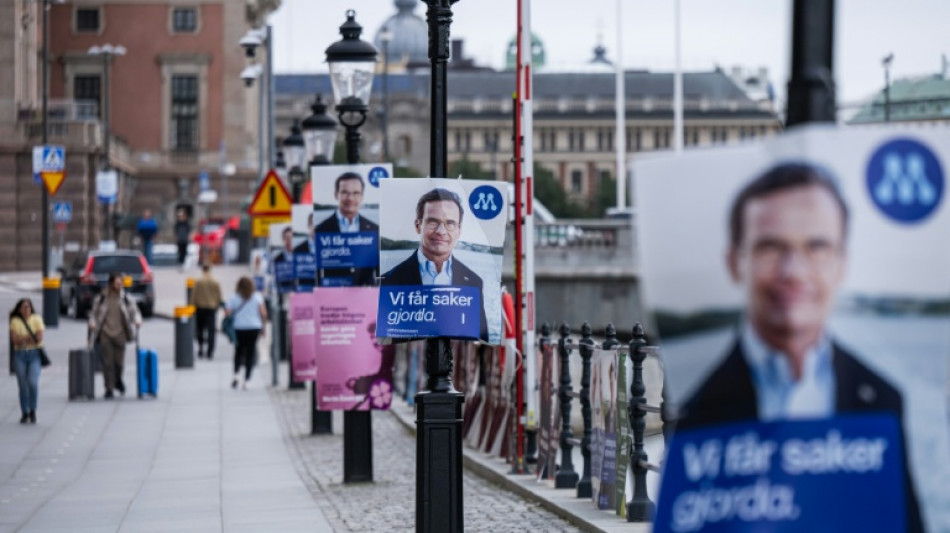
Sweden immigration restrictions spark healthcare concerns / Photo: Jonathan NACKSTRAND - AFP

A dramatic tightening of Sweden's migration policy has sparked concern in a healthcare sector that is ever more dependent on immigrants, professionals warned ahead of a general election on Sunday.
"I'm the only one born in Sweden here today. The rest are born abroad," said Johanna Bjorkman, a nurse at the NU Hospital Group in the southern city of Trollhattan.
"There wouldn't have been any operations without them," she told AFP outside the operating room in the cardiology department.
Davood Javid, a senior specialist in the department, explained that three out of four of the 20 doctors working at the cardiology unit were born abroad.
Nationally, 37 percent of specialist doctors were born abroad, according to the Swedish Association of Local Authorities and Regions (SKR), while over half (53 percent) of nursing assistants were.
Following a large influx of asylum seekers in Sweden in 2015, successive left- and right-wing governments have tightened asylum and immigration rules.
Originally from Iran, Javid first arrived in Sweden in the 1980s. He said he and his colleagues all felt the change.
"The tone has hardened in Sweden, and the debate has become highly polarised," he told AFP.
Doctors and specialised nurses often earn enough to meet Sweden's new, higher income requirements for work permits, but nursing assistants, elderly-care workers and adult children of healthcare workers in many cases do not.
Javid started speaking out publicly after his nephew's two daughters, aged 21 and 24, were deported, having lived in Sweden for eight years while studying to become nurses.
- Families 'torn apart' -
The case received national attention as an illustration of what became known as "teenage deportations" -- when people who came to Sweden as minors with their parents are deported as adults because they cannot meet the income requirements.
Javid said decisions like these also leave parents who work in the health sector questioning whether to stay in the country when their children are deported.
"The individual loses out, the family is torn apart, and society pays the price for this," he told AFP.
He complained that the migration debate was too focused on criminality and not what "immigrants had contributed to society".
Bjorn Jarbur, director of the hospital, told AFP at least one employee had left after their child was deported.
He said losing competent colleagues was a problem at a time when a lack of qualified staff was more pressing than a lack of funds.
"Today, it's not money that's the limiting factor, it's finding employees with the skills we need," Jarbur said.
"If, for example, we had been able to recruit more nurses, then we would have been able to have more beds open," he explained.
In Sweden's last election in 2022, Prime Minister Ulf Kristersson's coalition came to power via an alliance with the anti-immigration Sweden Democrats, vowing to crack down on immigration and crime.
- Electoral stakes -
In the general election on September 13, opinion polls show that healthcare is the top concern among voters.
Polls have for months pointed to a victory for the centre-left opposition headed by the Social Democrats, but the gap has narrowed in recent weeks.
On the campaign trail, Sweden Democrats leader Jimmie Akesson told AFP he was not convinced by the argument that the lack of labour in healthcare meant that the migration policy needed to be relaxed.
"What people often forget in that discussion is that those who immigrate to Sweden also have needs when it comes to welfare, healthcare, and social care," Akesson told AFP after a press conference.
"Statistically, they often have greater needs than those born in the country," Akesson added.
Tommy Moller, a professor of political science at Stockholm University, told AFP however that he had noted a shift heading into this year's election.
Moller said attention to the "teenage deportations" had led the government to "change its position".
In June, the government along with the Sweden Democrats, among other measures, raised the age at which the children of migrants would be considered adults from 18 to 21.
He also noted that parties like the Centre Party and the Green Party were actively saying Sweden needed more immigration in their campaigning.
"They are raising these issues. It hasn't really been opportune to do so before, because public opinion has been so critical of immigration," Moller said.
(G.Gruner--BBZ)