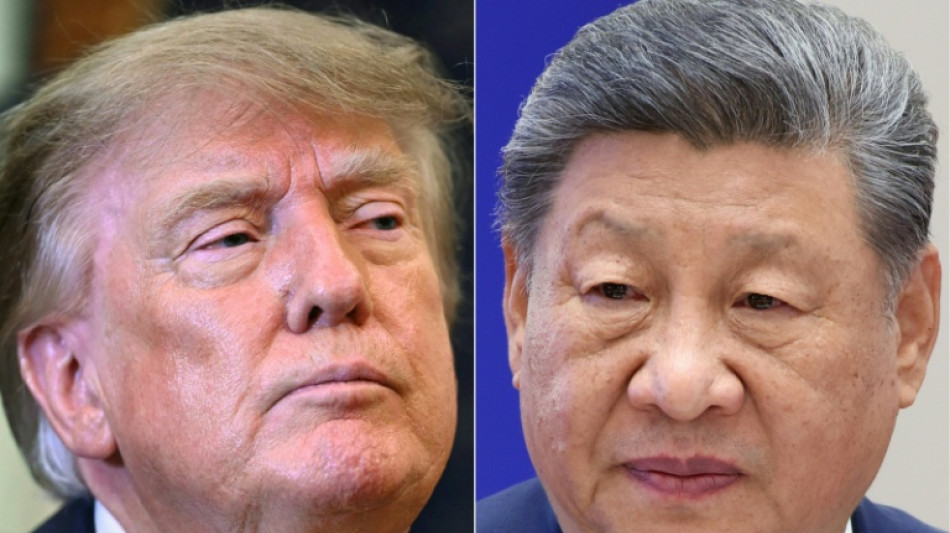
Where the US-China tariff row stands ahead of White House summit / Photo: Kent NISHIMURA, Peter KOVALEV - AFP/File

Trade frictions between the world's top two economies are set to take centre stage next week when US President Donald Trump hosts Chinese counterpart Xi Jinping at the White House.
Although a shaky truce was reached last October that halted the frenzied escalating tariff battle launched by Trump, a comprehensive and permanent deal has remained elusive.
Here is where things stand ahead of the summit, which is expected to take place on September 24:
How high are current levies?
Tariffs have represented a major hurdle in the China-US trade relationship since 2018, during Trump's first term.
In April 2025, the base US tariff rate on Chinese goods reached an eye-watering 145 percent -- matched by China's reciprocal levies of 125 percent -- although both sides have since significantly reduced rates.
Tolls are now imposed by both sides in a complex patchwork of sector-specific policies.
The effective tariff rate for imports from China, which balances various duties paid across all items, was 22.8 percent as of July, the highest among all major US trading partners, according to research organisation the Penn Wharton Budget Model.
Among the highest effective tariff rates for Chinese goods heading to the United States are 40.5 percent on steel and aluminium, it said.
China still maintains a 10 percent levy on all US goods, with additional rates applicable in other specific sectors, such as 15 percent on liquid natural gas.
How much is still being traded?
Trade between the world's two largest economies has continued despite the turbulence caused by the tariffs.
Total imports and exports hit $400.8 billion in January through August this year, Chinese customs data shows, a 5.4 percent rise from the same period in 2025.
But the balance is lopsided, with Chinese exports accounting for 75 percent of that.
Beijing's soaring trade surplus has long ruffled feathers in Washington, while a similar asymmetry with the European Union is also exacerbating tensions with Brussels.
What is being discussed?
Trump told reporters on Sunday that he would be discussing "almost everything" with Xi at the summit.
Tariffs, however, are "the main issue on the agenda", Dan Wang, a director on Eurasia Group's China team, told AFP. "Xi wouldn't go if there were no deliverables on tariffs or a trade truce," she said.
Beijing and Washington are currently in consultation about a tariff reduction framework covering $30 billion worth of products on each side, China's commerce ministry said last week.
That goal was agreed at Xi's last meeting with Trump in Beijing in May, during which they also agreed to establish trade and investment councils intended to manage friction.
US Treasury Secretary Scott Bessent said Tuesday that he will meet his Chinese counterpart He Lifeng this weekend for talks expected to lay the groundwork for the White House summit.
What is China's leverage?
Beijing successfully pressured Washington to back down from its sky-high tariffs last year after imposing stringent controls on exports of rare earths, the critical minerals used for various high-tech products whose processing is dominated by China.
"China still has the upper hand" going into next week's talks, said Wang of Eurasia Group.
The country's supply chains are "very flexible", and its historic boom in exports has not been significantly dented by tariffs so far, she noted.
Xi's diplomatic clout has also been on full display recently, having met this month with several leaders including Russian President Vladimir Putin and Indian Prime Minister Narendra Modi, traveling to Bishkek, Cairo and New Delhi.
What is Trump seeking?
With global oil prices spiking following renewed fighting in the US war with Iran, the Trump administration is looking to allay concerns about the economy ahead of crucial midterm elections in November.
Securing Chinese guarantees to purchase US agricultural goods, particularly soybeans, has been a recurring objective in trade talks with Beijing.
The meeting will also give Trump the chance to project statesmanship while hosting a high-stakes diplomatic engagement at the White House -- Xi's first visit to the US capital in 11 years.
What are other potential pitfalls?
Several other fraught issues threaten to derail any sweeping agreement.
Beijing's economic and diplomatic support for Tehran is one major sticking point, with recent reports by the Wall Street Journal claiming that Chinese entities supplied Iran with satellite imagery of a military base housing US troops in Jordan.
Fierce technological competition is also ongoing, particularly in the closely watched artificial intelligence sector.
The US government last week accused Chinese AI labs of stealing the capabilities of US firms on an "industrial scale".
(G.Gruner--BBZ)