Global rates and foreign outflows remain key risks for Indian markets

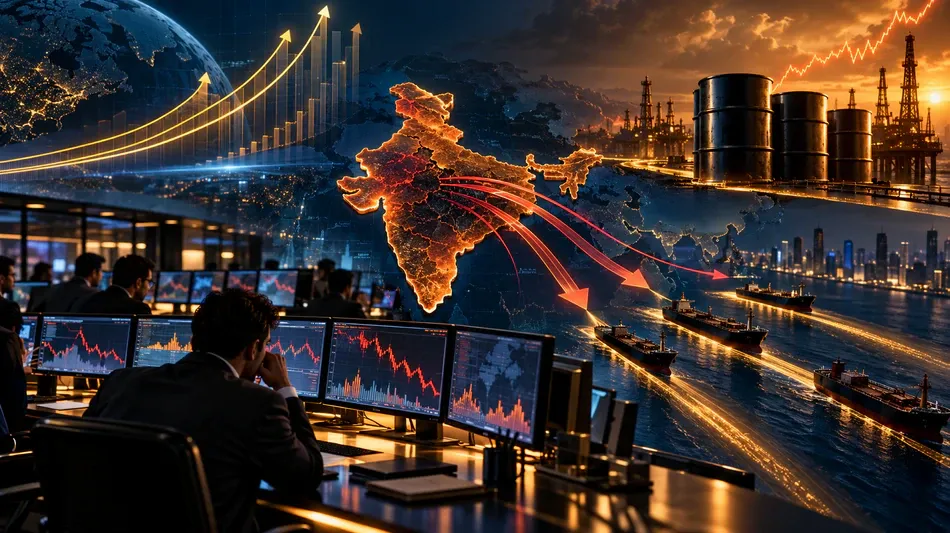
High global interest rates, elevated oil prices and capital outflows driven partly by investments in artificial intelligence (AI) are likely to continue weighing on Indian financial markets, according to experts speaking at the Business Standard BFSI Insight Summit 2026.
High global interest rates, elevated oil prices and capital outflows driven partly by investments in artificial intelligence (AI) are likely to continue weighing on Indian financial markets, according to experts speaking at the Business Standard BFSI Insight Summit 2026.
Speaking to Business Standard's Anjali Kumari at a panel discussion on ‘Navigating the rate cycle and a volatile bond market’, Aditya Bagree, head of markets at Citi India and the Indian Subcontinent, said high oil prices, foreign portfolio investor (FPI) outflows and changes in hedging behaviour among importers and exporters were contributing to the rupee's weakness.
“Global oil prices have stayed high for longer than most people expected. We are a very large importer of oil and energy, so this affects us negatively. I think the current basket costs us almost $120,” Bagree said.
He said India had run a current account deficit (CAD) in the past, but positive capital flows had helped offset it. However, global funds chasing AI investments had contributed to significant FPI outflows from Indian equities. “Over the last two years, there have been almost $60 billion of equity outflows from FPIs. Even in the last two months, there have been almost $10 billion of outflows,” he said.
AI investments add to capital flow challenges
Shailendra Jhingan, head of treasury and economic research at ICICI Bank, said the growing demand for capital to fund AI investments was adding to the challenges faced by emerging markets. “To me, AI is a bigger challenge than oil prices in today's world,” Jhingan added.
He said governments in the US and France were borrowing heavily against a backdrop of high fiscal deficits, pushing up yields. Markets were also expecting AI-related borrowing to continue. While AI could support productivity and economic growth, emerging markets had experienced significant capital outflows, which could continue unless oil prices declined.
Bagree said foreign investors remained cautiously optimistic about Indian equities. “What investors will wait for is earnings growth in India that justifies valuations before coming back,” he said.
Bagree said the government and regulators were discussing the removal of capital gains tax, but India also needed to change the underlying trends affecting investment flows. Efforts to improve the ease of doing business, provide manufacturing incentives and develop investment corridors were important in this regard.
High US yields pose risks to emerging markets
Parul Mittal Sinha, head of markets for India and South Asia and co-head of macro trading for Asia at Standard Chartered Bank, said the recent rise in US yields differed from earlier episodes because it was being driven more by deteriorating fiscal conditions than by stronger growth expectations.
The US 10-year yield has reached the level of 5%, she said. “In the past, when US yields were moving higher, they were driven mainly by positive or higher growth expectations,” Sinha said. When growth sentiment was strong in the US and other economies, including India, emerging markets were better able to absorb the impact of higher US yields and continued to attract capital, she said.
“What we've seen differently in the last bout of US rates moving higher is that it is driven higher more by the deteriorating fiscal conditions in the US,” she said, adding that similar trends were visible in other developed economies, including France and Japan.
The resulting increase in term premiums, or the additional returns investors demand for holding longer-term securities, was affecting emerging markets as investors sought higher risk premiums across markets, she said.
Sinha expects India's 10-year government bond yield to move closer to 7.75-7.8% over the next three to six months if current conditions persist.
RBI measures offer rupee temporary relief
On FCNR deposit scheme, Jhingan said, “FCNR is not going to change the outlook for the rupee permanently."
He explained that the circumstances were different from 2013, when India attracted around $34 billion through the FCNR scheme. At the time, US and other global policy rates were close to zero, creating a much wider interest-rate differential in India's favour. The RBI had also raised interest rates and the government had imposed restrictions on certain imports, including gold.
This time, US interest rates were already high and oil prices had risen, making the external environment more challenging, he added.
Arup Rakshit, group head of treasury at HDFC Bank, said the RBI's foreign exchange risk (FERR) measures had helped remove some speculative positions from the market, although importers had continued hedging because the cost of the measures did not necessarily offset the benefit of a 2% appreciation in the rupee.
If the rupee stabilised around ₹94-95 per dollar, some importers might decide not to pay the premium required to hedge their exposure, potentially easing demand for dollars. However, Rakshit said the impact would emerge gradually as businesses moved through successive trade cycles.
Debt inflows may remain limited as rate hikes loom
Rakshit said he did not expect an immediate return of FPI money to the debt market, given expectations of further rate hikes in India. He said at least another three to four rate hikes were expected, and the market would need time to stabilise.
On corporate debt, Rakshit said elevated borrowing rates for highly rated issuers could prevent lower-rated companies from entering the market. Although rates had eased somewhat, liquidity had also been withdrawn, and the impact of geopolitical volatility would take time to become clear.
Jhingan said around 60-65% of loans were linked to external benchmarks, largely repo rates, while deposits tended to carry fixed rates. This created a hedging challenge for banks.
He said banks could switch to alternative instruments because a basis swap was not available on the repo rate. If a secured overnight rupee rate (SORR) developed and banks shifted to it, basis swaps would be needed to hedge the associated risks.
Jhingan added offshore borrowing costs were high compared with onshore rates, while liquidity constraints could increase risks in the corporate bond market. However, he did not expect government bond spreads to be affected aggressively.
Tokenisation of financial markets
The panellists also discussed the potential of tokenisation to improve financial market transactions and the delivery of government benefits.
Sinha described the tokenised corporate bond issuance in September as a landmark event. The RBI and the Securities and Exchange Board of India (Sebi) had introduced the Demat 2.0 initiative, under which corporate bonds issued by three institutions used distributed ledger technology (DLT), with settlement through central bank digital currency (CBDC), or the wholesale e-rupee.
She said wider adoption would require greater acceptance of digital cash and the ability to transfer collateralised assets more seamlessly between investors. These developments could make secondary-market transactions on tokenised platforms easier.
Rakshit said the next steps could include moving commercial paper towards tokenisation. He also highlighted the potential of retail tokenisation to deliver direct benefits at the point of use and reduce leakages in government subsidies and other benefit transfers.
He added if a merchant discount rate (MDR) were introduced for Unified Payments Interface (UPI) transactions, digital tokenised money could gain traction because it would not incur MDR.
More From This Section
SBI wants to align growth plans with India's economic ambitions: CS Setty
FCNR(B) a strong insurance policy, but repayment risks loom: Uday Kotak
Bankers hail RBI's FCNR(B) playbook as dollar inflows surge to $12.7 bn
Expecting 50 bps rate hike in Dec, may impact credit demand: SBI chief
UPI's rising volumes need investment, minimal MDR can help: SBI Chairman
(L.Kaufmann--BBZ)