Korea’s Labor Share of GDP Hits Record Low Amid Semiconductor Boom

South Korea’s labor share of gross domestic product has fallen to its lowest level since comparable data began in 2010, hitting 41.1% in the second quarter. This decline coincides with a surge in corporate profits driven by the semiconductor industry, prompting experts to call for government intervention to address growing economic polarization.
As surging investment in artificial intelligence fuels a semiconductor boom, corporate profits in South Korea are soaring while the portion of economic output going to workers is falling to historic lows. New government figures indicate that labor’s share of the gross domestic product (GDP) dropped to 41.1% in the second quarter of this year, marking its lowest level since comparable quarterly data became available in 2010.
The analysis, conducted by the Hankyoreh using seasonally adjusted national accounts from the Bank of Korea’s Economic Statistics System, reveals a stark divergence between capital and labor income. Compensation of employees, which includes wages and employers’ contributions to social insurance programs, accounted for just 41.1% of nominal GDP in the second quarter. This represents a decline of 6.8 percentage points from 47.9% a year earlier.
Conversely, gross operating surplus—defined as income from invested capital earned by businesses and the self-employed—jumped from 43.9% to 51.9% of GDP over the same period. This marks the highest level for capital income since 2010. The gap between capital and labor shares has widened significantly; during the previous semiconductor boom of 2016-2018, the capital share never exceeded the labor share by more than 3 percentage points. In the current cycle, that gap has expanded to 10.8 percentage points.
Labor’s share had risen gradually over a 13-year period, moving from 43.2% in the first quarter of 2010 to around 48% in 2023, before leveling off. However, as the semiconductor boom gathered momentum, that share plunged 5.7 percentage points in just six months, falling from 46.8% in the fourth quarter of last year to 41.1% in the second quarter of this year.
The Bank of Korea typically publishes annual figures for labor’s share of income at the end of each year. That calculation compares compensation of employees and gross operating surplus as shares of national income while excluding depreciation of capital assets from total domestic output. For this analysis, however, the Hankyoreh calculated compensation of employees as a share of quarterly GDP, following a methodology used in earlier research by Chang Ji-yeun, a senior research fellow at the Korea Labor Institute.
Chang’s method provides a snapshot of how much of the rapidly increasing value added generated by the semiconductor industry is reaching workers. The decline in labor’s share does not indicate that wages are falling in a poor economy. Compensation of employees through June actually rose 7.9% year over year. However, labor’s share fell because of a 38.7% surge in operating surplus that drove the GDP increase.
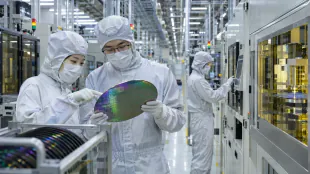
One reason for this decrease is that semiconductor manufacturing is not particularly labor-intensive. The main driver, however, is that the current boom has been fueled by a sharp increase in memory chip export prices, with most of the resulting profits flowing into operating surplus rather than wages. There appears to be little prospect of an improvement in labor’s share in the third quarter. Corporate profits rise immediately as product prices increase, but wages generally do not catch up until annual wage negotiations and performance bonuses are distributed the following year.
Labor’s share could rebound in the first quarter of next year when major semiconductor companies distribute performance bonuses. If semiconductor prices continue to rise in the meantime, the gap between capital and labor income could widen further. A more fundamental issue is that even if labor’s share rebounds early next year, those benefits may be concentrated among a narrow slice of the workforce who receive higher bonuses—specifically workers at major corporations, excluding those at their subcontractors.
According to Chang’s analysis, employees at major memory chip manufacturers earned an average of 140 million won per person in the first half of this year. In contrast, the average pay at 15 listed suppliers ranged from just 29 million to 51 million won. This disparity highlights the uneven distribution of gains within the supply chain.
In a recent report titled “Assessing the Conditions for a Recovery in Private Consumption,” the Bank of Korea predicted that purchasing power in high-income households would primarily be boosted by bonuses and dividends. In low-income households, it would largely depend on increased government transfers and a decline in the dollar’s value relative to the won.
Experts argue that a more lasting solution requires investment aimed at translating economic growth into employment and labor income. “To deal with the hiring slowdown and growing job insecurity that are being caused by artificial intelligence, investment in people must become the foundation for the next phase of growth,” Chang said. She proposed using the government’s announced Future Response Fund, which is to be financed with tax revenue generated by the semiconductor boom, to invest actively in workforce development.
Under her proposal, newly hired young workers would have an opportunity to build up their resumes, while middle-aged and older workers would take on the role of passing down their expertise and skills. Jeong Se-eun, a professor of economics at Chungnam National University, agreed about the need for government intervention.
“The profits generated by the semiconductor boom are trapped in the industry, with no trickle-down effect. There’s no way to unlock them through existing market mechanisms,” Jeong said. “We need to channel the additional public revenue generated by the boom into job creation and employment-related welfare, including unemployment benefits, vocational training for the AI transition, and more government jobs.”
With the Korean economy apparently set to post annual growth of at least 3.6% this year, experts are calling for more government investment in jobs to mitigate polarization. The data underscores the challenge of ensuring that the benefits of technological and industrial expansion are broadly shared across the workforce.
(S.G.Stein--BBZ)