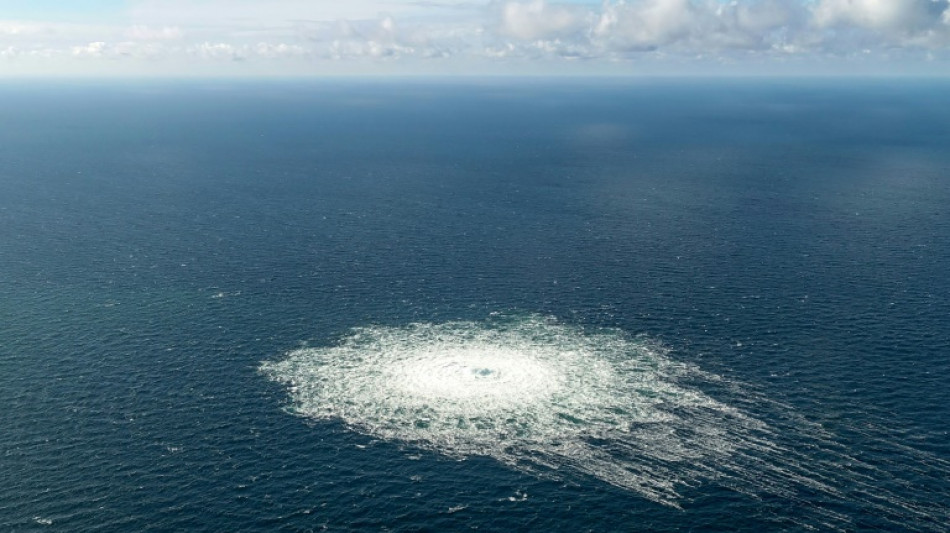
Leaders blame Russia-Europe pipeline leaks on sabotage / Photo: Handout - DANISH DEFENCE/AFP

Sabotage is the most likely cause of leaks in two Baltic Sea gas pipelines between Russia and Europe, European leaders said Tuesday, after seismologists reported explosions around the Nord Stream pipelines.
EU chief Ursula Von der Leyen said the leaks were due to "sabotage", threatening the "strongest possible response" to any deliberate disruption of European energy infrastructure.
Photos taken by the Danish military showed large areas of bubbles on the surface of the water, emanating from the three leaks in Sweden and Denmark's economic zones north of Poland, from 200 to 1,000 metres (656 feet to 0.62 miles) in diameter.
Danish Prime Minister Mette Frederiksen described them as "deliberate acts", adding: "We are not talking about an accident".
Polish Prime Minister Mateusz Morawiecki said the leaks were an act of sabotage which "probably marks the next step of escalation of the situation in Ukraine".
And Sweden's outgoing Prime Minister Magdalena Andersson said "there have been detonations" although foreign minister Ann Linde said they would not "speculate on motives or actors".
Copenhagen expects the leaks at the pipelines, which are full of gas but not operational, to last "at least a week" -- until the methane escaping from the underwater pipes runs out.
Like Denmark, the Swedish government said it does not consider this as an act of aggression against it, given that the events took place outside its territorial waters, in the exclusive economic zones.
Two "massive releases of energy" were recorded by the Swedish National Seismic Network shortly before the gas leaks near their locations off the coast of the Danish island of Bornholm, Uppsala University seismologist Peter Schmidt told AFP.
"With energy releases this big there isn't much else than a blast that could cause it," he added.
Russia said earlier that it was "extremely concerned" about the leaks.
Asked by reporters whether it could be an act of sabotage, Kremlin spokesman Dmitry Peskov said that at the moment "it is impossible to exclude any options".
Ukraine, however, pointed the finger directly at Moscow, saying it was "nothing more than a terrorist attack planned by Russia and an act of aggression towards the EU".
A White House official said the United States would not speculate on the cause but was ready to support European efforts to investigate.
- 'Extremely rare' -
The Nord Stream 1 and 2 pipelines have been at the centre of geopolitical tensions in recent months as Russia cut gas supplies to Europe in suspected retaliation against Western sanctions following its invasion of Ukraine.
While the pipelines -- operated by a consortium majority-owned by Russian gas giant Gazprom -- are not currently in operation, they both still contain gas.
One of the leaks on Nord Stream 1 occurred in the Danish economic zone and the other in the Swedish economic zone, while the Nord Stream 2 leak was in the Danish economic zone.
A leak was first reported on Nord Stream 2 on Monday.
Two Danish military vessels have been dispatched to the area, while Sweden's government called an emergency meeting to be held on Tuesday evening.
Navigational warnings have been issued for a distance of five nautical miles and a flight height of 1,000 metres (3,280 feet).
"Gas pipeline leaks are extremely rare and we therefore see a reason to increase the level of preparedness following the incidents we have witnessed over the past 24 hours," Danish Energy Agency director Kristoffer Bottzauw said in a statement.
The European Commission said it was too early to speculate on the causes of the leaks.
A Nord Stream spokesperson told AFP they had not been able to assess the damage but conceded that "an incident where three pipes experience difficulties at the same time on the same day is not common."
Built in parallel to the Nord Stream 1 pipeline, Nord Stream 2 was intended to double the capacity for Russian gas imports to Germany.
But Berlin blocked newly-completed Nord Stream 2 in the days before the war.
Germany, which has been highly dependent on imports of fossil fuels from Russia to meet its energy needs, has since come under acute stress as Moscow's supplies dwindle.
Russian energy giant Gazprom progressively reduced the volumes of gas being delivered via Nord Stream 1 until it shut the pipeline completely at the end of August, blaming Western sanctions for the delay of necessary repairs to the pipeline.
Germany has rebuffed Gazprom's technical explanation for the cut, instead accusing Moscow of wielding energy as a weapon amid tensions over the war in Ukraine.
(Y.Berger--BBZ)