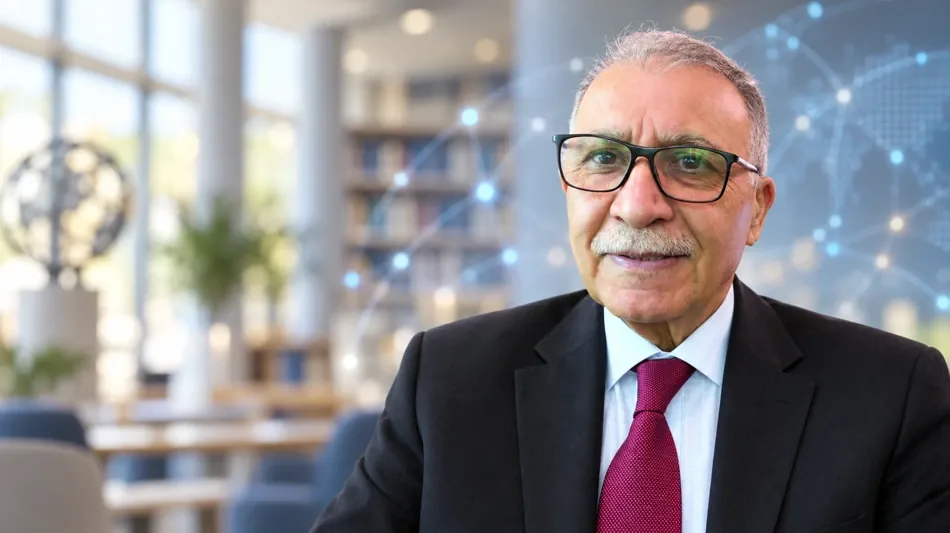
Expert proposes phased digital reform for Arab business schools

Arab university business schools need to reform their teaching, administration and use of data together to prepare graduates for changing markets, according to management education expert Prof Dr Mohammed Abdulwahab al-Azzawi.
Arab university business schools need to reform their teaching, administration and use of data together to prepare graduates for changing markets, according to management education expert Prof Dr Mohammed Abdulwahab al-Azzawi.
Al-Azzawi’s proposed approach starts with assessing an institution’s digital readiness, then sets measurable objectives and tests reforms through limited projects before expanding them. He argues that inserting a technology course into an otherwise outdated programme does not amount to the transformation business schools require.
An international expert in Total Quality Management, al-Azzawi previously advised Qatar’s Ministry of Administrative Development and the Institute of Public Administration. The ministry later split into the Ministry of Labour and the Ministry of Social Development and Family. He is also a professor at the University of Baghdad’s College of Administration and Economics and a former dean of its Institute of Accounting and Financial Studies.
His assessment calls for universities to examine their infrastructure, the abilities of faculty members, curriculum quality and whether administrative systems produce dependable data. The findings should guide achievable goals that reflect local conditions, rather than general declarations or models adopted from elsewhere without adjustment.
He recommends connecting technology with established management disciplines, including marketing, accounting, finance and human resources. Students should learn how digital systems influence organisational behaviour, decisions and risk management, as well as how to operate the tools themselves.
Business analytics, financial technology, cybersecurity and artificial intelligence in management would become defined, connected study pathways under this approach. Laboratories, case studies and practical projects would have a larger role, moving teaching beyond an emphasis on lectures.
Professional qualifications such as Google Analytics and Microsoft Power BI could complement degree programmes, al-Azzawi said, if they contribute to specified learning outcomes. He cautioned against allowing certificates to become the purpose of instruction. Critical thinking, interpreting evidence, asking useful questions and linking performance measures with responsible decisions remain the educational objectives.
He said sustained training for faculty and administrative employees is needed alongside curriculum changes. Staff would need support in using AI, creating digital learning experiences and evaluating student outcomes. Institutional discussion should explain both the advantages and risks of new systems, while employees should take part in designing solutions to reduce resistance to change.
For infrastructure, al-Azzawi favours scalable cloud systems that can work with one another, rather than purchasing technology principally because it is new. Universities should first remove duplicated tasks and simplify procedures, he said, since transferring complicated processes to digital systems leaves the underlying problems unresolved.
He also identifies privacy protections, data governance and clear responsibility for decisions as necessary conditions for confidence in university technology. Without those controls, digital systems can introduce additional institutional risks.
His five-stage roadmap begins with diagnosis and a comparison between current capabilities and future requirements. Restructuring follows, including revised curricula and study pathways. The third stage builds staff capabilities and gives teams responsibility to implement changes.
The fourth stage introduces small pilots, such as a course supported by analytics or a decision-making laboratory. Universities would measure their results before adopting the model more broadly. Continuous assessment, governance and sustainability form the final stage.
Indicators should include the quality of learning, student satisfaction, administrative efficiency and graduates’ connections with employment markets. Regular review would allow institutions to adjust their plans after gaining experience, reducing the difficulty of correcting large programmes once considerable resources have been committed.
Al-Azzawi said leaders must balance improving existing operations with testing new teaching and working methods, a capacity he describes as organisational ambidexterity. Concentrating exclusively on efficiency can leave an institution behind, while adopting every new technology without controls can consume resources and distract from its educational mission.
The purpose, he said, is to strengthen human understanding, innovation and judgement. He argues that phased implementation, staff training and effective governance can make management education more relevant to the knowledge economy and the institutions and communities it serves.
(O.Joost--BBZ)