Narcolepsy, cancer tipped as Medicine Prize opens Nobel week / Photo: Jonathan NACKSTRAND - AFP

Narcolepsy, cancer or mRNA vaccine research could win the Nobel Medicine Prize on Monday when a week of announcements kick off, but experts see no clear frontrunner for the Peace Prize.
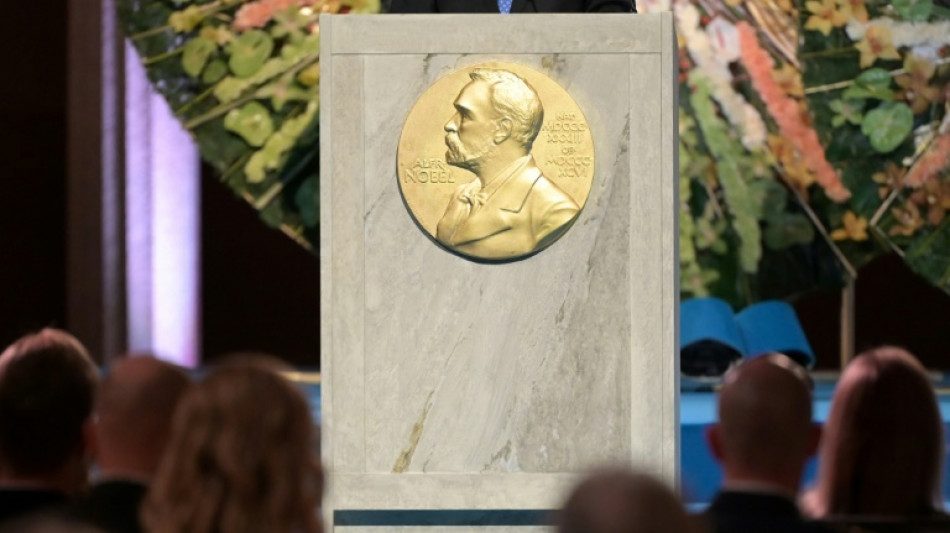
The awards, first handed out in 1901, were created by Swedish inventor and philanthropist Alfred Nobel in his 1895 will to celebrate those who have "conferred the greatest benefit on mankind."
The Medicine Prize is first out, and will be announced in Stockholm on Monday around 11:30 am (0930 GMT), followed by the awards for physics on Tuesday, chemistry on Wednesday and literature on Thursday.
The Peace Prize, the most highly-anticipated Nobel and the only one announced in Oslo, will follow on Friday, before the Economics Prize rounds things off on October 9.
The Medicine Prize has over the years crowned groundbreaking discoveries like the X-ray, penicillin, insulin and DNA -- as well as now-disgraced awards for the lobotomy and the insecticide DDT.
Several Nobel watchers have suggested this year's prize could go to research into narcolepsy and the discovery of orexin, a neuropeptide that helps regulate sleep.
It could also go to Hungarian-born Katalin Kariko and Drew Weissman of the United States for research that led directly to the first mRNA vaccines to fight Covid-19, made by Pfizer and Moderna.
Their discovery has already won a slew of major medicine prizes, but the Nobel committee nowadays often waits decades to bestow its laurels to ensure the research stands the test of time.
"Maybe the Academy thinks it needs to look into it more, but someday they should win," predicted Annika Ostman, science reporter at Swedish public radio SR.
- Gene engineering and IceCube telescope -
But Ostman said her guess for this year was on Kevan Shokat, an American biologist who figured out how to block the KRAS cancer gene behind a third of cancers, including challenging-to-treat lung, colon, and pancreatic tumours.
T-cell therapy for cancer treatment and work on the human microbiome could also be contenders, said David Pendlebury, head of the Clarivate analytics group which identifies Nobel-worthy research.
"There are more people deserving of a Nobel Prize than there are Nobels to go around," he told AFP.
Lars Brostrom, Ostman's colleague at SR, singled out two American biologists, Stanislas Leibler and Michael Elowitz, for their work on synthetic gene circuits which established the field of synthetic biology.
It enables scientists to redesign organisms by engineering them to have new abilities.
But Brostrom noted the field could be seen as controversial, raising "ethical questions about where to draw the line in creating life".
For the Physics Prize, twisted graphene or the IceCube Neutrino Observatory in Antarctica were seen as possible winners, as well as the development of high-density data storage in the field of spintronics.
- Peace Prize to Iranian women? -
For Wednesday's Chemistry Prize, Pendlebury suggested next-generation DNA sequencing could get the nod, or research into how to target and deliver drugs to genes.
Brostrom said he would love to see it go to US-based chemist Omar Yaghi for his work into porous materials known as MOFs, which can absorb poisonous gases or harvest water from desert air, and is an "important field for the future" with enormous potential for the environment.
Criticism over a lack of gender and geographical diversity has plagued the Nobels over the years.
US-based men have dominated the science fields, while women account for just six percent of overall laureates -- something the various award committees insist they are addressing.
Among the names making the rounds for Thursday's Literature Prize are Russian author and outspoken Putin critic Lyudmila Ulitskaya, Chinese avant-garde writer Can Xue, British author Salman Rushdie, Caribbean-American writer Jamaica Kincaid and Norwegian playwright Jon Fosse.
But for the Peace Prize, experts have been scratching their heads over possible winners, as conflicts rage around the globe.
Some have pointed to the Iranian women protesting since the death in custody a year ago of Mahsa Amini, arrested for violating Iran's strict dress code imposed on women.
Others suggest organisations documenting war crimes in Ukraine, or the International Criminal Court, which could one day be called upon to judge them.
"I think that climate change is a really good focus for the Peace Prize this year," Dan Smith, the head of the Stockholm International Peace Research Institute, told AFP after a year of extreme weather around the world.
For the Economics Prize, research on income and wealth inequality could be honoured.
(A.Lehmann--BBZ)