Berliner Boersenzeitung - Scientists find microplastics in blood for first time

EUR -
AED 4.31516
AFN 75.186175
ALL 95.293746
AMD 434.669939
ANG 2.102729
AOA 1078.452193
ARS 1630.2308
AUD 1.624055
AWG 2.116081
AZN 1.972096
BAM 1.949543
BBD 2.366794
BDT 144.45575
BGN 1.95966
BHD 0.443305
BIF 3494.983871
BMD 1.174784
BND 1.487719
BOB 8.119904
BRL 5.802732
BSD 1.175123
BTN 111.184676
BWP 15.724465
BYN 3.318535
BYR 23025.776091
BZD 2.363405
CAD 1.602048
CDF 2720.800684
CHF 0.915216
CLF 0.026764
CLP 1053.358606
CNY 8.00175
CNH 8.003695
COP 4381.253041
CRC 536.176843
CUC 1.174784
CUP 31.131789
CVE 110.371275
CZK 24.334502
DJF 208.783018
DKK 7.472646
DOP 69.958736
DZD 155.303645
EGP 61.942028
ERN 17.621767
ETB 184.561449
FJD 2.56679
FKP 0.865372
GBP 0.864271
GEL 3.159791
GGP 0.865372
GHS 13.216641
GIP 0.865372
GMD 86.346819
GNF 10314.60781
GTQ 8.970172
GYD 245.810019
HKD 9.204719
HNL 31.240732
HRK 7.535039
HTG 153.770943
HUF 357.845822
IDR 20346.562573
ILS 3.41111
IMP 0.865372
INR 111.018189
IQD 1538.967688
IRR 1542492.041252
ISK 143.805836
JEP 0.865372
JMD 185.157308
JOD 0.83289
JPY 183.801491
KES 151.759011
KGS 102.700249
KHR 4714.997648
KMF 492.234745
KPW 1057.310151
KRW 1699.372266
KWD 0.361786
KYD 0.979253
KZT 544.161183
LAK 25810.015627
LBP 105201.95124
LKR 376.191003
LRD 215.661076
LSL 19.425102
LTL 3.468833
LVL 0.710615
LYD 7.448409
MAD 10.806258
MDL 20.200081
MGA 4896.264456
MKD 61.652583
MMK 2466.517899
MNT 4205.316758
MOP 9.48422
MRU 46.876763
MUR 54.984854
MVR 18.156291
MWK 2046.474994
MXN 20.267324
MYR 4.610988
MZN 75.080436
NAD 19.425034
NGN 1600.056316
NIO 43.241033
NOK 10.928374
NPR 177.895283
NZD 1.972428
OMR 0.451734
PAB 1.175123
PEN 4.067693
PGK 5.109601
PHP 71.29591
PKR 327.500562
PLN 4.231549
PYG 7191.917329
QAR 4.280899
RON 5.267261
RSD 117.367963
RUB 87.820039
RWF 1715.185362
SAR 4.407583
SBD 9.436172
SCR 16.301074
SDG 705.462002
SEK 10.849505
SGD 1.490061
SHP 0.877095
SLE 28.958687
SLL 24634.638952
SOS 671.372647
SRD 43.949817
STD 24315.667154
STN 24.421514
SVC 10.281956
SYP 130.640379
SZL 19.149458
THB 37.85511
TJS 10.981508
TMT 4.11762
TND 3.414342
TOP 2.828599
TRY 53.113764
TTD 7.963407
TWD 36.875262
TZS 3045.25641
UAH 51.522813
UGX 4418.798927
USD 1.174784
UYU 47.218451
UZS 14189.398315
VES 579.75196
VND 30926.201816
VUV 138.918767
WST 3.198451
XAF 653.855648
XAG 0.01523
XAU 0.000251
XCD 3.174915
XCG 2.117894
XDR 0.818154
XOF 653.858422
XPF 119.331742
YER 280.332926
ZAR 19.270342
ZMK 10574.444756
ZMW 22.239527
ZWL 378.280128
  • RIO

    4.5300

    105.03

    +4.31%

  • CMSC

    0.0950

    22.975

    +0.41%

  • NGG

    0.4200

    88.06

    +0.48%

  • GSK

    0.3700

    50.75

    +0.73%

  • BTI

    0.4000

    59.8

    +0.67%

  • CMSD

    0.1150

    23.405

    +0.49%

  • BP

    -1.7000

    44.8

    -3.79%

  • BCE

    -0.0750

    24.025

    -0.31%

  • RYCEF

    1.0500

    17.5

    +6%

  • BCC

    2.7550

    74.885

    +3.68%

  • VOD

    0.3450

    16.085

    +2.14%

  • RBGPF

    0.0800

    63.18

    +0.13%

  • JRI

    0.1200

    13.16

    +0.91%

  • AZN

    3.5750

    184.815

    +1.93%

  • RELX

    -0.3200

    35.84

    -0.89%

Scientists find microplastics in blood for first time


Scientists find microplastics in blood for first time

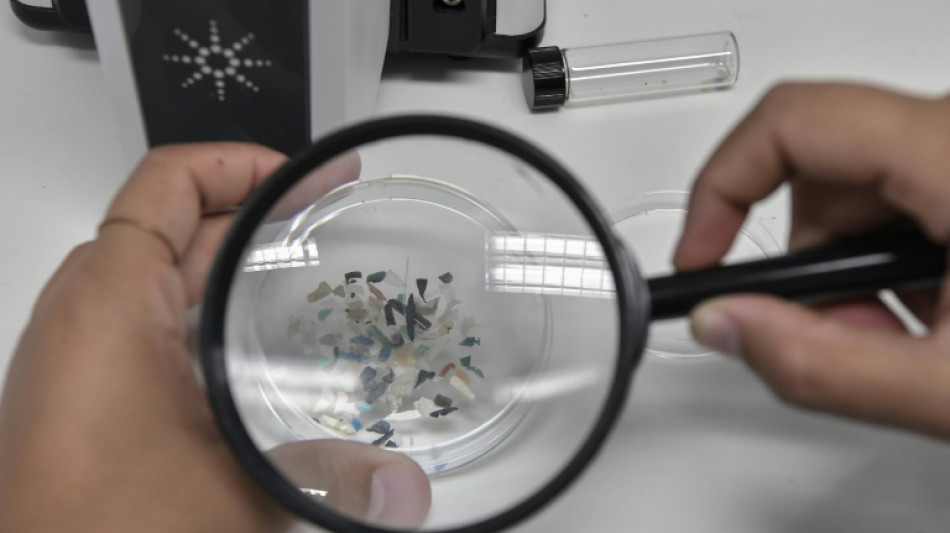
Scientists have discovered microplastics in human blood for the first time, warning that the ubiquitous particles could also be making their way into organs.

Text size:

The tiny pieces of mostly invisible plastic have already been found almost everywhere else on Earth, from the deepest oceans to the highest mountains as well as in the air, soil and food chain.

A Dutch study published in the Environment International journal on Thursday examined blood samples from 22 anonymous, healthy volunteers and found microplastics in nearly 80 percent of them.

Half of the blood samples showed traces of PET plastic, widely used to make drink bottles, while more than a third had polystyrene, used for disposable food containers and many other products.

"This is the first time we have actually been able to detect and quantify" such microplastics in human blood, said Dick Vethaak, an ecotoxicologist at Vrije Universiteit Amsterdam.

"This is proof that we have plastics in our body -- and we shouldn't," he told AFP, calling for further research to investigate how it could be impacting health.

"Where is it going in your body? Can it be eliminated? Excreted? Or is it retained in certain organs, accumulating maybe, or is it even able to pass the blood-brain barrier?"

The study said the microplastics could have entered the body by many routes: via air, water or food, but also in products such as particular toothpastes, lip glosses and tattoo ink.

"It is scientifically plausible that plastic particles may be transported to organs via the bloodstream," the study added.

Vethaak also said there could be other kinds of microplastics in blood his study did not pick up -- for example, it could not detect particles larger than the diameter of the needle used to take the sample.

The study was funded by the Netherlands Organisation for Health Research and Development as well as Common Seas, a UK-based group aimed at reducing plastic pollution.

Alice Horton, anthropogenic contaminants scientist at Britain's National Oceanography Centre, said the study "unequivocally" proved there was microplastics in blood.

"This study contributes to the evidence that plastic particles have not just pervaded throughout the environment, but are pervading our bodies too," she told the Science Media Centre.

Fay Couceiro, reader in biogeochemistry and environmental pollution at the University of Portsmouth, said that despite the small sample size and lack of data on the exposure level of participants, she felt the study was "robust and will stand up to scrutiny".

She also called for further research.

"After all blood links all the organs of our body and if plastic is there, it could be anywhere in us."

(Y.Berger--BBZ)