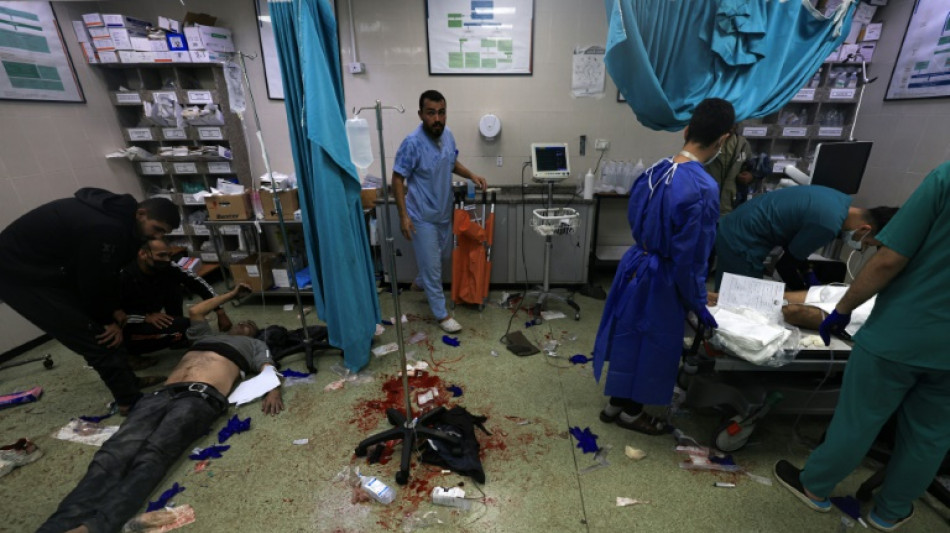
Chaos in south Gaza hospitals after new Israeli strikes / Photo: Mahmud HAMS - AFP

Patients lie on cold, bloodstained floors in hospitals filled to overflowing. Some scream in pain, but others lie silently, deathly white, too weak even to cry out.
Hospitals in the southern Gaza Strip have descended into chaos since the resumption of the war between the Palestinian militant group Hamas and Israel.
After eight weeks of war, interrupted only by one seven-day pause that ended on Friday, the doctors are exhausted.
Fuel reserves have almost run dry because of Israel's blockade of the territory, so doctors are forced to choose when and where across their hospitals to run generators.
According to the United Nations, not a single hospital in the territory's north can currently operate on patients.
The most seriously wounded are transferred daily to the south by convoys organised by the International Committee of the Red Cross.
But even there, the UN says, the 12 remaining hospitals are only "partially functional".
Abdelkarim Abu Warda and his nine-year-old daughter Huda have just arrived at Deir al-Balah Hospital aboard one of the ICRC convoys.
On Friday, after the truce ended, an Israeli strike hit their house in the vast Jabalia refugee camp in the north.
Huda was wounded in the head. "She had a brain haemorrhage -- she was placed on a ventilator," her father told AFP.
Since then, "she hasn't responded to anything", he says, lifting up the little girl's arms.
"She doesn't answer me any more," he repeats, sobbing.
- No words -
It is daybreak and the first prayers for the dead are being performed.
A few dozen men gather in front of white body bags lined up on the ground.
Between two larger bags lies the small shroud of a child, close to his or her parents even in death.
Women in tears crouch down to touch a face or kiss a loved one for one last time before the bodies are carefully loaded into the back of a pickup.
"It's Adam going... and there is Abdullah," says one woman, weeping.
At the Nasser hospital in Khan Yunis, the largest medical facility in southern Gaza, the story is the same.
World Health Organization chief Tedros Adhanom Ghebreyesus said on Sunday he was unable to "find words strong enough" to express his concerns about the conditions there.
Members of a WHO team who visited found it packed with 1,000 patients, three times its capacity.
Patients were being treated on the floor "screaming in pain", with "countless people... seeking shelter, filling every corner", the WHO chief wrote.
Israel unleashed its air and ground campaign in response to Hamas's October 7 attack on southern Israel, which killed around 1,200 people and saw some 240 kidnapped, Israeli officials say.
The Hamas government that runs Gaza says the Israeli campaign has killed more than 15,500 people -- including 280 medical staff -- since it began eight weeks ago.
- 'Saw the bomb fall' -
Israel, which has vowed to eliminate Hamas, says it is now focusing on the southern city of Khan Yunis.
The army drops warning leaflets on neighbourhoods due to be targeted each day, telling residents that a "terrible attack is imminent" and ordering them to leave.
Each day, too, the warnings move closer to the hospital.
With each new explosion that shakes the city, more casualties arrive, often in private cars.
Staff race out with stretchers which are often still stained with blood from the previous patient.
Some bodies arrive unaccompanied, and so cannot even be identified.
In the corridors, families, the wounded and medical staff all jostle together.
Some tend to the patients, sliding a sweater or a T-shirt under the head of an wounded person lying on the hard floor.
Ehab al-Najjar, a man with several family members both alive and dead at the hospital, lets his anger explode.
"I came home and saw the bomb fall on our house. Women, children died. What did they do to deserve this?" he screams.
(U.Gruber--BBZ)