Berliner Boersenzeitung - S. Korean trainee doctors stop work to protest medical reforms

EUR -
AED 4.273873
AFN 76.929105
ALL 96.379067
AMD 444.029165
ANG 2.083178
AOA 1067.159907
ARS 1669.272238
AUD 1.756871
AWG 2.097662
AZN 1.979007
BAM 1.953746
BBD 2.344035
BDT 142.270396
BGN 1.955457
BHD 0.438721
BIF 3450.522479
BMD 1.163751
BND 1.509219
BOB 8.070548
BRL 6.320677
BSD 1.163776
BTN 104.758292
BWP 15.482786
BYN 3.365775
BYR 22809.524649
BZD 2.340649
CAD 1.612779
CDF 2597.492788
CHF 0.939101
CLF 0.027377
CLP 1074.002511
CNY 8.229703
CNH 8.229217
COP 4447.857307
CRC 568.302402
CUC 1.163751
CUP 30.839408
CVE 110.730605
CZK 24.29028
DJF 206.822123
DKK 7.468604
DOP 74.771025
DZD 151.366954
EGP 55.248856
ERN 17.456269
ETB 180.916335
FJD 2.643812
FKP 0.872848
GBP 0.873441
GEL 3.136298
GGP 0.872848
GHS 13.336175
GIP 0.872848
GMD 85.546628
GNF 10111.253446
GTQ 8.914626
GYD 243.48501
HKD 9.054869
HNL 30.651768
HRK 7.533312
HTG 152.379765
HUF 384.868819
IDR 19409.043474
ILS 3.752108
IMP 0.872848
INR 104.908859
IQD 1524.596811
IRR 49023.021981
ISK 148.913831
JEP 0.872848
JMD 186.573808
JOD 0.825087
JPY 181.472459
KES 150.414828
KGS 101.769946
KHR 4661.987879
KMF 491.10353
KPW 1047.375979
KRW 1710.377003
KWD 0.357377
KYD 0.969884
KZT 594.694649
LAK 25239.567778
LBP 104218.856453
LKR 359.122365
LRD 205.414879
LSL 19.76172
LTL 3.436255
LVL 0.703942
LYD 6.32435
MAD 10.750995
MDL 19.732335
MGA 5189.56521
MKD 61.575251
MMK 2443.911415
MNT 4128.95989
MOP 9.326693
MRU 46.412195
MUR 53.672293
MVR 17.922294
MWK 2018.086552
MXN 21.261474
MYR 4.786468
MZN 74.375604
NAD 19.76172
NGN 1687.974768
NIO 42.824967
NOK 11.789138
NPR 167.613466
NZD 2.01475
OMR 0.447463
PAB 1.163781
PEN 3.914684
PGK 4.938807
PHP 68.853362
PKR 328.919325
PLN 4.23787
PYG 8003.583833
QAR 4.242039
RON 5.08815
RSD 117.38526
RUB 89.084365
RWF 1693.31939
SAR 4.367717
SBD 9.578362
SCR 16.246878
SDG 699.998259
SEK 10.94081
SGD 1.510321
SHP 0.873115
SLE 27.58248
SLL 24403.279831
SOS 663.904724
SRD 44.989458
STD 24087.301428
STN 24.474264
SVC 10.183292
SYP 12867.40098
SZL 19.756225
THB 37.123534
TJS 10.677872
TMT 4.084767
TND 3.418505
TOP 2.802034
TRY 49.539023
TTD 7.884743
TWD 36.277034
TZS 2851.190884
UAH 49.062908
UGX 4117.670065
USD 1.163751
UYU 45.462194
UZS 13954.326331
VES 299.789534
VND 30676.48315
VUV 141.795037
WST 3.245248
XAF 655.270765
XAG 0.020015
XAU 0.000278
XCD 3.145096
XCG 2.097494
XDR 0.81481
XOF 655.267953
XPF 119.331742
YER 277.613186
ZAR 19.828029
ZMK 10475.158382
ZMW 26.912815
ZWL 374.72743
  • RBGPF

    0.8500

    79.2

    +1.07%

  • CMSC

    -0.2100

    23.22

    -0.9%

  • CMSD

    -0.0800

    23.17

    -0.35%

  • RYCEF

    0.3100

    14.8

    +2.09%

  • RIO

    -0.0400

    73.02

    -0.05%

  • SCS

    -0.0200

    16.12

    -0.12%

  • NGG

    -0.0800

    75.33

    -0.11%

  • GSK

    0.0600

    48.47

    +0.12%

  • VOD

    0.0300

    12.5

    +0.24%

  • BCC

    -1.2400

    71.81

    -1.73%

  • JRI

    -0.0700

    13.72

    -0.51%

  • AZN

    1.1000

    91.28

    +1.21%

  • BTI

    0.4000

    57.41

    +0.7%

  • BCE

    -0.2100

    23.34

    -0.9%

  • RELX

    -0.8400

    39.48

    -2.13%

  • BP

    -0.0500

    35.78

    -0.14%

S. Korean trainee doctors stop work to protest medical reforms
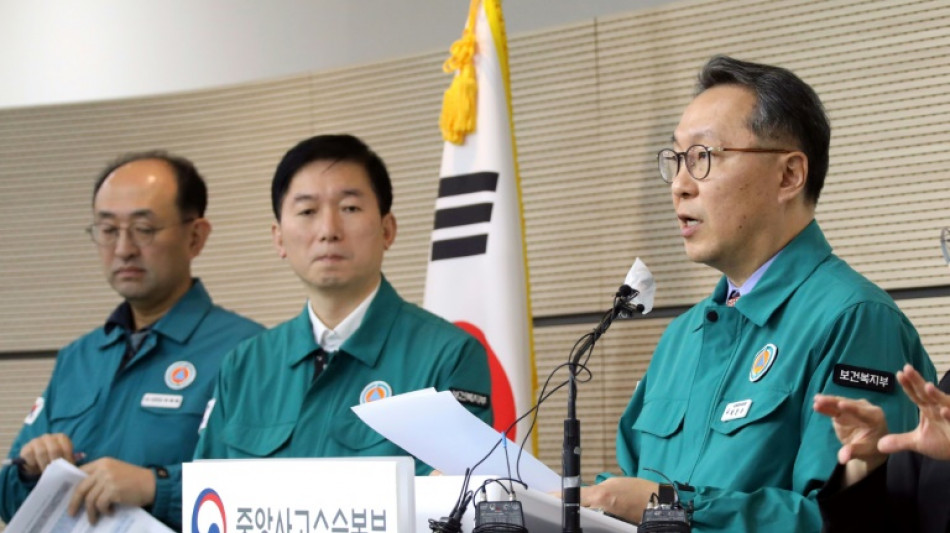
S. Korean trainee doctors stop work to protest medical reforms / Photo: - - YONHAP/AFP

S. Korean trainee doctors stop work to protest medical reforms

South Korean hospitals turned away some patients and delayed surgeries on Tuesday as hundreds of trainee doctors stopped working in a protest against medical training reforms.

Text size:

Almost 6,500 doctors submitted their resignations -- nearly half the junior workforce -- with 1,600 walking off the job, Second Vice Health Minister Park Min-soo told reporters.

The government has ordered the doctors back to work, and police have warned of arrests for instigators of the work stoppages, as South Korean law limits the ability of medical staff to strike.

"I express deep concern and regret over the trainee doctors' collective actions, which have resulted in cancellations of surgeries and disruptions in medical services", Park said.

The government's top priority is to "maintain medical emergency services and treatment for serious cases at major hospitals", he said, to "avoid situations in which patients with serious conditions are prevented from accessing treatment".

South Korea says it has one of the lowest doctor-to-population ratios among developed countries, and the government is pushing hard to increase the number of physicians, partly to help a fast-ageing society.

But doctors have voiced fierce opposition to a new government plan to sharply raise medical school admissions, claiming it would hurt the quality of service.

Proponents of the plan say doctors are mainly concerned reforms could erode their salaries and social status.

The training reforms call for a 65 percent increase in the number of students admitted to medical schools by 2,000 people a year, starting from 2025.

The plan is popular with the public, who experts suggest are tired of long wait times at hospitals, with a recent Korean Gallup poll showing over 75 percent of respondents in favour, regardless of political affiliation.

But it has drawn fierce opposition from doctors, with the Korean Medical Association saying the government's threats of legal action were akin to a "witch hunt" and claiming the plan would create a "Cuban-style socialist medical system".

The Korea Association of Medical Colleges has called for a significantly lower admissions increase of 11 percent, a demand the government has rejected.

"I have submitted my resignation letter," Park Dan, head of the Korea Interns and Residents Association, wrote Monday on Facebook.

"I am now able to abandon my dream of becoming a specialist in paediatric emergency medicine without any regrets. I have no intention of going back."

Vice Minister Park said the government's reform plan was necessary given South Korea's rapidly ageing society, saying they anticipated the number of people over 65 would have grown 70 percent by 2035, driving increased demands on hospitals.

(K.Müller--BBZ)