Berliner Boersenzeitung - US panel recommends all women receive breast cancer screening from 40

EUR -
AED 4.241153
AFN 72.754563
ALL 95.904412
AMD 436.077607
ANG 2.067262
AOA 1058.989364
ARS 1607.142281
AUD 1.654835
AWG 2.081601
AZN 1.95977
BAM 1.954803
BBD 2.329412
BDT 141.917624
BGN 1.97398
BHD 0.436272
BIF 3423.45409
BMD 1.154841
BND 1.479146
BOB 7.99182
BRL 6.143319
BSD 1.15661
BTN 108.125857
BWP 15.771435
BYN 3.508935
BYR 22634.884553
BZD 2.326114
CAD 1.587035
CDF 2627.263453
CHF 0.912861
CLF 0.02714
CLP 1072.223987
CNY 7.952696
CNH 7.970476
COP 4285.361066
CRC 540.224494
CUC 1.154841
CUP 30.603288
CVE 110.208795
CZK 24.490831
DJF 205.954966
DKK 7.471741
DOP 68.654987
DZD 152.950997
EGP 60.324739
ERN 17.322616
ETB 182.275564
FJD 2.568655
FKP 0.865578
GBP 0.865213
GEL 3.135356
GGP 0.865578
GHS 12.60757
GIP 0.865578
GMD 84.87984
GNF 10137.829861
GTQ 8.859482
GYD 241.973454
HKD 9.044802
HNL 30.613918
HRK 7.521945
HTG 151.732619
HUF 392.05814
IDR 19571.091251
ILS 3.618573
IMP 0.865578
INR 108.037231
IQD 1515.127308
IRR 1519337.754721
ISK 143.429337
JEP 0.865578
JMD 181.710477
JOD 0.818758
JPY 183.649756
KES 149.66002
KGS 100.990396
KHR 4621.643032
KMF 493.117464
KPW 1039.361533
KRW 1729.189906
KWD 0.354109
KYD 0.963808
KZT 556.046425
LAK 24836.118896
LBP 103580.078814
LKR 360.792877
LRD 211.652061
LSL 19.510581
LTL 3.409946
LVL 0.698551
LYD 7.404224
MAD 10.807448
MDL 20.141554
MGA 4822.686665
MKD 61.484385
MMK 2424.533847
MNT 4119.260525
MOP 9.335739
MRU 46.297389
MUR 53.781172
MVR 17.853984
MWK 2005.63794
MXN 20.652427
MYR 4.549493
MZN 73.795385
NAD 19.51075
NGN 1573.886435
NIO 42.558296
NOK 11.265017
NPR 173.000274
NZD 1.988749
OMR 0.444016
PAB 1.156595
PEN 3.998661
PGK 4.992454
PHP 69.281806
PKR 322.926298
PLN 4.27394
PYG 7554.1475
QAR 4.229343
RON 5.097703
RSD 117.46927
RUB 95.073447
RWF 1682.870906
SAR 4.335248
SBD 9.298388
SCR 16.082539
SDG 694.059788
SEK 10.871788
SGD 1.478179
SHP 0.86643
SLE 28.38022
SLL 24216.451871
SOS 660.97436
SRD 43.2921
STD 23902.878092
STN 24.487512
SVC 10.119839
SYP 127.6839
SZL 19.517722
THB 37.74134
TJS 11.108835
TMT 4.053492
TND 3.415858
TOP 2.78058
TRY 51.180177
TTD 7.84693
TWD 36.92108
TZS 2970.769215
UAH 50.668895
UGX 4371.770464
USD 1.154841
UYU 46.605223
UZS 14100.808802
VES 525.095404
VND 30419.668062
VUV 137.687189
WST 3.150166
XAF 655.633991
XAG 0.017179
XAU 0.000266
XCD 3.121016
XCG 2.084419
XDR 0.815409
XOF 655.622642
XPF 119.331742
YER 275.543707
ZAR 19.622018
ZMK 10394.962502
ZMW 22.582483
ZWL 371.858346
  • RBGPF

    -13.5000

    69

    -19.57%

  • RYCEF

    -1.2600

    15.34

    -8.21%

  • VOD

    -0.0900

    14.33

    -0.63%

  • AZN

    -5.3300

    183.6

    -2.9%

  • NGG

    -3.5400

    81.99

    -4.32%

  • GSK

    -0.5300

    51.84

    -1.02%

  • RELX

    -0.4600

    33.36

    -1.38%

  • BTI

    -1.3500

    57.37

    -2.35%

  • RIO

    -2.5000

    83.15

    -3.01%

  • BP

    -1.0800

    44.78

    -2.41%

  • CMSC

    -0.2000

    22.65

    -0.88%

  • CMSD

    -0.2420

    22.658

    -1.07%

  • BCE

    0.0600

    25.79

    +0.23%

  • JRI

    -0.3900

    11.77

    -3.31%

  • BCC

    -1.5600

    68.3

    -2.28%

US panel recommends all women receive breast cancer screening from 40
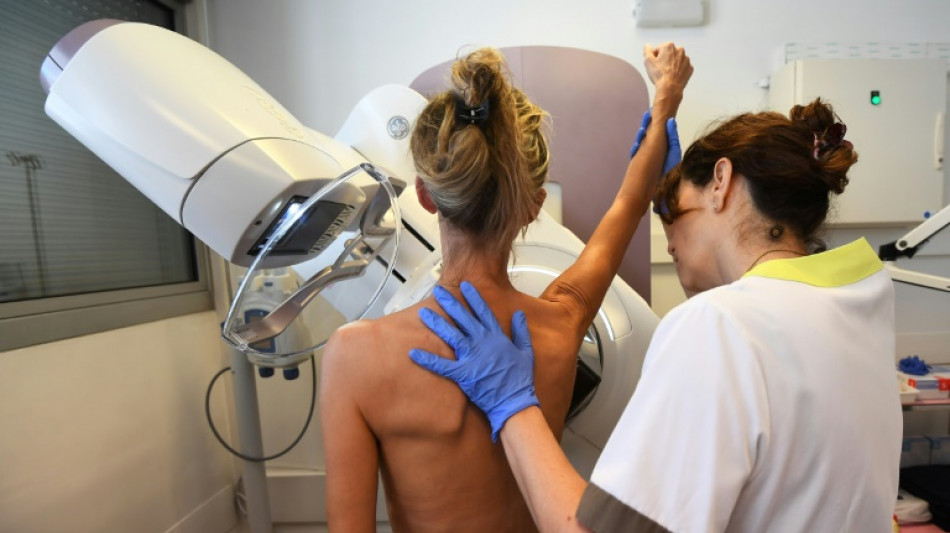
US panel recommends all women receive breast cancer screening from 40 / Photo: ANNE-CHRISTINE POUJOULAT - AFP/File

US panel recommends all women receive breast cancer screening from 40

Women should get screened for breast cancer every other year starting from the age of 40 to reduce their risk of dying from the disease, an influential US body recommended on Tuesday.

Text size:

The US Preventive Services Task Force, an independent panel of experts that receives federal funding, previously said that women in their 40s should make an individual decision about when to start mammograms based on their health history and reserved its mandatory recommendation for people turning 50.

Its new guidance was based on a review of evidence and a modeling study published in the Journal of the American Medical Association, and finalizes a draft recommendation proposed last year.

"More women in their 40s have been getting breast cancer, with rates increasing about 2 percent each year, so this recommendation will make a big difference for people across the country," Task Force chair Wanda Nicholson said in a statement.

"By starting to screen all women at age 40, we can save nearly 20 percent more lives from breast cancer overall."

Breast cancer is the second most common cancer and the second most common cause of cancer death for women in the United States, with more than 43,000 deaths last year.

Black women are 40 percent more likely to die of the disease than white women, and so ensuring they start screening at 40 "has even greater potential benefit for Black women," said Nicholson.

The new recommendation applies to nearly all women -- those who are at average risk of breast cancer, as well as those with a family history of breast cancer, and those with dense breasts.

Nearly half of all women have what's known as dense breast tissue, which they generally only find out during their first mammogram. Dense breast tissue increases their risk for breast cancer and means that mammograms may not work as well for them.

"Unfortunately, there is not yet enough evidence for the Task Force to recommend for or against additional screening with breast ultrasound or MRI," the experts said, urgently calling for more research.

The new recommendation doesn't apply however to those with a personal history of the disease, or those at very high rise due to certain genetic markers, or who have a lesion detected on previous biopsies -- they could benefit from more regular screening, in consultation with their doctor.

The new recommendation applies up until the age of 74, after which the balance of benefit-to-risk becomes uncertain, the task force said.

While screening is a powerful tool in the fight against cancer, there are also limits, the task force said, explaining why it is not recommending annual mammograms. Over-testing increases the number of harms, such as false positives, or receiving treatment that wasn't required.

(A.Lehmann--BBZ)