Berliner Boersenzeitung - Monkeypox can be stopped outside endemic countries: WHO

EUR -
AED 4.242869
AFN 76.250342
ALL 93.247528
AMD 421.964016
AOA 1060.572233
ARS 1728.626236
AUD 1.637747
AWG 2.082442
AZN 1.95442
BAM 1.95517
BBD 2.323451
BDT 142.793982
BHD 0.43505
BIF 3442.245991
BMD 1.155308
BND 1.479204
BOB 14.010485
BRL 5.937698
BSD 1.153603
BTN 109.671657
BWP 15.643552
BYN 3.4119
BYR 22644.030618
BZD 2.320142
CAD 1.618476
CDF 2612.150446
CHF 0.931709
CLF 0.026743
CLP 1055.974029
CNY 7.798053
CNH 7.795213
COP 3676.986215
CRC 523.120097
CUC 1.155308
CUP 30.615654
CVE 110.229477
CZK 24.187288
DJF 205.419355
DKK 7.475378
DOP 67.276572
DZD 153.581966
EGP 57.556847
ERN 17.329615
ETB 186.190862
FJD 2.553806
FKP 0.858651
GBP 0.857925
GEL 3.021126
GGP 0.858651
GHS 13.525641
GIP 0.858651
GMD 84.914239
GNF 10132.383874
GTQ 8.799164
GYD 241.32223
HKD 9.061864
HNL 30.919233
HRK 7.533413
HTG 150.826824
HUF 362.202869
IDR 20696.181862
ILS 3.470255
IMP 0.858651
INR 109.822567
IQD 1511.219527
IRR 1588317.004451
ISK 141.80247
JEP 0.858651
JMD 183.31537
JOD 0.819133
JPY 182.194907
KES 149.462068
KGS 101.031383
KHR 4675.351658
KMF 493.31666
KRW 1638.053175
KWD 0.357244
KYD 0.961394
KZT 541.347885
LAK 26077.708924
LBP 103304.008718
LKR 387.05831
LRD 208.222897
LSL 18.925383
LTL 3.411323
LVL 0.698834
LYD 7.342475
MAD 10.751835
MDL 20.043627
MGA 4910.290079
MKD 61.505179
MMK 2425.340128
MNT 4157.025473
MOP 9.319937
MRU 46.258492
MUR 54.264829
MVR 17.849421
MWK 2000.294776
MXN 19.917441
MYR 4.722435
MZN 73.836264
NAD 18.925383
NGN 1572.905055
NIO 42.454848
NOK 11.010256
NPR 175.469896
NZD 1.961395
OMR 0.444221
PAB 1.153628
PEN 3.905142
PGK 5.172176
PHP 70.03013
PKR 320.314956
PLN 4.300516
PYG 6879.634064
QAR 4.217541
RON 5.244867
RSD 117.359633
RUB 93.554303
RWF 1694.602551
SAR 4.335326
SBD 9.321425
SCR 15.49527
SDG 693.766315
SEK 10.9609
SGD 1.47936
SLE 28.429167
SOS 659.267569
SRD 43.518143
STD 23912.536514
STN 24.491365
SVC 10.093791
SZL 18.909415
THB 38.2141
TJS 10.647669
TMT 4.043577
TND 3.384909
TRY 54.983998
TTD 7.824327
TWD 37.250007
TZS 3061.563041
UAH 51.622323
UGX 4302.613418
USD 1.155308
UYU 46.385052
UZS 13713.580591
VES 871.346053
VND 30308.341798
VUV 138.133218
WST 3.161791
XAF 655.725817
XAG 0.018555
XAU 0.00027
XCD 3.122277
XCG 2.079039
XDR 0.815516
XOF 655.731491
XPF 119.331742
YER 273.663498
ZAR 18.861902
ZMK 10399.156062
ZMW 22.021903
ZWL 372.008603
  • CMSC

    -0.0600

    21.73

    -0.28%

  • RBGPF

    0.0000

    69.74

    0%

  • RYCEF

    0.6000

    21

    +2.86%

  • NGG

    -0.1600

    80.26

    -0.2%

  • RELX

    -0.1900

    36.61

    -0.52%

  • RIO

    2.5000

    101.51

    +2.46%

  • VOD

    -0.3800

    15.31

    -2.48%

  • BTI

    0.1500

    59.27

    +0.25%

  • GSK

    -0.0700

    51.46

    -0.14%

  • AZN

    5.8800

    161.5

    +3.64%

  • BP

    -1.2300

    41.21

    -2.98%

  • BCE

    0.0600

    22.06

    +0.27%

  • CMSD

    0.0200

    22.04

    +0.09%

  • JRI

    -0.0500

    12.67

    -0.39%

  • BCC

    -1.6900

    84.8

    -1.99%

Monkeypox can be stopped outside endemic countries: WHO
Monkeypox can be stopped outside endemic countries: WHO / Photo: John SAEKI - AFP

Monkeypox can be stopped outside endemic countries: WHO

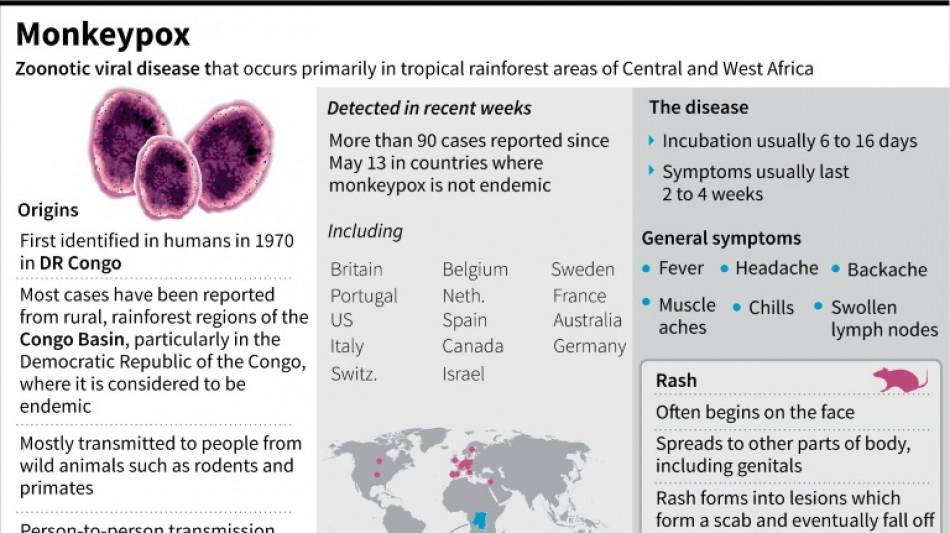
The monkeypox outbreaks in non-endemic countries can be contained and human-to-human transmission of the virus stopped, the World Health Organization said Monday.

Text size:

Fewer than 200 confirmed and suspected cases had been recorded so far, the WHO's emerging disease lead Maria Van Kerkhove said.

"This is a containable situation, particularly in the countries where we are seeing these outbreaks that are happening across Europe, in North America as well," Van Kerkhove told a live interaction on the UN health agency's social media channels.

"We want to stop human-to-human transmission. We can do this in the non-endemic countries.

"We're in a situation where we can use public health tools of early identification, supported isolation of cases.

"We can stop human-to-human transmission."

Van Kerkhove said transmission was happening via "close physical contact: skin-to-skin contact", and that most of the people identified so far had not had a severe case of the disease.

Rosamund Lewis, who heads the smallpox secretariat on the WHO emergencies programme, said monkeypox had been known for at least 40 years and a few cases had appeared in Europe over the last five years in travellers from the endemic regions.

However, "this is the first time we're seeing cases across many countries at the same time and people who have not travelled to the endemic regions in Africa", she said.

She cited Nigeria, Cameroon, the Central African Republic and the Democratic Republic of the Congo.

"It is primarily in the animal kingdom in forested areas. Now we're seeing it more in urban areas," she said.

- Mutation studies -

Lewis said it was not yet known whether the virus had mutated but viruses in the wider orthopoxvirus group "tend not to mutate and they tend to be fairly stable.

"We don't yet have evidence yet that there is mutation in the virus itself," she said. Virologists will be studying the first genomic sequences of the virus coming through, she added.

Van Kerkhove said a major global meeting next week would discuss research, epidemiology, diagnostics, therapeutics and vaccines.

Andy Seale, strategies advisor at the WHO's global HIV, hepatitis and sexually transmitted infections programmes, stressed that while the virus could be caught through sexual activity, it was not a sexually transmitted disease.

"While we are seeing some cases amongst men who have sex with men, this is not a gay disease, as some people in social media have attempted to label it. That's just not the case.

"Anybody can contract monkeypox through close contact."

Van Kerkhove added that as surveillance widened, experts did expect to see more cases.

(A.Berg--BBZ)