Berliner Boersenzeitung - US bans red food dye over possible cancer risk: health authorities

EUR -
AED 4.256956
AFN 73.025715
ALL 95.949476
AMD 436.297619
ANG 2.074964
AOA 1062.93451
ARS 1612.94327
AUD 1.652435
AWG 2.089356
AZN 1.967595
BAM 1.955789
BBD 2.330587
BDT 141.989225
BGN 1.981335
BHD 0.437098
BIF 3425.18131
BMD 1.159144
BND 1.479892
BOB 7.995956
BRL 6.158991
BSD 1.157194
BTN 108.18041
BWP 15.778914
BYN 3.510781
BYR 22719.216032
BZD 2.327287
CAD 1.590438
CDF 2637.051746
CHF 0.913915
CLF 0.027244
CLP 1075.743011
CNY 7.982325
CNH 8.005156
COP 4253.376791
CRC 540.497051
CUC 1.159144
CUP 30.717307
CVE 110.264398
CZK 24.533102
DJF 206.058876
DKK 7.485174
DOP 68.689625
DZD 153.294405
EGP 59.995673
ERN 17.387155
ETB 182.369105
FJD 2.566866
FKP 0.868886
GBP 0.868988
GEL 3.147122
GGP 0.868886
GHS 12.613931
GIP 0.868886
GMD 85.195634
GNF 10142.944655
GTQ 8.863952
GYD 242.098679
HKD 9.082181
HNL 30.628833
HRK 7.547526
HTG 151.809172
HUF 393.825438
IDR 19654.671984
ILS 3.603923
IMP 0.868886
INR 108.971735
IQD 1515.891728
IRR 1524998.397107
ISK 144.047075
JEP 0.868886
JMD 181.799008
JOD 0.821884
JPY 184.582318
KES 149.909182
KGS 101.364683
KHR 4623.974769
KMF 494.9542
KPW 1043.263627
KRW 1744.871088
KWD 0.355359
KYD 0.964295
KZT 556.326964
LAK 24848.864411
LBP 103633.234522
LKR 360.97803
LRD 211.758845
LSL 19.520593
LTL 3.42265
LVL 0.701154
LYD 7.40796
MAD 10.813041
MDL 20.15189
MGA 4824.973672
MKD 61.639664
MMK 2432.829233
MNT 4136.032637
MOP 9.340449
MRU 46.320747
MUR 53.912042
MVR 17.920267
MWK 2006.589051
MXN 20.785187
MYR 4.565818
MZN 74.068653
NAD 19.520593
NGN 1572.088888
NIO 42.579768
NOK 11.082828
NPR 173.089056
NZD 1.98507
OMR 0.445687
PAB 1.157194
PEN 4.000678
PGK 4.994973
PHP 69.722594
PKR 323.078037
PLN 4.286287
PYG 7557.95876
QAR 4.231477
RON 5.101971
RSD 117.449359
RUB 96.003076
RWF 1683.690813
SAR 4.352186
SBD 9.333031
SCR 15.877613
SDG 696.645486
SEK 10.817726
SGD 1.4866
SHP 0.869658
SLE 28.485998
SLL 24306.675843
SOS 661.296392
SRD 43.453394
STD 23991.933773
STN 24.499866
SVC 10.124945
SYP 128.330276
SZL 19.526893
THB 38.14515
TJS 11.114439
TMT 4.068594
TND 3.417581
TOP 2.790939
TRY 51.295008
TTD 7.850957
TWD 37.135139
TZS 3008.583584
UAH 50.692923
UGX 4373.976133
USD 1.159144
UYU 46.629746
UZS 14107.92302
VES 527.051768
VND 30499.388379
VUV 137.76417
WST 3.161925
XAF 655.953421
XAG 0.017051
XAU 0.000258
XCD 3.132643
XCG 2.085489
XDR 0.815796
XOF 655.953421
XPF 119.331742
YER 276.574852
ZAR 19.764849
ZMK 10433.68695
ZMW 22.593877
ZWL 373.24379
  • RBGPF

    -13.5000

    69

    -19.57%

  • CMSD

    -0.2420

    22.658

    -1.07%

  • BCC

    -1.5600

    68.3

    -2.28%

  • NGG

    -3.5400

    81.99

    -4.32%

  • VOD

    -0.0900

    14.33

    -0.63%

  • RIO

    -2.5000

    83.15

    -3.01%

  • RYCEF

    -1.2600

    15.34

    -8.21%

  • BCE

    0.0600

    25.79

    +0.23%

  • RELX

    -0.4600

    33.36

    -1.38%

  • CMSC

    -0.2000

    22.65

    -0.88%

  • JRI

    -0.3900

    11.77

    -3.31%

  • GSK

    -0.5300

    51.84

    -1.02%

  • BTI

    -1.3500

    57.37

    -2.35%

  • AZN

    -5.3300

    183.6

    -2.9%

  • BP

    -1.0800

    44.78

    -2.41%

US bans red food dye over possible cancer risk: health authorities
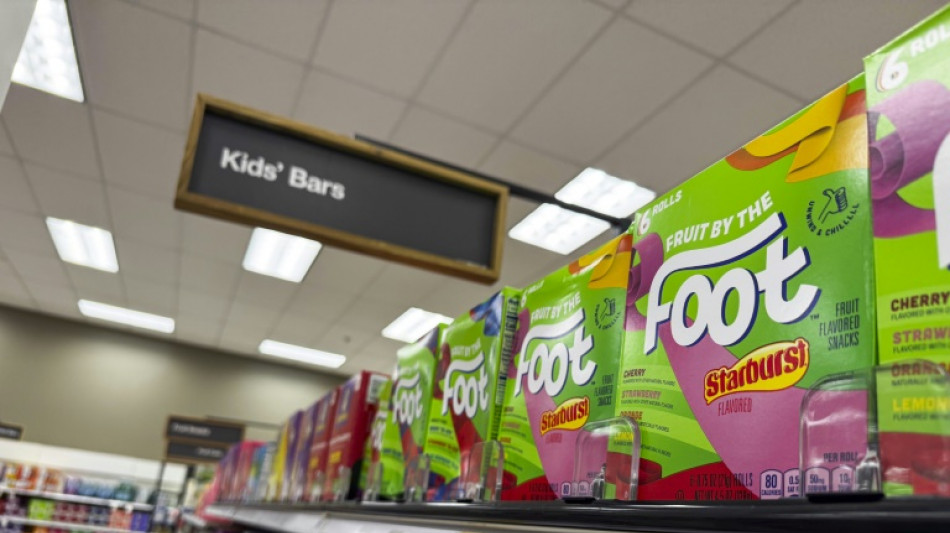
US bans red food dye over possible cancer risk: health authorities / Photo: ROBERTO SCHMIDT - AFP

US bans red food dye over possible cancer risk: health authorities

Outgoing US President Joe Biden's administration on Wednesday announced a ban on Red Dye No 3, a controversial food and drug coloring long known to cause cancer in animals.

Text size:

Decades after scientific evidence first raised alarm, Red 3, as it is also called, is currently used in nearly 3,000 food products in the United States, according to the nonprofit Environmental Working Group.

"FDA is revoking the authorized uses in food and ingested drugs of FD&C Red No 3 in the color additive regulations," said a document from the Department of Health and Human Services, published in the Federal Register on Wednesday.

The decision follows a petition filed in November 2022 by the Center for Science in the Public Interest (CSPI) and other advocacy groups, which cited the "Delaney Clause" -- a provision mandating the prohibition of any color additive shown to cause cancer in humans or animals.

Notably, the FDA determined as early as 1990 that Red 3 should be banned in cosmetics because of its link to thyroid cancer in lab rats.

However, the additive continued to be used in foods, largely due to resistance from the food industry. Manufacturers of maraschino cherries, for example, relied on Red 3 to maintain the iconic red hue of their products.

It's also present in thousands of candies, snacks and fruit products.

The United States is one of the last major economies to take action on the dye. The European Union prohibited its use in 1994, with similar bans implemented in Japan, China, the UK, Australia and New Zealand.

CSPI hailed the decision as overdue and expressed hope it would lead to further action against other potentially harmful chemicals in food.

"They don't add any nutritional value, they don't preserve the food -- they're just there to make food look pretty," Thomas Galligan, a scientist with CSPI, told AFP.

"There's growing discussion across the political spectrum about food additives and chemicals, which reflects ongoing failures by the FDA."

(U.Gruber--BBZ)