Berliner Boersenzeitung - AI helps doctors spot breast cancer in scans: world-first trial

EUR -
AED 4.242245
AFN 75.654532
ALL 93.325519
AMD 422.942357
AOA 1059.262039
ARS 1728.414775
AUD 1.636649
AWG 2.079249
AZN 1.966445
BAM 1.956746
BBD 2.325324
BDT 142.909084
BHD 0.435409
BIF 3445.050474
BMD 1.155138
BND 1.480416
BOB 14.021475
BRL 5.929904
BSD 1.154558
BTN 109.759584
BWP 15.656501
BYN 3.414651
BYR 22640.712839
BZD 2.321972
CAD 1.619464
CDF 2610.61251
CHF 0.932426
CLF 0.026751
CLP 1056.327434
CNY 7.801285
CNH 7.794025
COP 3684.972388
CRC 523.553093
CUC 1.155138
CUP 30.611168
CVE 110.318329
CZK 24.185945
DJF 205.581372
DKK 7.475951
DOP 67.33255
DZD 153.427453
EGP 57.552814
ERN 17.327076
ETB 186.341747
FJD 2.553022
FKP 0.858526
GBP 0.85735
GEL 3.015253
GGP 0.858526
GHS 13.536016
GIP 0.858526
GMD 85.480763
GNF 10140.902255
GTQ 8.806257
GYD 241.50734
HKD 9.060848
HNL 30.944959
HRK 7.535202
HTG 150.952973
HUF 361.642075
IDR 20621.530898
ILS 3.469747
IMP 0.858526
INR 109.753455
IQD 1512.43113
IRR 1588459.705816
ISK 141.815708
JEP 0.858526
JMD 183.468691
JOD 0.818964
JPY 181.916396
KES 149.440027
KGS 101.0169
KHR 4679.241757
KMF 494.399724
KRW 1643.149575
KWD 0.357204
KYD 0.962161
KZT 541.779559
LAK 26098.051339
LBP 103385.040277
LKR 387.427288
LRD 208.389837
LSL 18.940556
LTL 3.410824
LVL 0.698732
LYD 7.348552
MAD 10.760502
MDL 20.05961
MGA 4914.26927
MKD 61.559759
MMK 2424.984769
MNT 4156.41639
MOP 9.327369
MRU 46.29638
MUR 54.279962
MVR 17.8581
MWK 2001.889755
MXN 19.879863
MYR 4.729249
MZN 73.808421
NAD 18.940556
NGN 1573.448369
NIO 42.490541
NOK 10.989496
NPR 175.616656
NZD 1.963302
OMR 0.444142
PAB 1.154533
PEN 3.908289
PGK 5.176502
PHP 70.003118
PKR 320.581474
PLN 4.299373
PYG 6885.328464
QAR 4.22094
RON 5.247563
RSD 117.352814
RUB 93.537754
RWF 1696.012535
SAR 4.33469
SBD 9.323758
SCR 15.493821
SDG 693.672599
SEK 10.949522
SGD 1.479507
SLE 27.607866
SOS 659.821823
SRD 43.511783
STD 23909.032875
STN 24.511849
SVC 10.101883
SZL 18.925231
THB 38.212042
TJS 10.656021
TMT 4.054536
TND 3.387638
TRY 54.956167
TTD 7.831786
TWD 37.301841
TZS 3061.11446
UAH 51.665276
UGX 4306.08162
USD 1.155138
UYU 46.422441
UZS 13724.634681
VES 871.218385
VND 30323.538404
VUV 138.112979
WST 3.161328
XAF 656.27141
XAG 0.018521
XAU 0.000272
XCD 3.121819
XCG 2.080715
XDR 0.817207
XOF 656.274252
XPF 119.331742
YER 275.327055
ZAR 18.833613
ZMK 10397.632497
ZMW 22.039177
ZWL 371.954097
  • BCC

    -1.6100

    84.88

    -1.9%

  • CMSC

    -0.0400

    21.75

    -0.18%

  • BCE

    -0.2750

    21.725

    -1.27%

  • NGG

    -0.2900

    80.13

    -0.36%

  • GSK

    0.0350

    51.565

    +0.07%

  • CMSD

    0.0180

    22.038

    +0.08%

  • RIO

    2.3400

    101.35

    +2.31%

  • RYCEF

    0.6500

    21

    +3.1%

  • AZN

    6.1600

    161.78

    +3.81%

  • RBGPF

    -1.2500

    69.74

    -1.79%

  • VOD

    -0.3590

    15.331

    -2.34%

  • BP

    -0.8400

    41.6

    -2.02%

  • RELX

    -0.1900

    36.61

    -0.52%

  • BTI

    0.1400

    59.26

    +0.24%

  • JRI

    -0.0500

    12.67

    -0.39%

AI helps doctors spot breast cancer in scans: world-first trial
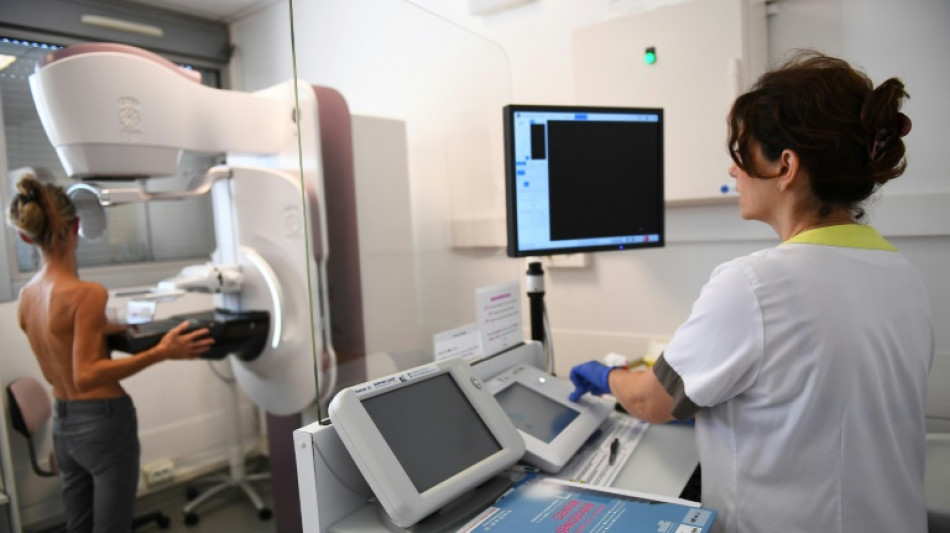
AI helps doctors spot breast cancer in scans: world-first trial / Photo: ANNE-CHRISTINE POUJOULAT - AFP

AI helps doctors spot breast cancer in scans: world-first trial

Artificial intelligence helps doctors spot more cases of breast cancer when reading routine scans, a world-first trial found Friday.

Text size:

The results suggest countries should roll out programmes taking advantage of AI's scanning power to ease the workload of short-staffed radiologists, the Swedish lead researchers said.

Well before the release of ChatGPT in 2022 raised global awareness about AI, scientists had been testing out the technology's capacity to read medical scans.

But the new study published in The Lancet medical journal marks the first completed randomised controlled trial -- the gold standard for this kind of research -- looking at AI-supported breast cancer screening.

The trial involved more than 100,000 women who received routine breast cancer scans across Sweden in 2021 and 2022.

They were randomly sorted into two groups. In one, a single radiologist was assisted by an AI system to check the scans.

The other followed the standard European method, which requires two radiologists to read the scans.

Nine percent more cancer cases were spotted in the AI group compared to the control group.

Over the following two years, those in the AI group also had a 12 percent lower rate of being diagnosed with cancer between routine scans, which are known as interval cancers and can be particularly dangerous.

The improvement was consistent across different ages and levels of breast density, which can be risk factors. The rate of false positives was similar in both groups.

Senior study author Kristina Lang of Sweden's Lund University said that "widely rolling out AI-supported mammography in breast cancer screening programmes could help reduce workload pressures amongst radiologists, as well as helping to detect more cancers at an early stage".

But this must be done "cautiously" and with "continuous monitoring", she said in a statement.

- 'The radiologist's eye' -

Jean-Philippe Masson, head of the French National Federation of Radiologists, told AFP that "the radiologist's eye and experience must correct the AI's diagnosis".

Sometimes the "AI tool will have seen a change in breast tissue that is not actually cancer," he added.

The use of AI by radiologists is still in its "infancy" in France because these systems are expensive -- and prone to overdiagnosis, Masson warned.

Stephen Duffy, emeritus professor of cancer screening at Queen Mary University of London who was not involved in the study, said it provided further evidence that AI-assisted cancer screening is safe.

But he warned that the "reduction in interval cancers following screening in the AI group is not significant".

He urged another follow-up of the trial's participants to see if the control group "catches up".

Interim results from the trial, published in 2023, showed that AI nearly halved the time radiologists spent reading scans.

The AI model Transpara was trained on more than 200,000 previous examinations taken in 10 countries.

More than 2.3 million women were diagnosed with breast cancer and 670,000 died from the disease in 2022, according to the World Health Organization.

(O.Joost--BBZ)