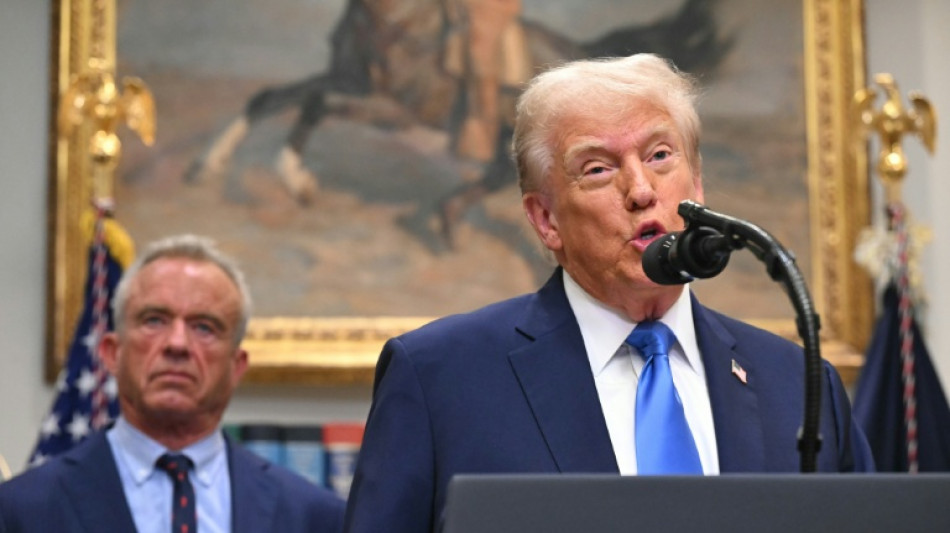
Trump administration does about face on autism treatment / Photo: SAUL LOEB - AFP

The Trump administration did an about-face Tuesday on an autism treatment it had promoted with great fanfare.
It had said back in September it would approve use of a drug called leucovorin -- synthetic vitamin B9 -- to treat the disorder.
But on Tuesday the Food and Drug Administration backed off, citing insufficient evidence that it works for the condition.
The initial announcement came from Health Secretary Robert F. Kennedy Jr, who for decades has spread debunked claims that vaccines cause autism.
Kennedy touted leucovorin, usually used to alleviate chemotherapy side effects, as an "exciting therapy" that could help children with autism, a disorder whose symptoms vary widely across a spectrum.
"This gives hope to the many parents with autistic children that it may be possible to improve their lives," President Donald Trump said in September at a press conference.
At the event he gave sweeping, unsubstantiated advice on autism, such as insisting that pregnant women should "tough it out" and avoid Tylenol over an unproven link to autism -- statements slammed by scientists.
Studies on a small number of patients have suggested that taking leucovorin can help ease some communication or personal-relations problems linked to autism, but experts say this issue needs more study.
On Tuesday the FDA said it was in fact approving use of leucovorin for a rare condition called cerebral folate deficiency but not for autism.
The Trump administration's touting of it for autism ran the risk of raising false hopes, dozens of autism specialists said at the time in a joint letter.
"We don't have sufficient data to say that we could establish efficacy for autism more broadly," an FDA official told NBC News.
"It'll be up to patients to talk with their physicians to see if that might be right for them," said the official, whose name was not given.
(A.Berg--BBZ)