WHO says now five confirmed cruise ship hantavirus cases / Photo: - - AFP

The World Health Organization said Thursday there were now five confirmed hantavirus cases from the Atlantic cruise ship outbreak, with three more suspected -- and warned further cases were possible.
Despite the three fatalities, the WHO insisted that the outbreak on the MV Hondius was not the start of an epidemic, or a repeat of the spread of Covid-19.
The UN health agency said it expected the outbreak to be limited -- so long as public health measures are properly implemented.
"So far, eight cases have been reported, including three deaths. Five of the eight cases have been confirmed as hantavirus and the other three are suspected," WHO chief Tedros Adhanom Ghebreyeus said.
"The species of hantavirus involved in this case is the Andes virus, which is found in Latin America," he told a press conference in Geneva.
He stressed that "none of the remaining passengers or crew on the ship are currently symptomatic".
But given that the incubation period of the Andes virus -- the only species of hantavirus that spreads between people -- can be up to six weeks, he warned that "it's possible that more cases may be reported".
- Morale on ship improving -
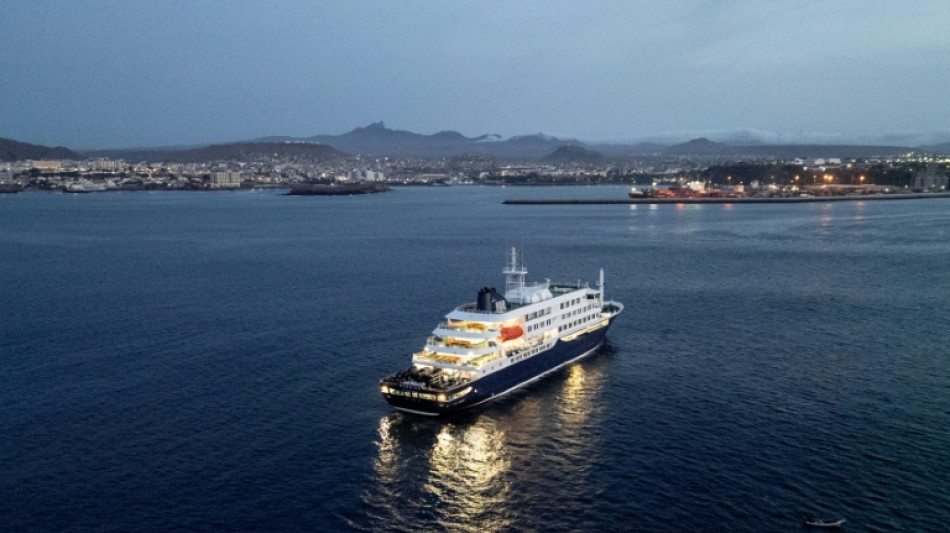
The Dutch-flagged ship left Ushuaia on the southern tip of Argentina on April 1 for a cruise across the Atlantic Ocean to Cape Verde off the coast of West Africa.
On Wednesday it set sail north from Cape Verde towards Tenerife, from where the passengers should finally be able to be repatriated.
Tedros said he had been in regular contact with the ship's captain, including earlier Thursday.
"He told me morale has improved significantly since the ship started moving again," he said.
The WHO's emergency alert and response director Abdi Rahman Mahamud added: "We believe this will be a limited outbreak if the public health measures are implemented."
The disease is usually spread from infected rodents, typically through urine, droppings and saliva.
The Andes strain of hantavirus is the only one with documented human-to-human transmission.
Tedros said that prior to boarding the ship on April 1, the first two cases -- a Dutch couple who have both died -- had travelled through Argentina, Chile and Uruguay on a bird-watching trip, which included visits to sites where the species of rat known to carry Andes virus was present.
The WHO was working with Argentina -- which followed the United States in quitting the agency -- to trace the couple's movements.
He said 2,500 diagnostic kits would be sent from Argentina to laboratories in five countries.
- 'This is not Covid' -
The WHO's epidemic and pandemic preparedness and prevention director Maria Van Kerkhove was the agency's technical lead on Covid-19 throughout the coronavirus crisis.
"This is not the start of an epidemic. This is not the start of a pandemic," she said, explaining: "This is not Covid; this is not influenza -- it spreads very, very differently.
The WHO is awaiting the results of full genome sequencing of the virus from South Africa, Switzerland and Dakar, which will help determine the clustering pattern compared to previous outbreaks -- with a high level of detail.
"It will give us a sense of whether or not we are seeing some changes," said Anais Legand, a WHO technical expert on viral haemorrhagic fevers, with Van Kerkhove adding that "nothing unusual" had been detected so far in the virus.
Legand said the RNA of the virus could be detected in a case "from the first day of onset" of symptoms, which typically occur two to three weeks after exposure to the virus.
Van Kerkhove added that the patient in intensive care in South Africa was "doing better", while the two patients in hospital in the Netherlands following evacuation from Cape Verde were in a stable condition.
(T.Burkhard--BBZ)