Berliner Boersenzeitung - Dangerous livestock pest case confirmed in Texas

EUR -
AED 4.212777
AFN 72.835586
ALL 94.512843
AMD 422.248264
ANG 2.053494
AOA 1052.895931
ARS 1680.790338
AUD 1.635257
AWG 2.067368
AZN 1.95436
BAM 1.956354
BBD 2.309354
BDT 140.73988
BGN 1.939347
BHD 0.432422
BIF 3423.630825
BMD 1.146945
BND 1.480319
BOB 7.92328
BRL 5.90941
BSD 1.146625
BTN 108.087801
BWP 15.582008
BYN 3.185903
BYR 22480.122
BZD 2.305963
CAD 1.623185
CDF 2615.035015
CHF 0.925648
CLF 0.026299
CLP 1035.072439
CNY 7.764364
CNH 7.780559
COP 3960.034063
CRC 520.14739
CUC 1.146945
CUP 30.394043
CVE 110.569964
CZK 24.190336
DJF 203.835517
DKK 7.474072
DOP 66.986043
DZD 152.939427
EGP 57.331754
ERN 17.204175
ETB 181.647461
FJD 2.564
FKP 0.867567
GBP 0.866531
GEL 3.039852
GGP 0.867567
GHS 12.874504
GIP 0.867567
GMD 84.304874
GNF 10064.442782
GTQ 8.746478
GYD 239.84901
HKD 8.988436
HNL 30.606273
HRK 7.533254
HTG 149.77244
HUF 351.906109
IDR 20445.785654
ILS 3.394682
IMP 0.867567
INR 108.1919
IQD 1502.49795
IRR 1577049.375404
ISK 143.976448
JEP 0.867567
JMD 181.171337
JOD 0.813229
JPY 185.008009
KES 148.419043
KGS 100.300781
KHR 4599.249852
KMF 492.617229
KPW 1032.250901
KRW 1752.130969
KWD 0.353179
KYD 0.955446
KZT 559.543917
LAK 25295.872375
LBP 102708.92515
LKR 382.668433
LRD 208.916469
LSL 18.815678
LTL 3.386631
LVL 0.693776
LYD 7.311819
MAD 10.580612
MDL 20.248208
MGA 4817.169398
MKD 61.628611
MMK 2408.272435
MNT 4107.54883
MOP 9.256923
MRU 45.947051
MUR 54.881752
MVR 17.720734
MWK 1992.243861
MXN 19.872547
MYR 4.745948
MZN 73.301688
NAD 18.814173
NGN 1560.350288
NIO 41.990088
NOK 11.102662
NPR 172.945006
NZD 1.997675
OMR 0.441554
PAB 1.14663
PEN 3.881306
PGK 5.032508
PHP 69.638491
PKR 319.223511
PLN 4.259467
PYG 7041.056554
QAR 4.175458
RON 5.239364
RSD 117.183799
RUB 83.845404
RWF 1679.12748
SAR 4.299026
SBD 9.24601
SCR 15.693948
SDG 688.744688
SEK 10.98638
SGD 1.482316
SHP 0.85631
SLE 28.387314
SLL 24050.86738
SOS 655.483268
SRD 42.898615
STD 23739.445827
STN 24.544623
SVC 10.032843
SYP 126.774237
SZL 18.814083
THB 37.723444
TJS 10.63456
TMT 4.014308
TND 3.339618
TOP 2.761569
TRY 53.262066
TTD 7.775237
TWD 36.375404
TZS 3017.595134
UAH 51.508996
UGX 4173.182519
USD 1.146945
UYU 45.84299
UZS 13769.075108
VES 695.774297
VND 30176.12295
VUV 136.226685
WST 3.156058
XAF 656.142926
XAG 0.017685
XAU 0.000276
XCD 3.099677
XCG 2.066386
XDR 0.807102
XOF 648.024305
XPF 119.331742
YER 273.665193
ZAR 18.876464
ZMK 10323.885445
ZMW 20.552914
ZWL 369.315822
  • JRI

    0.0500

    12.67

    +0.39%

  • CMSC

    0.0500

    22.37

    +0.22%

  • CMSD

    0.0000

    22.29

    0%

  • BCC

    3.8500

    74.66

    +5.16%

  • NGG

    -1.2400

    79.44

    -1.56%

  • RBGPF

    -0.5300

    60.61

    -0.87%

  • GSK

    -1.4800

    50.67

    -2.92%

  • BTI

    -0.5800

    58.91

    -0.98%

  • RIO

    -2.5900

    100.08

    -2.59%

  • RYCEF

    -0.0300

    18.4

    -0.16%

  • AZN

    -2.9600

    174.93

    -1.69%

  • BP

    -1.0400

    39.1

    -2.66%

  • BCE

    0.0000

    23.28

    0%

  • VOD

    -0.2300

    14.3

    -1.61%

  • RELX

    -0.8300

    31.18

    -2.66%

Dangerous livestock pest case confirmed in Texas
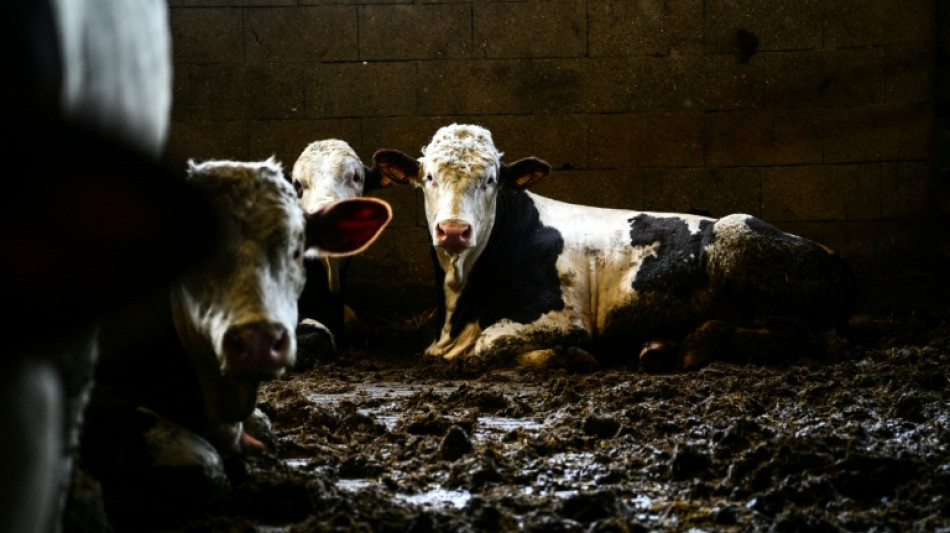
Dangerous livestock pest case confirmed in Texas / Photo: OLIVIER CHASSIGNOLE - AFP

Dangerous livestock pest case confirmed in Texas

The United States said on Thursday that the New World screwworm (NWS) fly, a dangerous livestock pest whose flesh-eating larvae can kill cattle, has been detected in a calf in south Texas.

Text size:

"We have a confirmed positive detection of New World screwworm in a three-week-old calf," US Agriculture Secretary Brooke Rollins said in a briefing.

She said "immediate action" to contain and eradicate the parasite that has raised fears over the beef supply was underway.

The NWS fly was eradicated in the United States in 1966.

But Florida experienced an outbreak in 2016 that primarily impacted deer, and was eliminated the following year, according to the US Department of Agriculture.

It has remained present in South America, and in recent years has moved northward, triggering alarm.

The impacted calf this time around had larvae in its umbilical area, the USDA said.

Michael Schmoyer -- the associate administrator for the country's Animal and Plant Health Inspection Service and head of the NWS Directorate -- said the infested beef calf "is not a danger to the food supply."

"The screw worm can be detected easily, and it can be treated," he told journalists.

Officials added that the calf was undergoing treatment and improving, and emphasized that the worms do not infest food sources like meat, fruit or vegetables.

The flies lay their eggs in open wounds or mucous membranes of warm-blooded animals, where they hatch into larvae and feed on flesh. Left untreated, the infestation can be deadly, and the parasites can quickly spread.

Texas has established a 12-mile (20-kilometer) quarantine zone, meaning all warm-blooded animals including pets must be inspected before leaving the zone.

- Sterilization by ground and sky -

The fly had been eradicated in the US thanks in large part by dropping millions of sterile flies to mate with wild females.

US officials said some four million sterile flies were already being released weekly from the sky, and that some four million more in the pupae stage were being deployed in ground release chambers.

Infections in humans are not common, the USDA said, but added that individuals who detect signs like suspicious lesions should immediately seek medical attention.

Jennifer Bloodgood, an assistant professor of practice and wildlife veterinarian at Cornell University, said to AFP in a statement that the detection in Texas "underscores the need for continued vigilance and collaboration among livestock, wildlife, and public health communities."

"The good news is that we have successfully eradicated New World screwworm from the United States before," Bloodgood said. "This detection should not cause panic, but it should reinforce the importance of awareness."

Feeder cattle futures at the Chicago Mercantile Exchange rose Thursday as the market feared an eventual decline in available supply.

A USDA study last year estimated a screwworm resurgence in Texas could cost the state's economy $1.8 billion.

(T.Burkhard--BBZ)