Berliner Boersenzeitung - Costa Rica crocodiles survive in 'most polluted' river

EUR -
AED 4.308126
AFN 74.482581
ALL 95.530224
AMD 434.876386
ANG 2.099301
AOA 1076.694304
ARS 1633.430504
AUD 1.628669
AWG 2.111165
AZN 1.965707
BAM 1.958337
BBD 2.362793
BDT 143.940617
BGN 1.956466
BHD 0.442905
BIF 3489.287302
BMD 1.17287
BND 1.49646
BOB 8.10609
BRL 5.83057
BSD 1.173135
BTN 111.283999
BWP 15.942812
BYN 3.310457
BYR 22988.245756
BZD 2.359378
CAD 1.592399
CDF 2721.057967
CHF 0.916621
CLF 0.026849
CLP 1056.720618
CNY 8.00853
CNH 8.013747
COP 4288.985037
CRC 533.345622
CUC 1.17287
CUP 31.081047
CVE 110.837016
CZK 24.383316
DJF 208.442259
DKK 7.472605
DOP 69.676157
DZD 155.310268
EGP 62.836842
ERN 17.593045
ETB 184.081928
FJD 2.571051
FKP 0.869443
GBP 0.862147
GEL 3.14914
GGP 0.869443
GHS 13.130323
GIP 0.869443
GMD 86.20339
GNF 10294.873151
GTQ 8.962491
GYD 245.425783
HKD 9.186982
HNL 31.221701
HRK 7.53311
HTG 153.674839
HUF 364.350205
IDR 20313.047299
ILS 3.462863
IMP 0.869443
INR 111.140369
IQD 1536.459283
IRR 1542323.631439
ISK 143.813067
JEP 0.869443
JMD 183.818172
JOD 0.831541
JPY 184.336996
KES 151.505454
KGS 102.532852
KHR 4706.13801
KMF 492.605147
KPW 1055.407589
KRW 1728.844869
KWD 0.360412
KYD 0.977638
KZT 543.376594
LAK 25761.90553
LBP 105109.106795
LKR 374.93256
LRD 215.264518
LSL 19.54009
LTL 3.463179
LVL 0.709457
LYD 7.453576
MAD 10.830302
MDL 20.212654
MGA 4879.137814
MKD 61.615302
MMK 2462.653947
MNT 4196.644722
MOP 9.466051
MRU 46.903081
MUR 55.171957
MVR 18.12671
MWK 2042.55632
MXN 20.479888
MYR 4.656723
MZN 74.952213
NAD 19.539534
NGN 1612.112655
NIO 43.068095
NOK 10.867939
NPR 178.045837
NZD 1.986249
OMR 0.450968
PAB 1.173105
PEN 4.114133
PGK 5.090212
PHP 71.923874
PKR 326.919943
PLN 4.256725
PYG 7215.055949
QAR 4.29048
RON 5.200857
RSD 117.377298
RUB 87.922577
RWF 1715.04647
SAR 4.398531
SBD 9.439939
SCR 17.153207
SDG 704.307623
SEK 10.838119
SGD 1.493315
SHP 0.875666
SLE 28.857779
SLL 24594.486288
SOS 670.414381
SRD 43.933321
STD 24276.034391
STN 24.534194
SVC 10.265307
SYP 129.771086
SZL 19.671417
THB 38.141749
TJS 11.003655
TMT 4.110908
TND 3.424137
TOP 2.823989
TRY 52.948383
TTD 7.963065
TWD 37.043902
TZS 3055.325613
UAH 51.546843
UGX 4411.148016
USD 1.17287
UYU 46.785207
UZS 14001.13781
VES 569.531156
VND 30912.153323
VUV 138.99247
WST 3.181044
XAF 656.855688
XAG 0.015748
XAU 0.000253
XCD 3.169739
XCG 2.114274
XDR 0.818332
XOF 656.224101
XPF 119.331742
YER 279.876052
ZAR 19.559772
ZMK 10557.235521
ZMW 21.907974
ZWL 377.663559
  • RBGPF

    0.2800

    63.75

    +0.44%

  • CMSC

    0.0000

    22.82

    0%

  • BCC

    0.2700

    79.27

    +0.34%

  • RELX

    0.7900

    36.59

    +2.16%

  • BP

    0.5800

    47.38

    +1.22%

  • JRI

    0.2500

    12.99

    +1.92%

  • BTI

    1.3500

    58.8

    +2.3%

  • NGG

    3.5600

    89.54

    +3.98%

  • CMSD

    0.0700

    23.13

    +0.3%

  • GSK

    0.9100

    52.31

    +1.74%

  • BCE

    0.5200

    23.78

    +2.19%

  • RIO

    3.9900

    100.48

    +3.97%

  • RYCEF

    0.5800

    15.8

    +3.67%

  • AZN

    2.1700

    187.37

    +1.16%

  • VOD

    0.4600

    15.8

    +2.91%

Costa Rica crocodiles survive in 'most polluted' river
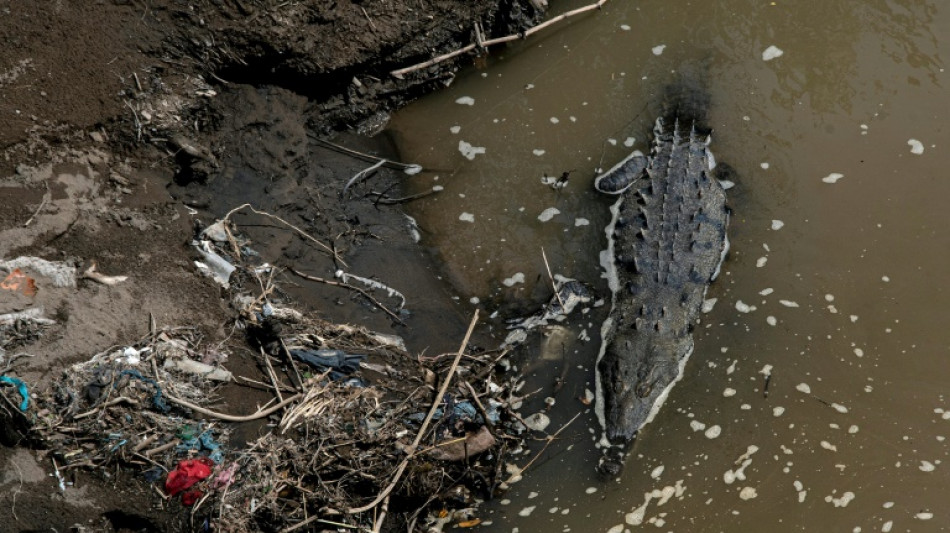
Costa Rica crocodiles survive in 'most polluted' river / Photo: Ezequiel BECERRA - AFP

Costa Rica crocodiles survive in 'most polluted' river

In one of the most polluted rivers in Central America, a vulnerable crocodile species is thriving despite living in waters that have become a sewer for Costa Rica's capital, experts say.

Text size:

Every day, trash and wastewater from San Jose households and factories flood into the Tarcoles River, which vomits tires and plastic into the surrounding mangroves.

Nevertheless, some 2,000 American Crocodiles have adapted to life in the toxic river that bears witness to the country's decades-long battle with waste management.

"It is a super-contaminated area, but this has not affected the crocodile population," said Ivan Sandoval, a biologist with the National University of Costa Rica.

"The Tarcoles River is the most polluted river in Costa Rica, and one of the most contaminated in Central America. Heavy metals, nitrites, nitrates, and a large amount of human waste can be found," added the crocodile expert.

According to the International Union for Conservation of Nature (IUCN), there are only about 5,000 of the crocodile species -- found in 18 countries -- left in the world after decades of hunting and habitat loss.

The organization lists the Crocodylus acutus as "vulnerable," but says its numbers have increased in recent years. The Costa Rica population is "healthy and robust."

Indeed, the large reptiles -- basking in the sun and occasionally feeding on fish that come up the channel from the sea -- appear unphased by some 150 types of bacteria that Sandoval says have been detected in the river.

He describes the carnivores as "living fossils" with the capacity to survive very tough conditions.

"They haven't had to change anything in millions of years, they are perfectly designed."

- Laws not applied -

Sandoval said that since 1980, Costa Rica's population of the crocodiles "are recovering," and warns of the threat of tourist activities.

The river's crocodiles are a major draw for foreign visitors, who take boat tours to see the creatures up close.

Some feed the animals, which is prohibited, and Sandoval worries about them getting too used to being close to people.

Juan Carlos Buitrago, 48, who captains one of the tour boats, says he and other locals regularly pull hundreds of tires and plastic waste from the water.

He delights in the fauna of the river, with macaws flying over ahead at sunset, but wishes his countrymen would stop polluting his "office."

"We cannot hide the pollution," he tells AFP.

Costa Rica has impressive environmental credentials, with a third of its territory marked for protection, 98 percent renewable energy, and 53 percent forest cover, according to the UN's environmental agency.

However, the law is not always strictly applied, as in the case of the Tarcoles River.

Lawyer and environmentalist Walter Brenes, 34, said that all of Costa Rica's rules and regulations "do not solve the problem."

He said the country needs "real public policy that is completely aimed at protecting wildlife."

(K.Müller--BBZ)