Berliner Boersenzeitung - Clock ticking down on vital UN nature talks

EUR -
AED 4.202809
AFN 72.097162
ALL 95.786655
AMD 431.439057
ANG 2.048573
AOA 1049.415759
ARS 1600.159384
AUD 1.631526
AWG 2.059922
AZN 1.946316
BAM 1.951454
BBD 2.304767
BDT 140.417249
BGN 1.956135
BHD 0.434931
BIF 3397.133571
BMD 1.144401
BND 1.464338
BOB 7.907388
BRL 6.100344
BSD 1.144351
BTN 105.626738
BWP 15.593269
BYN 3.385958
BYR 22430.261126
BZD 2.301374
CAD 1.568877
CDF 2582.913266
CHF 0.903665
CLF 0.026583
CLP 1049.655944
CNY 7.892473
CNH 7.896257
COP 4213.914357
CRC 538.400821
CUC 1.144401
CUP 30.326629
CVE 110.019953
CZK 24.464976
DJF 203.77613
DKK 7.471852
DOP 70.303413
DZD 152.804659
EGP 59.88872
ERN 17.166016
ETB 178.620459
FJD 2.550527
FKP 0.860334
GBP 0.863347
GEL 3.124469
GGP 0.860334
GHS 12.427321
GIP 0.860334
GMD 84.117996
GNF 10031.656512
GTQ 8.775454
GYD 239.40677
HKD 8.958085
HNL 30.290534
HRK 7.538742
HTG 150.045803
HUF 393.085178
IDR 19409.0995
ILS 3.598386
IMP 0.860334
INR 105.954202
IQD 1499.061144
IRR 1512583.514184
ISK 144.53934
JEP 0.860334
JMD 179.550088
JOD 0.811364
JPY 182.495918
KES 148.010337
KGS 100.077533
KHR 4588.779421
KMF 493.237021
KPW 1029.960907
KRW 1719.748978
KWD 0.351823
KYD 0.953576
KZT 560.21224
LAK 24520.385795
LBP 102472.163961
LKR 356.136777
LRD 209.403596
LSL 19.219393
LTL 3.379118
LVL 0.692237
LYD 7.301737
MAD 10.777695
MDL 19.962537
MGA 4751.417178
MKD 61.503014
MMK 2402.567533
MNT 4084.341362
MOP 9.224754
MRU 45.784025
MUR 53.226009
MVR 17.680917
MWK 1984.180639
MXN 20.448216
MYR 4.507221
MZN 73.138831
NAD 19.219393
NGN 1585.566919
NIO 42.106217
NOK 11.172719
NPR 169.002581
NZD 1.97261
OMR 0.440025
PAB 1.144251
PEN 3.946211
PGK 5.003855
PHP 68.194646
PKR 319.517539
PLN 4.27653
PYG 7382.556846
QAR 4.159735
RON 5.107007
RSD 117.109163
RUB 91.651288
RWF 1669.880678
SAR 4.294863
SBD 9.214394
SCR 17.472084
SDG 687.784516
SEK 10.806413
SGD 1.466619
SHP 0.858597
SLE 28.094957
SLL 23997.530791
SOS 652.845918
SRD 42.969965
STD 23686.791775
STN 24.445552
SVC 10.012699
SYP 126.484907
SZL 19.213206
THB 36.996194
TJS 10.968171
TMT 4.005404
TND 3.384162
TOP 2.755443
TRY 50.576857
TTD 7.760715
TWD 36.843533
TZS 2980.860735
UAH 50.462505
UGX 4302.417235
USD 1.144401
UYU 45.967616
UZS 13817.224924
VES 506.63165
VND 30090.881941
VUV 135.32917
WST 3.130183
XAF 654.499235
XAG 0.014083
XAU 0.000228
XCD 3.092801
XCG 2.062307
XDR 0.813987
XOF 654.499235
XPF 119.331742
YER 272.99679
ZAR 19.305382
ZMK 10300.948139
ZMW 22.273391
ZWL 368.49668
  • RBGPF

    0.1000

    82.5

    +0.12%

  • JRI

    -0.2300

    12.59

    -1.83%

  • RELX

    -0.0400

    34.14

    -0.12%

  • GSK

    -0.8900

    53.39

    -1.67%

  • NGG

    0.0900

    90.9

    +0.1%

  • BCE

    -0.1100

    25.57

    -0.43%

  • BCC

    0.3800

    70

    +0.54%

  • CMSC

    -0.1500

    22.99

    -0.65%

  • BTI

    0.0400

    59.93

    +0.07%

  • RYCEF

    -1.1300

    16.12

    -7.01%

  • AZN

    -2.6000

    189.9

    -1.37%

  • RIO

    -2.8700

    87.83

    -3.27%

  • CMSD

    -0.1100

    22.99

    -0.48%

  • VOD

    0.1000

    14.41

    +0.69%

  • BP

    0.5100

    42.67

    +1.2%

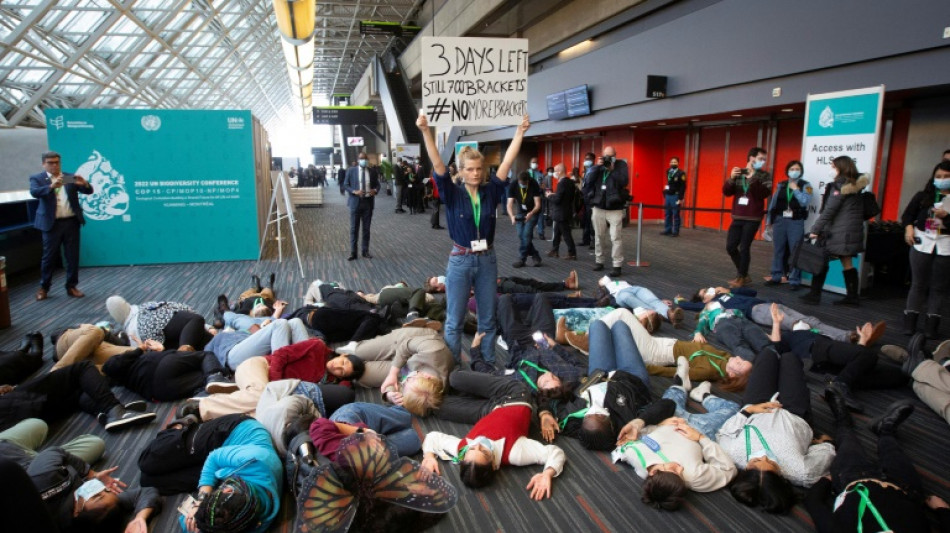
Clock ticking down on vital UN nature talks
Clock ticking down on vital UN nature talks / Photo: Lars Hagberg - AFP

Clock ticking down on vital UN nature talks

Crucial UN talks aimed at sealing a "peace pact for nature" were entering their final stages Saturday, officially the last day the world's environment ministers are gathered in Montreal for the COP15 meeting.

Text size:

Whether they deliver a deal for biodiversity that is as ambitious as the Paris accord for climate, endorse a watered-down text, or fail to agree on anything at all remains to be seen, though there are strong signs the negotiations set to last until December 19 will run beyond the allotted time.

With the clock ticking down, over 3,000 scientists wrote an open letter to policymakers, calling for immediate action to stop the destruction of critical ecosystems.

"We owe this to ourselves and to future generations -- we can't wait any longer," they said.

At stake is the future of the planet and whether humanity can roll back habitat destruction, pollution and the climate crisis, which are threatening an estimated million plant and animal species with extinction.

The text is meant to be a roadmap for nations to follow that carries them through until 2030, after the last 10-year plan signed in Japan failed to achieve any of its objectives, widely blamed on its lack of monitoring mechanisms.

Major draft goals include a cornerstone pledge to protect 30 percent of the world's land and oceans by 2030, which is compared to the Paris deal commitment to hold long-term planetary warming by 1.5 degrees Celsius or at least to 2C.

In all, there are more than 20 targets, including reducing environmentally destructive subsidies of agriculture, obliging businesses to assess and report on their biodiversity impacts, and tackling the scourge of invasive species.

The thorny issue of how much money the global north will send to the global south to help preserve their ecosystems has emerged as the biggest sticking point.

Several countries have announced new commitments either at the COP or recently, with Europe emerging as a key leader. The European Union has committed seven billion euros for the period until 2027, double its prior pledge.

But these commitments are still well short of what observers say is needed, and what developing countries are seeking.

Brazil has led that charge, proposing flows of $100 billion annually, compared to the roughly $10 billion at present.

But France has hit back, saying developed countries will only step up funding if developing countries agree to more ambitious plans, including on reducing pesticide use that agro industries in the global south use heavily.

"We cannot have on hand some tears for species but no real commitments at the end of this COP," French environment minister Christophe Bechu said Friday.

Whether international aid is delivered via a new fund, an existing mechanism called the Global Environment Facility, or a halfway solution involving a new "trust fund" within the GEF, is still up for debate.

(B.Hartmann--BBZ)