Berliner Boersenzeitung - California submits rival Colorado River water plan

EUR -
AED 4.204786
AFN 72.131522
ALL 95.999785
AMD 432.40092
ANG 2.049533
AOA 1049.907549
ARS 1600.516512
AUD 1.633909
AWG 2.060887
AZN 1.943184
BAM 1.955796
BBD 2.309895
BDT 140.729685
BGN 1.957052
BHD 0.433001
BIF 3404.692377
BMD 1.144937
BND 1.467597
BOB 7.924982
BRL 6.10469
BSD 1.146897
BTN 105.862225
BWP 15.628033
BYN 3.393492
BYR 22440.773758
BZD 2.306495
CAD 1.569761
CDF 2584.123556
CHF 0.90381
CLF 0.026697
CLP 1054.13247
CNY 7.896174
CNH 7.904373
COP 4228.895119
CRC 539.601148
CUC 1.144937
CUP 30.340842
CVE 110.265235
CZK 24.466209
DJF 204.229543
DKK 7.471896
DOP 70.46015
DZD 153.144657
EGP 60.431974
ERN 17.174062
ETB 179.018681
FJD 2.551715
FKP 0.860737
GBP 0.863673
GEL 3.12551
GGP 0.860737
GHS 12.454972
GIP 0.860737
GMD 84.152708
GNF 10054.767863
GTQ 8.795019
GYD 239.939463
HKD 8.963452
HNL 30.358065
HRK 7.534712
HTG 150.375066
HUF 392.446831
IDR 19449.052236
ILS 3.600072
IMP 0.860737
INR 105.821702
IQD 1502.403197
IRR 1513292.432889
ISK 144.20515
JEP 0.860737
JMD 179.950383
JOD 0.811718
JPY 182.703386
KES 148.337757
KGS 100.124438
KHR 4598.96962
KMF 493.468258
KPW 1030.44363
KRW 1715.448554
KWD 0.351988
KYD 0.955702
KZT 561.461195
LAK 24574.94498
LBP 102700.170069
LKR 356.927642
LRD 209.870447
LSL 19.262157
LTL 3.380703
LVL 0.692561
LYD 7.317984
MAD 10.801676
MDL 20.006955
MGA 4762.010134
MKD 61.639593
MMK 2403.69357
MNT 4086.255615
MOP 9.24532
MRU 45.885897
MUR 53.251062
MVR 17.689468
MWK 1988.604232
MXN 20.439555
MYR 4.503092
MZN 73.172957
NAD 19.262241
NGN 1589.046972
NIO 42.20009
NOK 11.164686
NPR 169.37936
NZD 1.970105
OMR 0.443929
PAB 1.146797
PEN 3.954991
PGK 5.014989
PHP 68.684226
PKR 320.228483
PLN 4.271887
PYG 7398.983435
QAR 4.169009
RON 5.095425
RSD 117.37025
RUB 92.411407
RWF 1673.603562
SAR 4.29649
SBD 9.218713
SCR 17.510961
SDG 688.107329
SEK 10.803727
SGD 1.467125
SHP 0.859
SLE 28.107741
SLL 24008.777972
SOS 654.301392
SRD 42.990121
STD 23697.893319
STN 24.499945
SVC 10.035021
SYP 126.544188
SZL 19.255957
THB 37.130895
TJS 10.992623
TMT 4.007281
TND 3.391707
TOP 2.756734
TRY 50.576236
TTD 7.778017
TWD 36.716884
TZS 2982.257478
UAH 50.575008
UGX 4311.990346
USD 1.144937
UYU 46.070098
UZS 13847.908522
VES 506.869099
VND 30103.267553
VUV 135.392596
WST 3.13165
XAF 655.958396
XAG 0.014405
XAU 0.000229
XCD 3.094251
XCG 2.066904
XDR 0.815802
XOF 655.955531
XPF 119.331742
YER 273.125117
ZAR 19.293513
ZMK 10305.812598
ZMW 22.32295
ZWL 368.669387
  • RBGPF

    0.1000

    82.5

    +0.12%

  • RELX

    -0.0400

    34.14

    -0.12%

  • NGG

    0.0900

    90.9

    +0.1%

  • BCC

    0.3800

    70

    +0.54%

  • RYCEF

    -1.1300

    16.12

    -7.01%

  • BCE

    -0.1100

    25.57

    -0.43%

  • GSK

    -0.8900

    53.39

    -1.67%

  • CMSC

    -0.1500

    22.99

    -0.65%

  • CMSD

    -0.1100

    22.99

    -0.48%

  • JRI

    -0.2300

    12.59

    -1.83%

  • RIO

    -2.8700

    87.83

    -3.27%

  • AZN

    -2.6000

    189.9

    -1.37%

  • VOD

    0.1000

    14.41

    +0.69%

  • BTI

    0.0400

    59.93

    +0.07%

  • BP

    0.5100

    42.67

    +1.2%

California submits rival Colorado River water plan
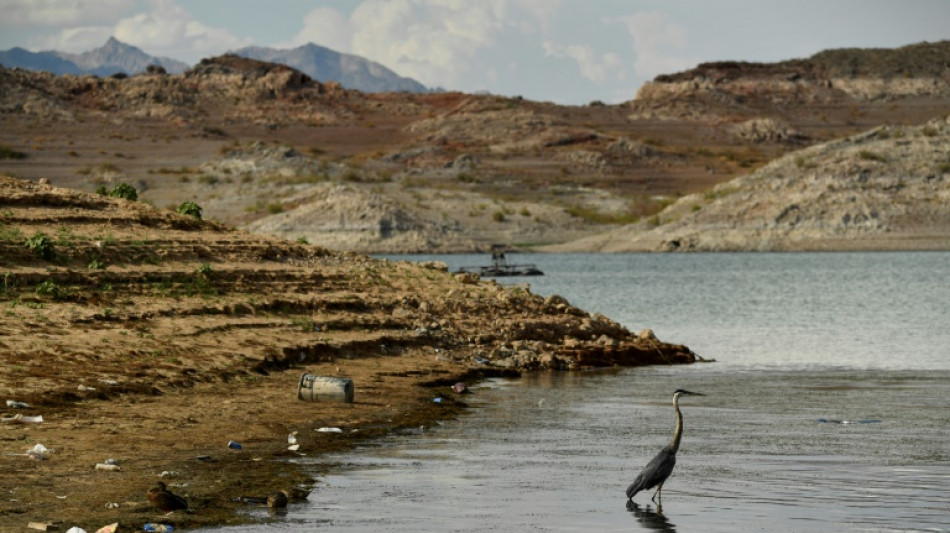
California submits rival Colorado River water plan / Photo: Patrick T. FALLON - AFP/File

California submits rival Colorado River water plan

California has submitted a rival plan for use of the Colorado River, after six other states accused it of refusing to cooperate in the battle over usage of a dwindling major US watercourse.

Text size:

Arizona, California, Colorado, Nevada, New Mexico, Utah and Wyoming were given until January 31 to come up with a plan to slash the amount of water they take from the river -- or face a solution imposed by Washington.

Everyone apart from California agreed on a proposal that would see a reduction in the amount of water that makes it as far as the most populous state in the country, where critics say farmers use too much to grow crops for export.

On Tuesday, California offered its own solution, and offered to trim its own use, but in the meantime to revert to the over-subscribed status quo.

"In the absence of a seven-state consensus proposal (we) should maintain existing protections to California’s senior entitlements," the Colorado River Board of California said in its submission to the Bureau of Reclamation, the federal government department with responsibility for water.

That came after a behind-closed-doors proposal last week from the state's representatives to model what would happen if big cities like Phoenix and Las Vegas were cut off from the water supply, CNN reported.

The suggestion was met with strong pushback from other negotiators, the broadcaster said, citing people familiar with the matter.

Eventually, the other six states huddled, and submitted a framework of water consumption ceilings, with the bulk of the cuts falling on California to "mitigate the risk of either Lake Powell or Lake Mead reaching dead pool."

Both reservoirs, fed by the Colorado River, have seen their levels plunge over the past two decades as a punishing drought grips the western United States.

Adel Hagekhalil, general manager of Metropolitan Water District of Southern California, said the state's proposal followed two decades of reductions from the region.

"We are committed to doing more now. But we must do it in a way that does not harm half of the people who rely on the river - the 19 million people of Southern California," he said.

"We must do it in a way that does not devastate our $1.6 trillion economy, an economic engine for the entire United States.

"The proposal presented today by California does all of this by equitably sharing the risk among Basin states without adversely affecting any one agency or state. The plan presented yesterday, which shut out California, does not."

The Colorado River rises in the Rocky Mountains and flows through Colorado, Utah, Arizona, Nevada, California and northern Mexico, where it empties into the Gulf of California.

It is fed primarily by snow accumulated at high altitude that gradually melts during the warmer months.

But declining precipitation and rising temperatures caused by humanity's unchecked burning of fossil fuels means less snow falls, and what does fall, melts faster.

That means less water reaches a river that is crucial to the great cities of the west like Las Vegas and Los Angeles, as well as to tens of thousands of acres (hectares) of farmland.

(F.Schuster--BBZ)