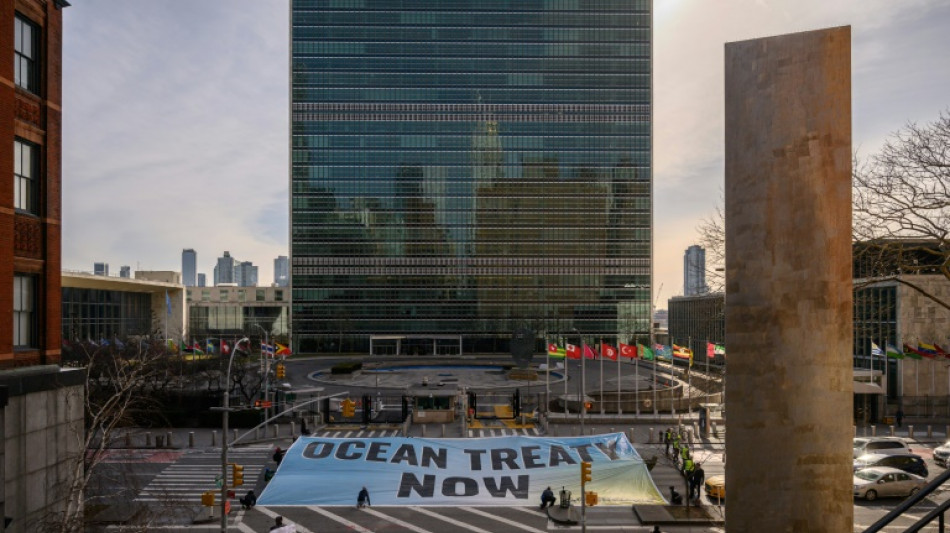
Worry, frustration as UN tries to finally agree high seas treaty / Photo: Ed JONES - AFP

UN member states have much work to do to finally agree a treaty to protect the high seas before scheduled negotiations close in five days, participants and observers say.
After 15 years of formal and informal talks, delegates have been meeting in New York since February 20 for the third "final" negotiating round in less than a year.
"There was progress last week but there are a lot of issues still to resolve," Nathalie Rey of the High Seas Alliance, which includes some 40 NGOs, told AFP.
"There's a need to pick up the pace in the second week to make sure that we do get the treaty over the line. I'm still remaining optimistic that's possible," she added.
Others, however, are less positive that an agreement can be reached before talks are due to end on Friday.
"Negotiations have been going around in circles, progressing at a snail's pace," Greenpeace's Laura Meller said in a statement.
Acknowledging that many key issues remain unresolved, conference chair Rena Lee urged negotiators to be "flexible and creative" Monday.
Jamaica's representative said flexibility should not come at the cost of ambition.
"Look forward, look to the best outcome, see how best you can be flexible, otherwise we will not achieve an agreement (and) these 20 years will be a failure and we will have no one to blame but ourselves," he pleaded.
The high seas begin at the border of countries' Exclusive Economic Zones, which extend up to 200 nautical miles (370 kilometers) from coastlines. They thus fall under the jurisdiction of no country.
While the high seas comprise more than 60 percent of the world's oceans and nearly half the planet's surface, they have long drawn far less attention than coastal waters and a few iconic species.
An updated draft text published this past weekend is still full of parenthetic clauses and multiple options on some major issues that will determine the robustness of the final agreement.
Still under dispute is how the marine protected areas, a core part of any future treaty's mandate, will be created.
"When we left (the previous round of negotiations) in August this was 95 percent good, but we're worried it's being watered-down," Minna Epps, of the International Union for Conservation of Nature, told AFP.
- China -
Several observers told AFP that China is pushing for the future governing body of any eventual treaty, known as the conference of the parties (COP), to determine the sanctuaries by consensus rather than a majority vote.
They say China is trying to give itself a de facto veto, like the one Beijing has used for years to prevent the creation of other marine protected areas by the Commission for the Conservation of Antarctic Marine Living Resources (CCAMLR).
"China must urgently reimagine its role at these negotiations," said Greenpeace's Meller.
She urged Beijing to show the same leadership as in December when, under its presidency of COP15 in Montreal, all the world's governments committed to protecting 30 percent of the planet's land and oceans by 2030.
That aim is almost impossible without including the high seas, of which only about one percent is protected today.
Another contentious issue is how to assess the environmental impact of activities like mining.
How to divide eventual profits from the collection -- by pharmaceutical, chemical or cosmetic manufacturers, for example -- of newly discovered marine substances also divides rich and poor countries.
A negotiator told AFP that agreement on that issue was "quite close." Consensus there could help unblock other sticking points, observers say.
Whatever the compromises, "We have to have a treaty that changes the status quo," said Andreas Hansen of The Nature Conservancy.
"Otherwise it will not be effective in helping to halt and reverse biodiversity loss in the ocean," he told AFP.
(F.Schuster--BBZ)