Berliner Boersenzeitung - UN head says high seas treaty must be 'ambitious'

EUR -
AED 4.254885
AFN 73.567814
ALL 94.598007
AMD 426.600616
ANG 2.074325
AOA 1063.000721
ARS 1664.575106
AUD 1.64142
AWG 2.085444
AZN 1.968596
BAM 1.952413
BBD 2.33465
BDT 142.294364
BGN 1.95902
BHD 0.436905
BIF 3465.31278
BMD 1.15858
BND 1.485024
BOB 8.039053
BRL 5.8981
BSD 1.159189
BTN 109.555933
BWP 15.532054
BYN 3.209232
BYR 22708.168
BZD 2.331355
CAD 1.623756
CDF 2687.90574
CHF 0.919142
CLF 0.026075
CLP 1026.223672
CNY 7.829047
CNH 7.832916
COP 3979.7223
CRC 527.98401
CUC 1.15858
CUP 30.70237
CVE 110.470693
CZK 24.100839
DJF 205.902683
DKK 7.456783
DOP 67.892723
DZD 153.950921
EGP 57.822639
ERN 17.3787
ETB 183.490132
FJD 2.587921
FKP 0.86213
GBP 0.864567
GEL 3.064443
GGP 0.86213
GHS 13.089289
GIP 0.86213
GMD 84.575974
GNF 10169.43481
GTQ 8.835747
GYD 242.479327
HKD 9.07799
HNL 30.930838
HRK 7.532973
HTG 151.387361
HUF 348.326662
IDR 20563.172988
ILS 3.381634
IMP 0.86213
INR 109.265098
IQD 1517.7398
IRR 1593047.499933
ISK 144.046287
JEP 0.86213
JMD 183.331941
JOD 0.821455
JPY 185.677505
KES 150.059488
KGS 101.317545
KHR 4648.794215
KMF 492.396282
KPW 1042.722405
KRW 1751.616548
KWD 0.356956
KYD 0.966024
KZT 565.294402
LAK 25523.517173
LBP 103750.839063
LKR 388.339628
LRD 211.03515
LSL 18.763038
LTL 3.420985
LVL 0.700814
LYD 7.38597
MAD 10.711092
MDL 20.227907
MGA 4866.035941
MKD 61.505117
MMK 2432.37726
MNT 4144.618153
MOP 9.352574
MRU 46.435939
MUR 54.604154
MVR 17.91193
MWK 2011.295178
MXN 19.943541
MYR 4.709401
MZN 74.035701
NAD 18.771217
NGN 1574.648845
NIO 42.415729
NOK 10.995446
NPR 175.288382
NZD 1.99468
OMR 0.445472
PAB 1.159189
PEN 3.953666
PGK 5.08356
PHP 69.946961
PKR 322.430713
PLN 4.226117
PYG 7073.727914
QAR 4.217813
RON 5.221762
RSD 117.098902
RUB 84.543374
RWF 1723.96704
SAR 4.34687
SBD 9.339805
SCR 16.353499
SDG 695.726506
SEK 10.894244
SGD 1.485334
SHP 0.864997
SLE 28.675193
SLL 24294.847556
SOS 662.137191
SRD 43.252139
STD 23980.266836
STN 24.793612
SVC 10.142492
SYP 128.060278
SZL 18.765381
THB 37.693822
TJS 10.745558
TMT 4.066616
TND 3.373496
TOP 2.789583
TRY 53.662906
TTD 7.874339
TWD 36.563049
TZS 3041.275941
UAH 51.914682
UGX 4288.559853
USD 1.15858
UYU 46.799213
UZS 13908.752735
VES 690.555849
VND 30500.77708
VUV 138.163938
WST 3.174178
XAF 654.820963
XAG 0.016607
XAU 0.000268
XCD 3.131121
XCG 2.089158
XDR 0.81529
XOF 654.597907
XPF 119.331742
YER 276.466182
ZAR 18.803829
ZMK 10428.609136
ZMW 20.488455
ZWL 373.062287
  • NGG

    -0.8900

    81.39

    -1.09%

  • CMSC

    0.0000

    22.365

    0%

  • RELX

    -0.0200

    32.78

    -0.06%

  • VOD

    -0.3200

    14.57

    -2.2%

  • RIO

    -1.7800

    103.96

    -1.71%

  • BCE

    -0.3350

    23.485

    -1.43%

  • CMSD

    0.0000

    22.26

    0%

  • RBGPF

    0.0000

    62.87

    0%

  • JRI

    -0.0950

    12.715

    -0.75%

  • GSK

    0.0800

    52.3

    +0.15%

  • AZN

    -0.0100

    178.7

    -0.01%

  • BP

    -0.3650

    40.785

    -0.89%

  • RYCEF

    0.3500

    18.98

    +1.84%

  • BCC

    1.4200

    72.98

    +1.95%

  • BTI

    -1.4150

    59.965

    -2.36%

UN head says high seas treaty must be 'ambitious'
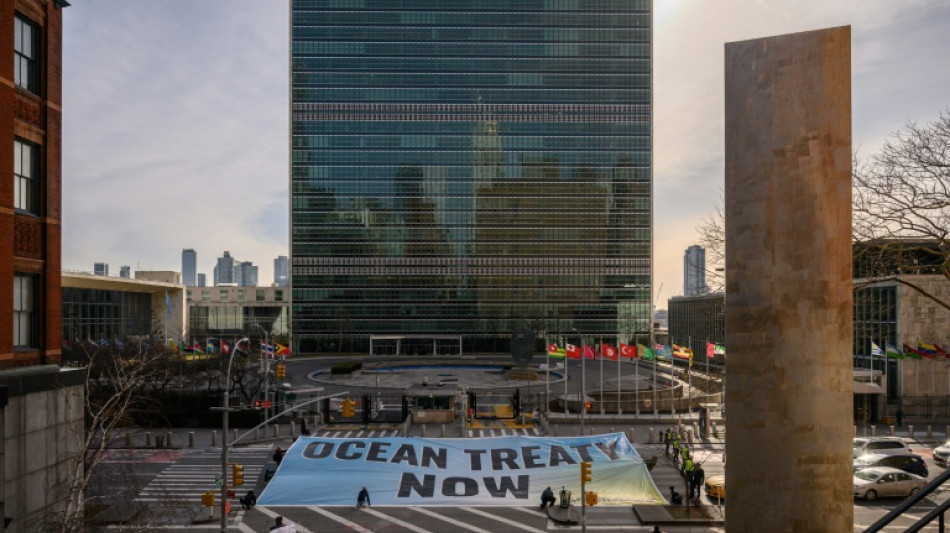
UN head says high seas treaty must be 'ambitious' / Photo: Ed JONES - AFP

UN head says high seas treaty must be 'ambitious'

United Nations chief Antonio Guterres urged countries Wednesday to agree a "robust and ambitious" treaty to protect the high seas, as time starts to run out for negotiators.

Text size:

After 15 years of formal and informal talks, delegates have been meeting in New York since February 20 to discuss a text that aims to protect nearly half the planet.

It is the third "final" negotiating round in less than a year and is due to end Friday.

"Our ocean has been under pressure for decades. We can no longer ignore the ocean emergency," Guterres said in a message read to negotiators.

"The impacts of climate change, biodiversity loss and pollution are being keenly felt around the globe, affecting our environment, our livelihoods and our lives," the secretary-general added.

"In adopting a robust and ambitious agreement at this meeting, you can take an important step forward in countering these destructive trends and advancing ocean health for generations to come."

The high seas begin at the border of countries' exclusive economic zones, which extend up to 200 nautical miles (370 kilometers) from coastlines. They thus fall under the jurisdiction of no country.

While the high seas comprise more than 60 percent of the world's oceans and nearly half the planet's surface, they have long drawn far less attention than coastal waters and a few iconic species.

An updated draft text released last weekend is still full of parenthetical clauses and multiple options on some major issues that will determine the robustness of the final agreement.

Observers who spoke with AFP however were optimistic Wednesday thanks to significant progress in talks over recent days.

"The first week felt like we were going around in circles, but we feel like the pace is very much picking up and the views are moving closer to one another," said Greenpeace's Laura Meller.

"A strong global ocean treaty is very, very reachable," she added.

Glen Wright, a researcher at the Institute for Sustainable Development and International Relations, said he wouldn't call the proposal "ambitious."

"But I think it's strong enough to be meaningful, to set up something that states can use in the future to build on," he added.

Still under dispute is how the marine protected areas, a core part of any future treaty's mandate, will be created.

Several observers told AFP that China is pushing for the future governing body of any eventual treaty, known as the conference of the parties (COP), to determine the sanctuaries by consensus rather than a majority vote.

They say China is trying to give itself a de facto veto, like the one Beijing has used for years to prevent the creation of other marine protected areas by the Commission for the Conservation of Antarctic Marine Living Resources (CCAMLR).

How to divide eventual profits from the collection -- by pharmaceutical, chemical or cosmetic manufacturers, for example -- of newly discovered marine substances is also causing division.

(Y.Yildiz--BBZ)