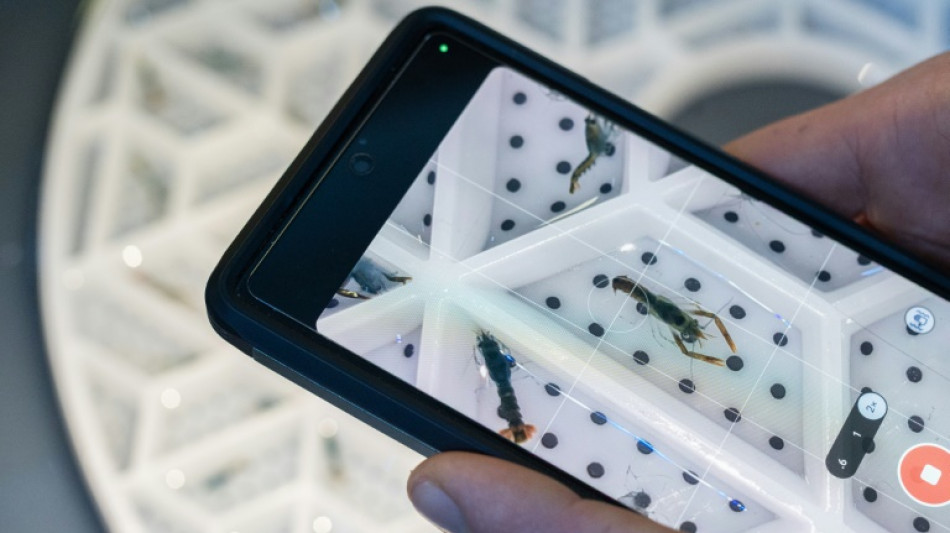
Pincered at sea, lobsters get new hope on land in UK / Photo: OLI SCARFF - AFP

The tiny lobsters are safe from predators -- including each other -- as they eddy in large white plastic tanks swirling with artificial currents.
In a few weeks' time, as part of a conservation project, they will leave their small shed in the northeastern English port of Whitby for the open sea.
Whitby, whose dramatic abbey ruins were an inspiration for "Dracula" author Bram Stoker, is Europe's third-largest lobster port.
Some 100,000 lobsters are landed each year, providing jobs for 150 people. Joe Redfern, who runs the Whitby Lobster Hatchery, hopes eventually to release the same number each year from his tanks.
"We want to make sure that the marine environment is protected and the lobster populations are conserved for the future," the 31-year-old biology graduate told AFP.
Lobster pots are piled high on the quays of the port, but the crustaceans were once part of a much bigger fishing industry in Whitby.
The town's mainstay catch of white fish has collapsed, a result of overfishing and climate change. Fishermen also blame European Union quotas, before Britain quit the bloc.
In the 1990s, there were about 30 big fishing boats in Whitby but by 2005, "there was only one", according to Redfern, who has been a fisherman himself.
White fish such as cod and haddock have migrated to colder waters north. Some of the Whitby boats moved with them, relocating to the Scottish ports of Peterhead and Aberdeen.
"The guys that didn't want to move, they had to migrate into shellfish," said Jonathan Parkin, a 43-year-old Whitby fisherman.
- Mass die-off -
A new disaster struck Whitby fishermen from late 2021.
Lobsters, crabs and other crustaceans began dying off in huge numbers. The cause remains a mystery.
Locals suspect a government project to dredge for a new post-Brexit "freeport" in the Teesside region, to the north of Whitby.
They say the dredging has stirred up chemical pollutants in the seabed -- a legacy of Teesside's past as a centre of heavy industry.
But a government-commissioned study by independent experts said in January that it was "as likely as not that a pathogen new to UK waters" was the cause.
Plans for the hatchery began before the mass die-off. But Redfern said it could help "bring a bit of hope back into the communities" and show that "something can be done to start to rebuild".
The project involves harvesting female lobsters, each carrying thousands of eggs, from the North Sea so that they can hatch safely.
- Cannibalism -
In the unforgiving open sea, the survival rate for lobster larvae is just one in 20,000, or 0.005 percent.
By allowing them to grow in a protected environment, Redfern hopes to increase that to 20 or 30 percent.
As they are fed and develop in their hatchery tanks, the larvae are separated when they reach the stage when, in the wild, they are likely to eat each other.
After two to three months, they are ready for the sea.
"Obviously when we release them, they won't all survive, but what we've done is protect them over the larval stage, which is their most vulnerable period," Redfern said.
The project raised more than £100,000 ($120,000) to get off the ground, from crowdfunding and corporate sponsorship.
Individual donors can sponsor a lobster and follow it until it is introduced into the sea.
The idea came from the Whitby fishing community, drawing inspiration from a similar project in Cornwall, southwest England.
"It's massively, massively important," said Parkin, who is involved in the project.
"We're releasing future generations of lobsters for future generations of fishermen."
(T.Burkhard--BBZ)