Brazil Indigenous group fights to save endangered evergreen / Photo: ANDERSON COELHO - AFP

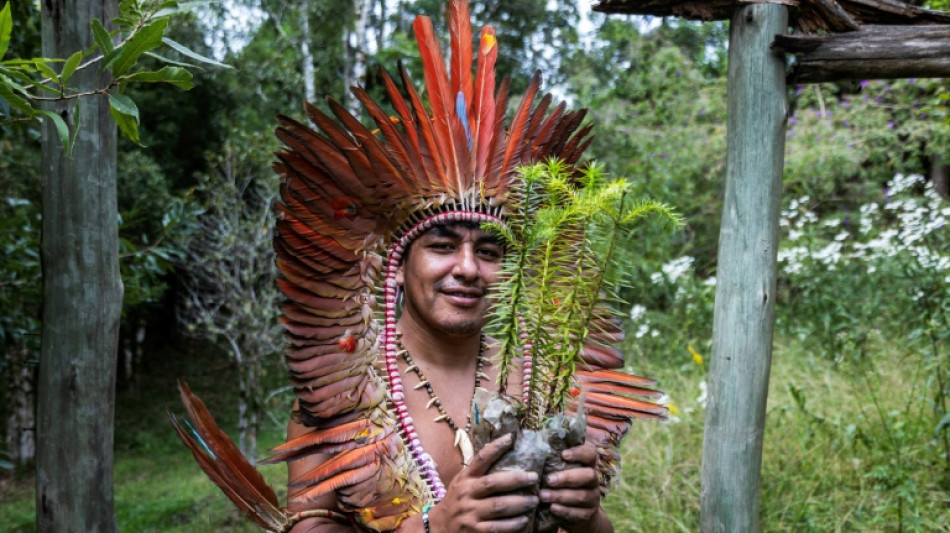
Dancing around a campfire in bright feather headdresses, a group of Indigenous eco-warriors prepares the painstaking process of planting the Brazilian pine tree, fighting to save the critically endangered species -- and their way of life.
The Xokleng Indigenous group, who live on a threatened reservation in south Brazil, depend on the Araucaria angustifolia tree for food, use its medicinal properties to treat illness and consider it a central element of their spirituality.
But the majestic evergreen, also known as the candelabra tree, is dangerously close to extinction: just three percent of the forests where it was once found survive today, according to the Brazilian Agricultural Research Corporation (Embrapa).
"Without the araucaria, the Xokleng do not exist," says Carl Gakran, a 32-year-old resident of the Ibirama-Laklano reservation.
He is helping lead the effort to save the Brazilian pine by planting tens of thousands of seedlings.
If the tree goes extinct, "our people and our culture are at risk of extinction, too," he says, wearing a traditional headdress of red and blue feathers.
Standing up to 40 meters (130 feet) tall, with sweeping branches that fan out from the top, the tree lives to be about 400 years old on average.
Its seeds, which resemble large pine nuts, are a staple food for the 2,200 Xokleng.
But it is also prized by loggers for its quality wood -- helping drive it toward extinction, along with the clear-cutting of forests for farmland.
Alarmed by its decline, Gakran and his wife, Gape, founded an organization to save it: the Zag Institute, after the Xokleng word for the tree.
"This is our mother, our sacred tree," says Gape, 36, wearing a headdress similar to her husband's and nursing her baby daughter.
"And we are its guardians."
- Protection ritual -
They estimate they have planted more than 50,000 seedlings so far.
It is a delicate, time-consuming and highly ritualized process.
The seeds take around a year to germinate. Once planted, a young tree takes 12 to 15 years to produce seeds of its own.
Before planting them, the Xokleng perform a ritual, singing and dancing around a campfire to call for the seedlings' protection.
Like many Indigenous peoples in Brazil, the Xokleng have suffered decades of persecution and the encroachment of farmers and loggers on their land.
Their reservation, which they share with the Guarani and Kaigang peoples, is at the center of a massive legal dispute in Brazil.
The territory partly lost its protected status when a court ruled the Indigenous groups did not have the right to claim territory where they were not present in 1988, the year Brazil's current constitution was ratified.
The Indigenous groups argue they were forced to leave by Brazil's military regime (1964-1985), and still have rightful claim to their ancestral lands.
The case became top news under far-right ex-president Jair Bolsonaro (2019-2022), who left office in December having followed through on his vow not to allow "one more centimeter" of Indigenous reservations in Brazil.
It has been appealed all the way to the Supreme Court, whose ruling could establish a precedent for all Indigenous lands in Brazil.
The Xokleng see planting araucarias as another form of resistance.
"I learned from my grandparents that Indigenous peoples are born to protect the land. We're the guardians of the Earth, the forests and the araucarias," says Carl.
"We need everyone's help to protect them."
(G.Gruner--BBZ)