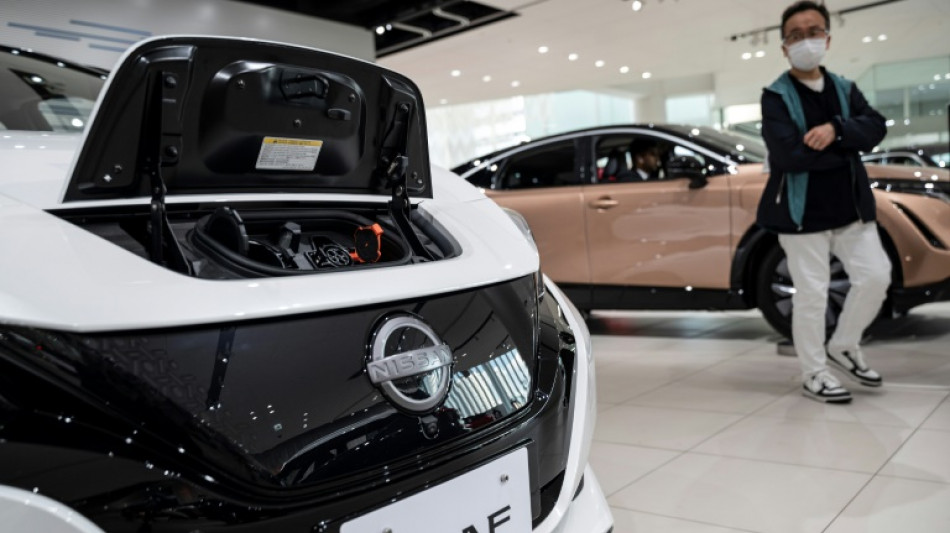
Japan, land of the hybrid car, takes slowly to EVs / Photo: Richard A. Brooks - AFP

Atsushi Ikeda loves his car so much that he founded a club for Tesla owners, but his embrace of an electric vehicle makes him something of an outlier in Japan.
As markets from China to the United States race to put more EVs on their roads, the pedal is nowhere near the metal yet in Japan, where the hybrid still reigns supreme.
Last year, 59,000 new EVs were sold in Japan, a record and a three-fold annual increase, but still less than two percent of sales of all cars in the country in 2022.
It's a situation that might seem counterintuitive, given Japan's auto industry -- which employs eight percent of the country's workforce, and accounts for a quarter of all its exports -- pioneered hybrid and electric cars.
But experts say the popularity of hybrids has actually hindered uptake of EVs, with Japanese automakers in no hurry to abandon existing line-ups.
The scepticism is no secret, and the former chief of Toyota, the world's top-selling carmaker, regularly questioned the growing focus on electric.
"I think Toyota didn't want the trend to tilt towards plug-in hybrids and electric vehicles because of their focus on hybrids and also their significant investment," said Kenichiro Wada, president of the Japan Electrification Research Institute, who helped develop early EVs at Mitsubishi Motors in the 2000s.
He compared the company to a top-ranking sumo wrestler, eager to "maintain the status quo for as long as possible".
When Ikeda went looking for a car that was "affordable, safe, with no pollutants", he quickly turned to Tesla.
"I like high-performance cars," he told AFP, describing the few Japanese options on the market when he bought in 2016 as small and unattractive.
There are now government incentives for people to go electric, but Ikeda says "charging infrastructure is too weak in Japan", blaming "heavy regulations".
- Zero-emission targets -
The situation in Japan is increasingly inconsistent with priorities elsewhere.
EVs made up 20 percent of new cars sold in China last year, around 15 percent in western Europe and 5.3 percent in the United States, according to a PwC study.
Ironically, EVs have a long history in Japan, with Mitsubishi Motors unveiling its i-MiEV in 2009, and Nissan its Leaf model a year later.
At the time though, the models were expensive because of their batteries and considered impractical given the lack of a nationwide charging network.
Hybrids looked like a better bet, and have proved enduringly popular, making up more than 40 percent of sales in Japan last year.
Government and industry efforts have also been sidetracked by a drive to develop hydrogen-powered vehicles -- a sector that has grown much slower than electric.
The European Union, Britain and several US states want all new cars sold to be zero-emission by 2035.
Japan's goal however includes hybrids and hydrogen-powered fuel cell vehicles by the same year.
Despite the obstacles, there are some signs of change, spurred in part by more demanding EV targets in overseas markets.
If they cannot "react quickly" to these new demands, "some Japanese carmakers could disappear", said auto analyst Koji Endo, of SBI Securities.
- 'Has to be EV first' -
Japanese firms have begun rolling out more ambitious EV targets, even as foreign automakers try to establish a foothold for their EVs in the country.
Last year, Nissan launched its "Sakura" model -- a fully electric car in the mini-sized "kei" category that is popular in Japan. It accounted for a third of the country's EV sales in 2022.
"Japanese drivers' daily travel range is shorter," compared with European or US consumers, Nobuhide Yanagi, Nissan's chief marketing manager for EVs in Japan, told AFP.
So small cars "could potentially win more share in the EV market, not only for Nissan".
Japan's government plans to increase the number of charging stations from 30,000 to 150,000 by 2030.
Its embrace remains qualified though, with an official from Japan's trade ministry warning electric vehicles "are expensive, and resources are limited".
"Hybrid technology is affordable and offers significant (emission) savings," Kuniharu Tanabe, a director at the ministry's auto industry division, told AFP.
He described Europe's EV strategy as "extreme", and noted a last-minute carve-out for synthetic fuel vehicles.
Japan's caution is not entirely unwarranted, particularly given potential shortages of raw materials like lithium, said Christopher Richter, an auto analyst at CLSA.
"If you are all EV, you could be putting your franchise at great risk. That said, it still has to be EV first," he told AFP.
"Climate change is real, the effects are going to get worse with time, so at some point there will be a demand to have zero emissions."
(H.Schneide--BBZ)