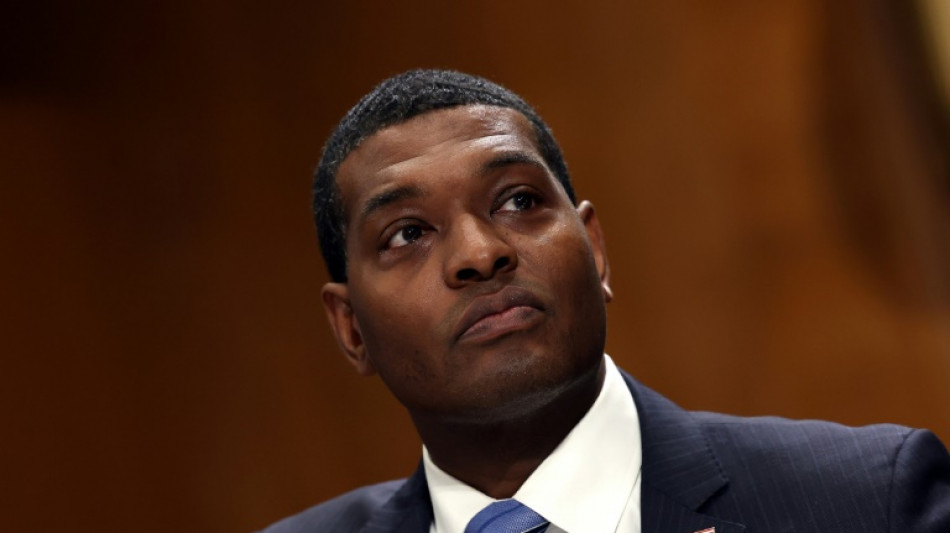
Biden admin unveils tough emissions rules to speed electric auto shift / Photo: Kevin Dietsch - GETTY IMAGES NORTH AMERICA/AFP/File

President Joe Biden's administration unveiled new proposed auto emissions rules Wednesday, aiming to accelerate the electric vehicle transition with a target of two-thirds of the new US car market by 2032.
The proposed rules set aggressively low standards for emissions of greenhouse gases and criteria pollutants, which is expected to lead to further manufacturing and marketing of EVs amid already considerable investments announced by US and foreign carmakers.
The head of the Environmental Protection Agency (EPA), Michael Regan, described the measure as the "strongest ever federal pollution standards for cars and trucks," saying his department's new policy would "accelerate the ongoing transition to a clean vehicles future."
The proposal -- which will next be open to a public comment period -- is the latest in a series of steps under Biden, a Democrat, to help put EVs on track for mass adoption.
The rules do not explicitly mandate greater EV manufacturing, but the tough emissions targets are expected to hasten a transition as automakers turn to EVs as the only viable way to remain in compliance.
Past US tailpipe rules have led carmakers to employ lighter-weight materials, or greater use of aerodynamically efficient designs to save energy -- but have been the subject of heated political debate.
The EPA under Biden's Republican predecessor, Donald Trump, moved to roll back auto emission regulations, resulting in several long lawsuits which created uncertainty for manufacturers.
Electric vehicles accounted for 5.8 percent of the US market for new vehicles in 2022, up from 3.2 percent in 2021, according to Cox Automotive.
However, efforts championed by Biden, including $7.5 billion to finance a national EV charging network and myriad tax incentive policies in his signature Inflation Reduction Act, have dovetailed with major EV investment announcements by General Motors, Ford and others.
Even so, targeting 67 percent penetration in less than a decade might seem unrealistic.
But White House environmental advisor Ali Zaidi said expert forecasts have underestimated the progress towards EV investment since Biden took office in January 2021. He noted that GM has targeted 2035 to go all-electric.
"The automakers have strategies and now have the technologies and an infrastructure and a supply chain to achieve this," Zaidi said at a briefing with journalists.
"If you look at the history that's been written over the last two and a half years, that's a really good predictor for the incredible foundation on which this draws and reinforces."
- Winds of politics -
The proposed regulations, which cover cars manufactured between 2027 and 2032, are based on "advances in clean car technology to further reduce both climate pollution and smog- and soot-forming emissions," according to a fact sheet.
The measure is expected to lead to greater use of filters to reduce gasoline particulate matter emissions in conventional internal combustion engine autos.
Manish Bapna, president of the National Resources Defense Council, an environmental group, praised the proposal.
"Done right, these will put the US on the path to end pollution from vehicle tailpipes –- while also slashing our dependence on oil, creating good domestic jobs, and saving consumers money on fuel," Bapna said.
Arthur Wheaton, a transportation industry expert at Cornell University, said the standards are a tool to lead the auto industry towards a more environmental path, but flagged challenges in realizing the aim of the policy.
For one, while Biden has unveiled meaningful policies to address climate change, history shows that "as you get a change in president or presidential party, then the targets can dramatically switch," Wheaton said.
"It is extremely difficult to do long-term planning for a trillion dollar industry if you don't know what's going to happen, say two years from now, in the next election," he added.
Moreover, the EV build-out requires amassing key raw materials like lithium and nickel, with manufacturers around the globe competing for supplies.
Other challenges noted by Wheaton include the continued need for more EV chargers and shifting the US electric supply -- which will fuel a growing number of cars -- away from power generated by coal.
(A.Lehmann--BBZ)