Berliner Boersenzeitung - India population to surpass China mid-year

EUR -
AED 4.215763
AFN 72.319432
ALL 96.250511
AMD 433.530234
ANG 2.054886
AOA 1052.649851
ARS 1605.041005
AUD 1.627805
AWG 2.06627
AZN 1.952677
BAM 1.960904
BBD 2.315928
BDT 141.097233
BGN 1.962163
BHD 0.433516
BIF 3413.584513
BMD 1.147928
BND 1.47143
BOB 7.94568
BRL 6.045904
BSD 1.149893
BTN 106.138709
BWP 15.668849
BYN 3.402355
BYR 22499.382989
BZD 2.312519
CAD 1.569918
CDF 2590.872602
CHF 0.903995
CLF 0.026617
CLP 1051.008272
CNY 7.916795
CNH 7.911483
COP 4240.54825
CRC 541.010441
CUC 1.147928
CUP 30.420084
CVE 110.553218
CZK 24.433584
DJF 204.762935
DKK 7.471654
DOP 70.644173
DZD 151.956974
EGP 60.095851
ERN 17.218916
ETB 179.486229
FJD 2.543695
FKP 0.866615
GBP 0.86424
GEL 3.133911
GGP 0.866615
GHS 12.487501
GIP 0.866615
GMD 84.391326
GNF 10081.028197
GTQ 8.817989
GYD 240.56612
HKD 8.98925
HNL 30.437352
HRK 7.534075
HTG 150.767805
HUF 389.675577
IDR 19505.587538
ILS 3.586138
IMP 0.866615
INR 105.924459
IQD 1506.327068
IRR 1517244.7443
ISK 143.617015
JEP 0.866615
JMD 180.420365
JOD 0.81386
JPY 182.616948
KES 148.654125
KGS 100.386359
KHR 4610.980884
KMF 494.756922
KPW 1033.134925
KRW 1710.52135
KWD 0.352115
KYD 0.958198
KZT 562.92758
LAK 24639.128089
LBP 102968.395132
LKR 357.859841
LRD 210.418571
LSL 19.312464
LTL 3.389532
LVL 0.694369
LYD 7.337096
MAD 10.829887
MDL 20.059208
MGA 4774.447217
MKD 61.66314
MMK 2410.237597
MNT 4099.576954
MOP 9.269466
MRU 46.005739
MUR 53.654501
MVR 17.735995
MWK 1993.797928
MXN 20.440127
MYR 4.511928
MZN 73.364265
NAD 19.312549
NGN 1584.174748
NIO 42.310305
NOK 11.139837
NPR 169.821734
NZD 1.964437
OMR 0.441378
PAB 1.149793
PEN 3.965321
PGK 5.028087
PHP 68.547329
PKR 321.064833
PLN 4.268403
PYG 7418.307578
QAR 4.179897
RON 5.094046
RSD 117.399254
RUB 93.496271
RWF 1677.974562
SAR 4.30773
SBD 9.24279
SCR 15.713391
SDG 689.904142
SEK 10.75777
SGD 1.468045
SHP 0.861243
SLE 28.18199
SLL 24071.482406
SOS 656.010251
SRD 43.10238
STD 23759.785806
STN 24.563932
SVC 10.06123
SYP 126.874693
SZL 19.306248
THB 37.205504
TJS 11.021333
TMT 4.017747
TND 3.400565
TOP 2.763934
TRY 50.72017
TTD 7.798331
TWD 36.719334
TZS 2990.351426
UAH 50.707096
UGX 4323.252098
USD 1.147928
UYU 46.190421
UZS 13884.075513
VES 508.192904
VND 30179.019325
VUV 137.252268
WST 3.139829
XAF 657.671582
XAG 0.014508
XAU 0.000229
XCD 3.102332
XCG 2.072303
XDR 0.817932
XOF 657.66871
XPF 119.331742
YER 273.838357
ZAR 19.27319
ZMK 10332.727681
ZMW 22.381252
ZWL 369.632252
  • RBGPF

    0.1000

    82.5

    +0.12%

  • RYCEF

    -0.2300

    16.32

    -1.41%

  • RELX

    0.1150

    34.255

    +0.34%

  • CMSC

    0.0300

    23.02

    +0.13%

  • RIO

    1.7500

    89.58

    +1.95%

  • BCE

    0.3636

    25.6115

    +1.42%

  • BCC

    1.6350

    71.635

    +2.28%

  • VOD

    0.1950

    14.605

    +1.34%

  • CMSD

    -0.0500

    22.94

    -0.22%

  • AZN

    1.6800

    191.58

    +0.88%

  • GSK

    0.6200

    54.01

    +1.15%

  • BTI

    1.3650

    61.295

    +2.23%

  • JRI

    0.1200

    12.71

    +0.94%

  • NGG

    0.3800

    91.28

    +0.42%

  • BP

    0.5700

    43.24

    +1.32%

India population to surpass China mid-year
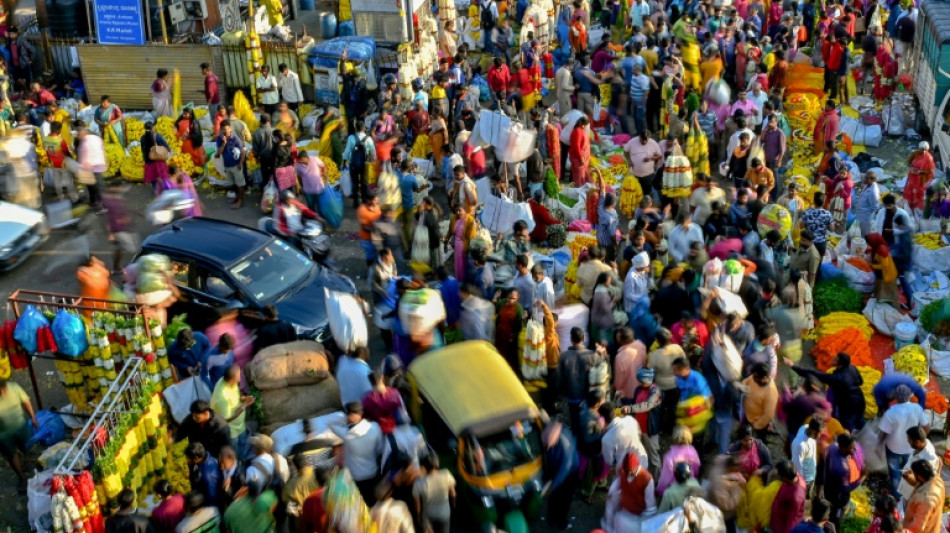
India population to surpass China mid-year / Photo: Manjunath KIRAN - AFP/File

India population to surpass China mid-year

India is set to overtake China as the world's most populous country by mid-year with almost three million more people, UN estimates showed on Wednesday.

Text size:

India's population will be 1.4286 billion compared to China's 1.4257 billion at mid-year, the United Nations Population Fund's State of World Population report showed.

The number of people in China shrank last year for the first time since 1960, when millions starved to death under the disastrous agricultural policies of former leader Mao Zedong.

Many have blamed the slowdown on the soaring cost of living as well as the growing number of women going into the workforce and seeking higher education.

Beijing ended its strict "one-child policy", imposed in the 1980s amid overpopulation fears, in 2016 and started letting couples have three children in 2021.

China faces a looming demographic decline as birth rates plunge and its workforce ages.

Several regions have also announced plans to boost birth rates –- but official efforts have so far failed to reverse the decline.

India has no recent official data on how many people it has because it has not conducted a census since 2011.

India's once in a decade census was due to be held in 2021 but was delayed due to the coronavirus pandemic.

It is now bogged down by logistical hurdles and political reluctance, making it unlikely the massive exercise will begin anytime soon.

Critics say the government is deliberately delaying the census to hide data on contentious issues such as unemployment ahead of national elections next year.

The Indian economy under Prime Minister Narendra Modi is struggling to provide jobs for the millions of young people entering the job market every year.

Half of the population of the Asian giant are under 30.

The country also faces huge challenges providing electricity, food and housing for its growing population, with many of its huge cities already struggling to cope.

According to the Pew Research Centre, India's population has grown by more than one billion people since 1950, the year the UN began gathering population data.

- 8 billion -

The new UN report also estimated that the global population will have hit 8.045 billion by mid-2023.

Other countries, mostly in Europe and Asia, can expect a demographic slump over the coming decades, according to other UN figures published last July which forecast how the world's population will develop between now and 2100.

A different picture is emerging in Africa, where the population is expected to rise from 1.4 to 3.9 billion inhabitants by 2100, with some 38 percent of Earth dwellers living there, against around 18 percent today.

Eight nations of more than 10 million inhabitants, most of them in Europe, saw their populations shrink over the past decade.

Japan is also seeing a decline due to its ageing population, losing more than three million inhabitants between 2011 and 2021.

The population of the entire planet, meanwhile, is only expected to decline in the 2090s, after peaking at 10.4 billion, according to the UN.

(Y.Berger--BBZ)